





What a soggy patch in a dry El Paso yard usually means
A patch of lawn stays dark and soft long after the last dry, hot afternoon. Water pools in one corner of the yard with no storm behind it, or the ground along the foundation never dries. Sometimes the only sign is a water bill that jumped while nothing looked wet. Soggy spots in lawn, water pooling in yard and wet ground near the house sound like three problems, and they often share one source. Everything comes down to one split. Pressurized supply water escapes all night whether anyone is home or not, and a drain line only leaks while something upstream is running.
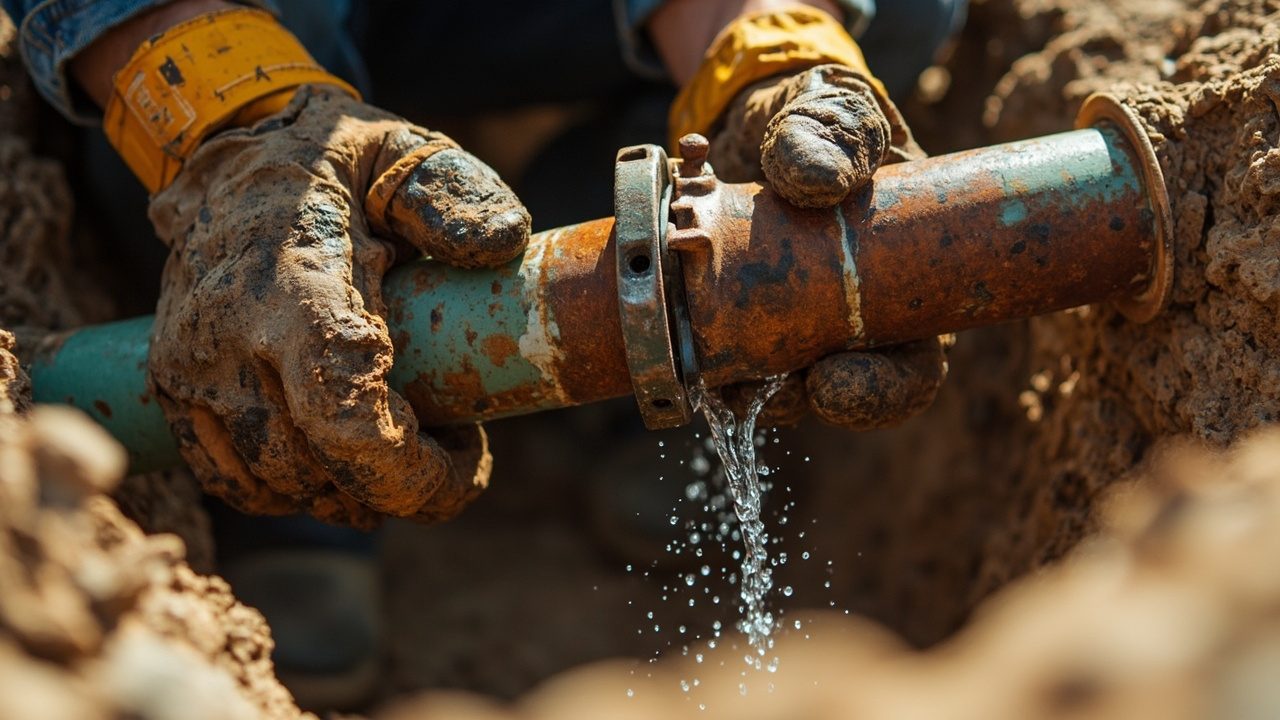
Where the patch sits and when it shows tell you which segment is leaking. Soil that is soft at three in the morning with the house asleep points to the supply line, the buried pipe between the meter and the house, because only pressurized water keeps coming all night. A patch that shows while the washer drains or after a long shower points to a sewer leak in the yard, over a cracked joint or a lateral with roots in it, and it often carries a smell. Wet ground beside a hose bib or an irrigation assembly right after a hard freeze points to a split outdoor pipe. Nothing shows until the ice clears and the pipe is under pressure again.
El Paso ground changes how that water behaves. Rain here is infrequent, so a wet spot that follows no storm has few innocent explanations. Short, heavy monsoon thunderstorms do run off fast and collect in low streets, dips and the flatter river valley, and a patch that follows one of those and dries out on its own is runoff. Beneath the sandy, gravelly soil sits caliche hardpan, and dense layers like it slow water on its way down, so water from a break can travel sideways before it surfaces. The soggy spot marks where the water comes up. A trench opened over the dampest ground can miss the break entirely. In the river valley, finer alluvial soil holds more water, and a small leak there keeps the lawn soft far longer than it would on a gravel slope.
Call today when the meter dial turns with every fixture closed and the ground beside the house stays wet. A hairline supply leak keeps that soil saturated, then the moisture works into the wall and the framing stays damp because nothing dries inside a wall, then the pipe repair turns into a wall rebuild. A patch that grows overnight is fed by pressure, and that growth is the detail to tell whoever answers. Until someone arrives, closing the main shutoff where the line enters the house or at the meter shrinks the problem to one segment.
More detail on discolored or rusty water is on its own page.
How the meter dial decides whether anyone digs
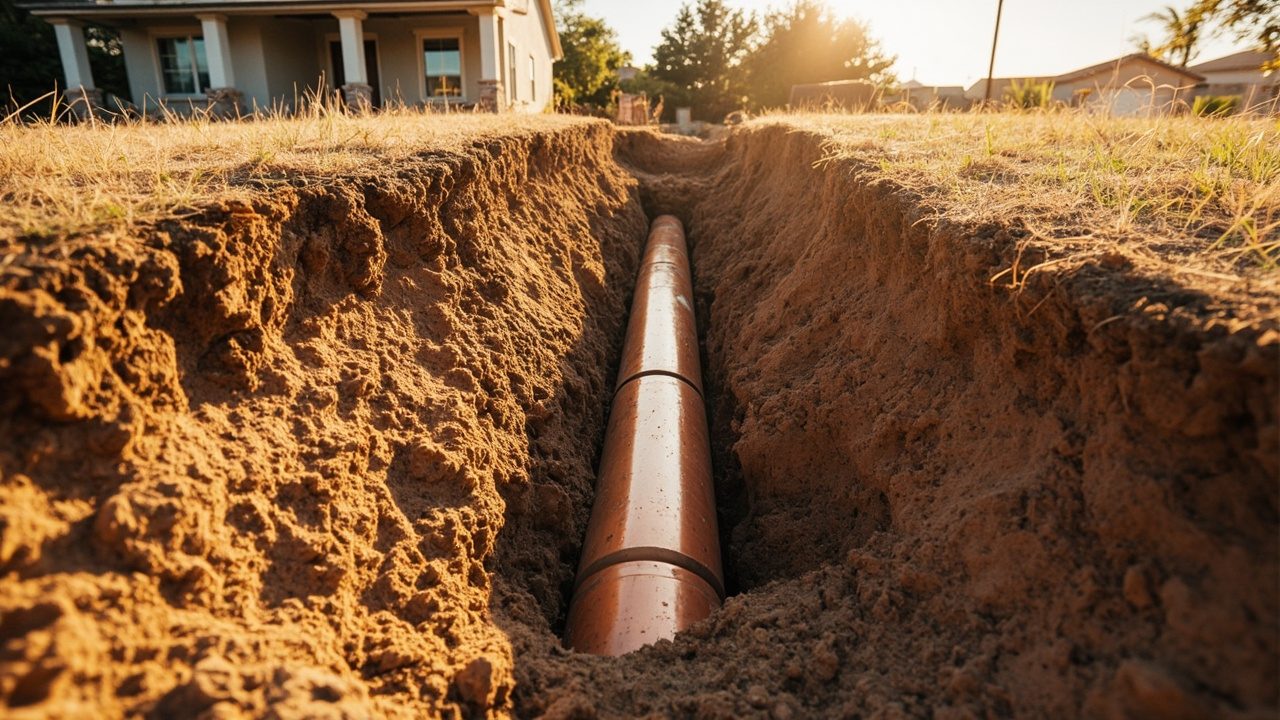
The visit starts at the meter, before anyone touches a shovel. With every fixture in the house closed, the leak indicator gets watched for fifteen minutes, then the main is closed and the dial is read again. A dial that keeps moving with the main closed puts the loss on the street side of that valve, which is where a service line under a yard sits. A dial that stops puts the loss on the house side, on a branch such as the line feeding a hose bib. Stops and branches get closed one at a time until the loss stops, and a surface opens only after that. When the dial holds still and the patch appears only while the washer runs, the water is on the drain side. That line gets cleared first and put on camera from a cleanout second, because a full line shows nothing but water.
One reading decides whether anything gets dug, and it is the dial moving with every fixture closed. Any movement at all means water is leaving the system somewhere you cannot see, and movement that survives the closed main moves the scope out to the service line. A locator then puts a spot and a depth on the leak, and the depth sets the trench. Because the dial sets the scope, a steady dial ends the digging conversation and sends the work to the drain side, while a turning dial gives a trench length from a measurement. You see the same dial we saw before you approve anything. Where a second pinhole turns up in one segment, the segment gets replaced, and the condition of the rest of that run decides it.
If the service line has to be replaced, the choice is type L copper against PEX. Copper is rigid, tolerates heat directly and costs more in material and labor, with a soldered joint at every coupling. PEX is flexible, so a long run lays into the trench with no fittings along its length, and every joint left out of the ground is one that cannot weep later. PEX A takes expansion fittings and PEX B takes crimp rings, and either has to stay out of sunlight, which matters here because intense sun and heat degrade exposed plastic lines. Where the pipe rises at the house wall, the exposed stub needs protection from sun and from the short hard freezes that split unprotected outdoor piping. On the sewer side, roots at one clay joint are a repair at that joint, a belly holding water is a re-lay, and cured in place lining needs a host pipe that is still round while open cut restores full diameter and lets slope be corrected. Through caliche, depth, length and what sits on top of the line decide between them.
Our page on dripping faucets & leaks covers that side of the work in more depth.
Ask which of these readings was taken before any part is replaced.
| Instrument | Good reading | Bad reading | What it changes |
|---|---|---|---|
| Water meter leak indicator with every fixture closed | The dial or the small leak wheel does not move over fifteen minutes | Any movement at all with the whole house off | Water is leaving the system somewhere you cannot see |
| Thermometer at the farthest hot tap | Hot water arriving around 120 degrees | Hot enough at the tap to scald a child in seconds | The first slug of water is whatever was sitting in the pipe |
| Drain camera with a locator | Continuous fall to the main, clean joints | Standing water part way along a level run means a belly | Roots at a joint mean the repair belongs at that joint rather than the whole line |
| Overnight pressure hold with the gauge left | The morning reading is close to the reading taken the night before | A reading far above the night figure | The heater is expanding water into a closed system with nowhere to put it |
| Anode rod pull on a tank water heater | The rod still has sacrificial metal along the core wire | A bare core wire with the metal gone | The tank itself is now the part being eaten |
How a yard leak visit runs
Meter read first
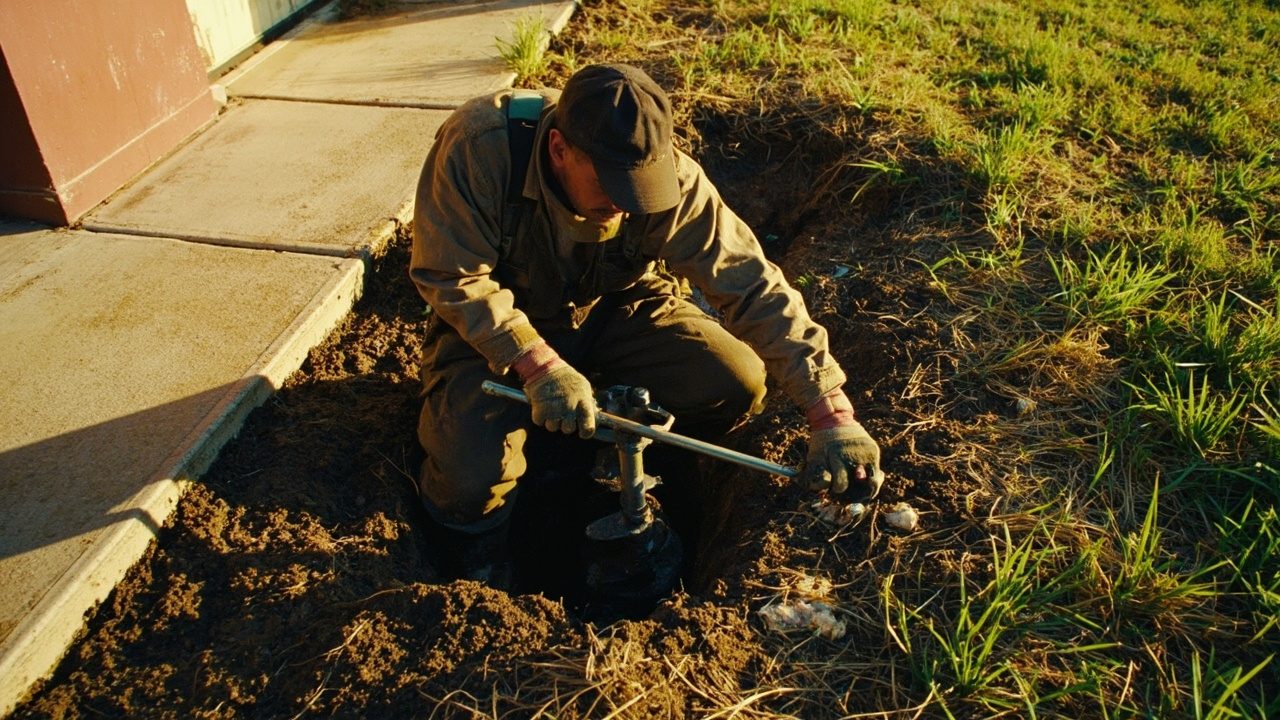
On the phone we ask when the patch appeared and where your meter and main shutoff sit, so the first minutes on site go to the dial. You will see us at the meter before anyone opens a tool bag. Every fixture goes off and we monitor the dial for fifteen minutes with the main closed, then read it again. Branches and stops are isolated sequentially until the loss stops. That places the leak on the service line, on a house branch or on the drain side, and only then does a locator go on the ground. On a drain, the line is cleared first and the camera goes in from a cleanout second.
Your approval, then the dig
You get the written scope with the dial reading behind it, and nothing starts until you approve it. Then the water is isolated at the main or the branch, turf is lifted and set aside, and the trench opens. Through caliche the last stretch above the pipe is dug carefully so the line is not nicked. The failed segment is cut out and replaced in type L copper with soldered joints, or in PEX with expansion fittings or crimp rings, and a dielectric union goes where new copper meets old galvanized. If the opening turns up more corroded pipe behind the leak, we stop and show you before going further.
Dial and pressure proven
Before the trench is backfilled, the meter goes back under watch. Every fixture is closed, and the dial has to sit still for fifteen minutes. A screw on pressure gauge at a hose bib then reads static pressure with nothing running, and it should sit in the 45 to 70 psi range, because above 80 psi fixtures, supply hoses and water heaters start failing early. Only after both readings pass does the backfill go in. We walk you along the trench line and show you the dial, and you keep the written scope with the readings noted on it.
Why El Paso ground changes how a yard leak gets found
Main line work and gas work usually need a permit, and a like for like fixture swap usually does not, with the final call belonging to the permitting authority. Replacing a buried service line or a sewer lateral is main line work, so the permit conversation belongs before the trench opens. The adopted plumbing code carries local amendments, and the answer for your address comes from the authority.
A crew that has not worked this ground makes predictable mistakes. It digs at the wettest spot, and because caliche and dense layers carry water sideways, the trench misses the break and the yard ends up with a hole and a leak. It prices the dig as if the soil were soft, then meets hardpan at the bottom and the job changes halfway through. It reads a wet patch after a monsoon storm as a broken pipe, or a broken pipe as runoff, because nobody watched the dial. It assumes the supply is one material, when older houses often carry galvanized, copper and plastic in the same run after partial repipes. It joins old cast iron to new plastic with glue where a no hub transition band belongs, which makes that joint the next leak.
The freeze pattern catches outsiders too. Winter brings the first freeze on average in mid November and the last in early March, and most cold nights sit just below freezing and end in mild days, so the ground does not freeze deeply. The damage comes from occasional arctic cold fronts that drop temperatures well into the teens and split exposed hose bibs, backflow assemblies and outdoor lines. That split shows up as wet ground after the thaw, once the line is under pressure again, and a crew expecting deep frost looks in the wrong place.
Calls come from across El Paso County and the greater metro. When the day is arranged, a dial turning with every fixture closed goes ahead of a patch that stays dry. Where responsibility for a line changes hands is decided by the water utility and the permitting authority, and the meter watched with the main closed narrows it before anyone argues about it.
See cold water sandwich effect for how the related work is scoped and priced.
Your local utility, El Paso Water, publishes service and water-quality information every El Paso homeowner should know.
Working with Bedrock Plumbing El Paso on a yard leak
When we arrive
You call and we ask three things. How long has the patch been there, is it wet with nothing running, and what is the meter dial doing. Those answers decide whether this is a same day visit or a scheduled one. The arrival window is given to you before the call ends, and a turning dial with wet ground beside the house moves to the front of the day. If the job ahead of yours runs long, the window shifts and you hear about it before it passes.
Protecting your lawn and walkways
Before a shovel goes in, plywood or plastic sheeting goes down for the spoil, and sod is cut in squares and set aside so it goes back where it came from. Caliche breaks out in hard chunks, and those chunks are hauled off, so none goes back over the line. Backfill returns in layers and gets tamped as it rises. The last thing we do is walk the trench line with you and leave the lawn free of tools and loose rock.
What moves the cost
Depth and length of the trench move the cost up as either grows, and caliche adds digging time. Paving or a walkway on top adds cutting and putting it back. A repair at one joint costs less than replacing the segment, and whether the neighboring sections hold or fail determines which makes sense. Old pipe matched to new and after hours dispatch also raise it, and clearing access and fixing pressure while the trench is open are yours to decide. The written scope says in advance what happens if the opening finds more, and you approve it before digging starts.
How technicians earn sign off
A new technician rides with a lead and does not work alone until the lead has watched them run the meter test start to finish, close the main and read the dial again. The lead signs off on that sequence and on how a no hub band joins cast iron to plastic. On a line with several pipe materials, or a trench deeper than expected, a second technician looks at it before a scope is written. Updated Texas codes get studied as they change.
You Have Questions,
We Have Answers
Waterlogged soil dries fastest once the source of the water is stopped and the surface is opened to air. Aerating with a garden fork every few inches lets water drain and oxygen reach the roots. Skip watering until the top two inches feel dry to the touch. If the patch stays soft after several dry days, the supply is still feeding it, and no amount of aeration will outpace a pressurized leak.
A leaking supply line, a drain leak, or a stuck irrigation valve usually causes an unexplained wet spot. Irrigation causes are the easiest to rule out, so shut the controller off for a day and watch the patch. A supply leak keeps saturating overnight, while an irrigation valve that weeps stops once its zone is isolated. A patch that smells sour and darkens the grass green points toward a drain.
Drying a wet spot starts with finding out whether water is still entering it. Shut off irrigation, fix any downspout that empties beside the spot, and rake the surface open so evaporation can work. Adding sand or gypsum to a patch fed by a leak only hides it for a week or two. When the patch returns within days of drying, treat it as a plumbing symptom, because surface fixes cannot outlast a steady source.
A sudden wet spot most often means a pipe failed recently or a sprinkler part broke loose. Sudden onset with no change in watering habits favors a pressurized supply line, because a pinhole can open in corroded pipe within days. Look for a sunken or soft area, a hissing sound near the ground, or a fresh green streak in the grass. Watch whether the patch is larger in the morning than the evening.
Wet grass with no rain is usually dew, irrigation overspray, or a leak below the surface. Dew disappears within a couple of hours after sunrise and covers the whole lawn evenly. Grass that stays wet in one patch by midday, feels spongy underfoot, or grows noticeably greener and taller than the lawn around it is being fed from below. Stepping on it and seeing water fill the footprint suggests saturation from a pipe.
Coarse sand, gravel and compost soak up surface water better than topsoil alone, but only to a limit. Mixed into the top few inches, compost improves how soil takes in water and lets it move downward. Absorbent products cannot handle a continuous flow. If the standing water reappears within a day or two of adding material, a pressurized line or drain is refilling it faster than the soil can absorb.
Start by identifying the source, then choose the repair or grading fix that matches it. Sort the causes into three groups: surface water from rain or irrigation, a supply line under pressure, and a drain or sewer line. Each group leaves different clues, such as timing, smell and whether the patch grows overnight. Correcting drainage before locating a pipe leak wastes effort and leaves the pipe still discharging into the soil.
Yard leaks come from corroded metal pipe, cracked joints, root intrusion, ground movement, and fittings that loosen over time. Galvanized steel rusts from the inside and pinholes through the wall. Clay sewer joints admit roots that pry them apart. Copper can develop pinholes where water chemistry or soil is aggressive. Poorly compacted backfill also lets a pipe settle and stress a coupling. Irrigation lines fail at glued fittings and at valves that wear out.
A low spot collects water because surrounding grade slopes toward it and compacted soil lets little drain away. Hard-packed clay or dense subsoil layers stop infiltration, so water sits until it evaporates. A downspout or driveway edge feeding the spot makes it worse. Filling the dip with topsoil and regrading a slight slope away from the house usually helps, provided no pipe is leaking into it.
A random puddle typically comes from a leaking pipe, a cracked irrigation line, or runoff pooling in a depression. Check whether it refills after you scoop or pump it out and whether it appears at the same spot each time. A puddle that returns within hours with irrigation off suggests pressurized water below. Clear water points to supply, while grayish or odorous water points toward the sewer.
Why caliche hardpan changes wet spot repair in El Paso yards
Caliche sets the pace of any dig here. It is a hardpan that sits in layers under the sandy, gravelly soil of the mesas and foothills, and it slows a trench enough that depth and length become the largest part of reaching a buried line. The river valley behaves differently, because finer alluvial soil holds more water and keeps a leak visible longer. The pipe underneath follows the era of the house. The oldest homes carry galvanized supply that closes up from the inside and clay laterals jointed in short sections. Postwar slab homes from the 1940s through the 1960s often have galvanized or early copper supply with cast iron drains under the slab. The 1970s through the 1990s brought copper run under or through the slab with PVC laterals, and newer subdivisions use PEX on a manifold. A wet patch over a slab era copper line and one over old galvanized call for different pipe in the trench.
Work like this is inspected at stages, and a buried supply line or sewer lateral replacement usually carries a permit, so the trench stays open until the dial test passes and the joints, the pipe material and any transition bands can be seen. Which office inspects depends on the address, because city limits, the county and the neighboring town each cover their own ground. Where responsibility for the line changes hands belongs to El Paso Water and the permitting authority, and the meter test with the main closed is what narrows the question first. Sequencing follows the sky as well. Short, heavy monsoon thunderstorms can flash flood low ground, and an open trench fills fast, so the work is planned to dig, repair, test and backfill in one visit where the ground allows. Knowing that order up front shortens the job, because the line can be seen open and already tested, and nobody digs the same ground twice.
Plumbing Services in The El Paso Area
Explore our service area and locate Bedrock Plumbing El Paso with ease. We're proudly local and serve the surrounding neighborhoods with fast response and honest pricing. Use the map to check our coverage area, or call us and we'll confirm in seconds.
Address:
Bedrock Plumbing El Paso, 221 North Kansas St, Suite 700, El Paso, TX, 79901
Additional Services We Offer
Reading the meter dial, closing the main shutoff and draining a hose bib before a freeze are homeowner jobs. DIY stops at anything soldered, anything on the gas line, anything behind a finished wall or under a slab, and any drain already backed up past a cleanout. Wet ground that is only monsoon runoff in a low spot needs grading, which is yard work outside plumbing, and we tell you that on the first visit rather than after the invoice.
Before you call, know when the patch first showed and whether it stays wet with nothing running. Read the meter dial with every fixture closed if you can, and find the main shutoff. Note what changed just before, such as a freeze, a monsoon storm or new digging, and the age of the house if you know it. Say whether anyone is home.
Last reviewed September 2026 by Dave Parker, Owner.