





What rusty hot water from a garage heater means in El Paso
The hot tap runs orange or brown for the first minute, then clears, while the cold tap beside it runs clean. That split is the clue. Rust on the hot side only comes from the tank, because the cold line never passes through it. Rust on both taps points to galvanized pipe, and the local water utility notes that rusting galvanized pipe inside homes is the typical cause of discolored water. In a slab home from the 1970s through the 1990s, the copper supply runs under or through the slab and the heater stands in a garage or a closet, so a hot-only stain usually traces to the tank rather than the pipe.
A steel tank stays sound because a rod of sacrificial metal hangs inside it and corrodes first. Hard water works that rod down early. Local water is moderately hard to hard, commonly around ten grains per gallon or more, and above about seven grains per gallon scale forms steadily on the elements, the tank floor and the valves. A heater in a garage or closet also sits through summer afternoons above one hundred degrees, and heat stresses a tank further. The rod is the first part consumed, and nothing on the outside of the tank shows it happening. You notice the color of the water, and by then the rod may be down to a bare core wire.
The sequence runs one way. When the rod is gone, the steel tank itself becomes the sacrificial metal, rusty hot water arrives first, and a split tank arrives after. A split tank on an open cold inlet keeps refilling and spilling until someone closes it, and in a closet the water reaches drywall and framing at the base, where nothing dries quickly. If the rust runs past the first minute of an open tap, call today, because a new rod protects a shell that still has metal and a shell that has started to corrode is a replacement.
Repair or replacement comes down to the rod. A rod pulled with sacrificial metal still along the core wire is hot water tank repair, and a new rod restarts the protection. A bare wire moves the talk to hot water heater replacement. A cold heater is a separate call. To fix a hot water heater that has stopped heating, the failed part is usually a gas control, a thermocouple, an element or a dip tube, and those are repairs. The tank is the messenger only when scale has been building for years. A heater that runs out halfway through the second shower fits that case, and the hardness test at the tap says how far it has gone.
Our page on commercial water heater systems covers that side of the work in more depth.
We install and service equipment from major manufacturers like Rheem to manufacturer specifications.
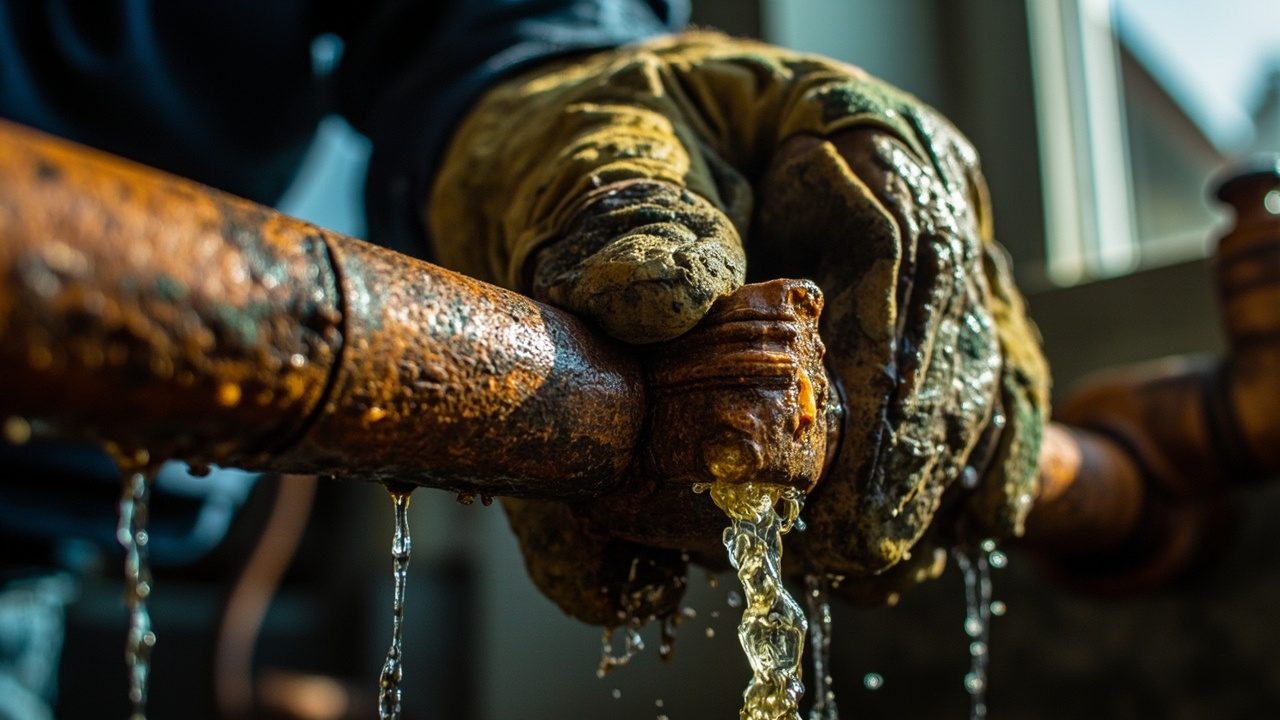
Find the sign you have, then read across to see whether it can wait.
| Symptom or first sign | What is already happening | What it becomes if ignored | When to call |
|---|---|---|---|
| An anode rod eaten away | The steel tank becomes the sacrificial metal | Rusty hot water arrives first and a split tank arrives after | This week, while it is still one part |
| Incoming pressure above the normal band | The relief valve on the heater starts weeping | The tank seams work harder every cycle and the heater fails years before it should | This week, while it is still one part |
| A weeping angle stop under a sink | The compression nut corrodes so it cannot be snugged | The stop snaps off in someone's hand during a faucet change | Now, the same day |
| A hairline supply leak behind tile | The framing stays damp | The pipe repair turns into a wall rebuild | This week, while it is still one part |
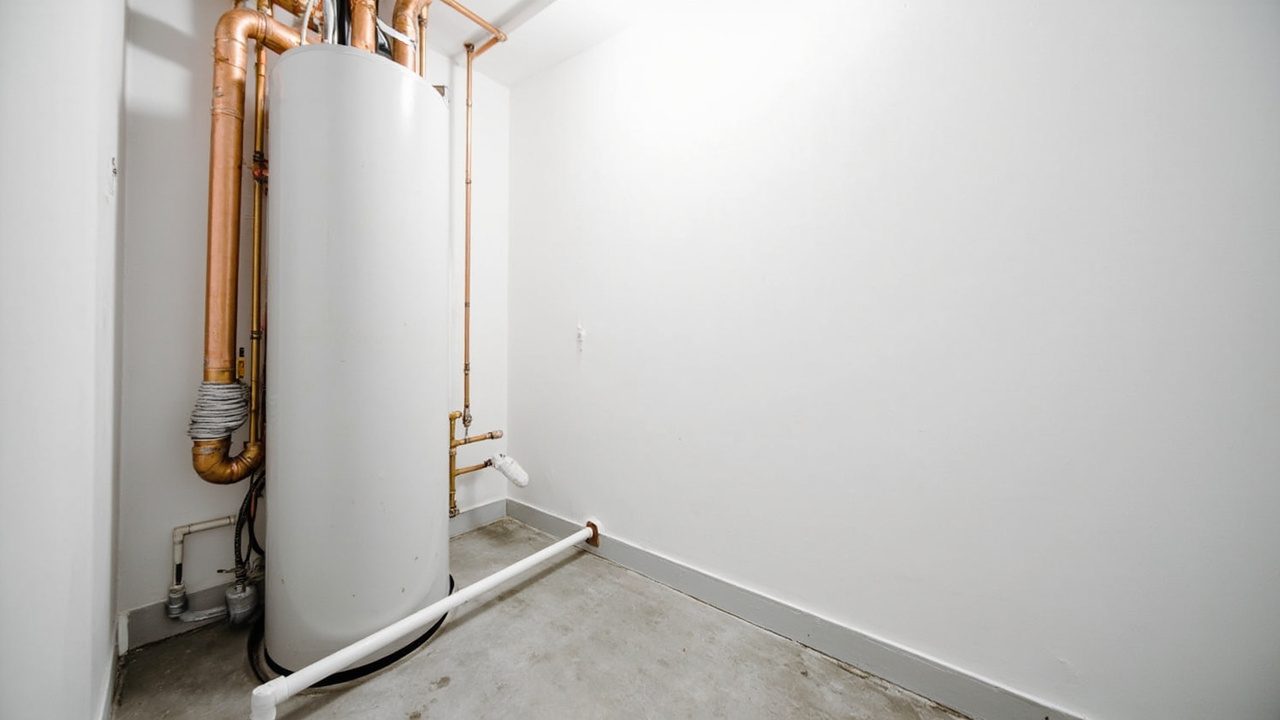
How the anode rod pull decides repair or replacement
Isolation comes first, because water under pressure escapes whether anyone is home or not. With every fixture closed, the water meter leak indicator gets watched for fifteen minutes. Any movement means water is leaving the system somewhere you cannot see, and a still dial puts the work on the heater itself. Next the cold inlet on top of the tank closes and the gas control or breaker goes off. Before anything gets promised, the space above the tank is measured, because pulling an anode rod needs headroom, and a tank in a closet or a garage corner often sits under a shelf or a low ceiling. Then the rod comes out.
The rod is the reading that splits repair from replacement. Sacrificial metal still along the core wire means the shell is protected and a new rod is a repair. A bare core wire means the tank itself is now the part being eaten, and replacement is the honest scope. The hardness kit at the tap sets the next fork. Local water commonly reads around ten grains per gallon or more, so the scope includes flushing, descaling or treatment. A screw on gauge at a hose bib, read with everything off, comes after that. A reading in the 45 to 70 psi range leaves the plumbing alone. Above 80 psi is where fixtures, supply hoses and heaters start failing early, and a pressure reducing valve normally belongs in the job. The gauge left on overnight finds a failed expansion tank when the morning number sits far above the night number. Each reading changes what goes into the written scope, and you see all of them before you approve anything.
Two local conditions decide tank against tankless here, the hardness of the water and the room around the heater. A condensing tankless unit scales its heat exchanger in water at ten grains or more, so treatment or descaling has to be planned before the unit is bought rather than after it clogs. Its installation also reopens the gas line size, the venting and the condensate path, and in a closet built for a tank that can mean opening walls. A tank swap in the same spot reuses all three, which is why a like for like water heater change out is the shorter job in a slab era closet. Where a garage has room for a larger gas line and a vent run, and the hardness is dealt with, hot water system installation with a tankless unit becomes a fair comparison. Hard water also pushes toward treating the water before buying another heater of either kind, because a second heater failing inside a few years is a water problem.
If this sounds close but not quite your situation, emergency water heater repair may be the better starting point.
Narrow this to two options before calling, then ask which one suits the house.
| Option | The numbers a buyer weighs | Best suited to |
|---|---|---|
| Tank water heater against tankless | A tank is judged on capacity in gallons and its first hour rating | Households with long back to back hot water use |
| Type L copper against PEX | Copper is rigid, tolerates heat directly | Repipes where the existing layout sets the method |
| Cast iron drain against PVC or ABS | Cast iron is heavy and quiet and corrodes from the inside over decades | Drain replacement under a finished house |
| Trenchless lining against open cut replacement | Lining cures a new pipe inside the old one with a small loss of inside diameter | Runs under a slab, a drive or mature trees |
| Sump pump selection | Sized by horsepower against the vertical lift plus pipe run it has to push through | Basements with a real lift to the discharge |
How a water heater call runs
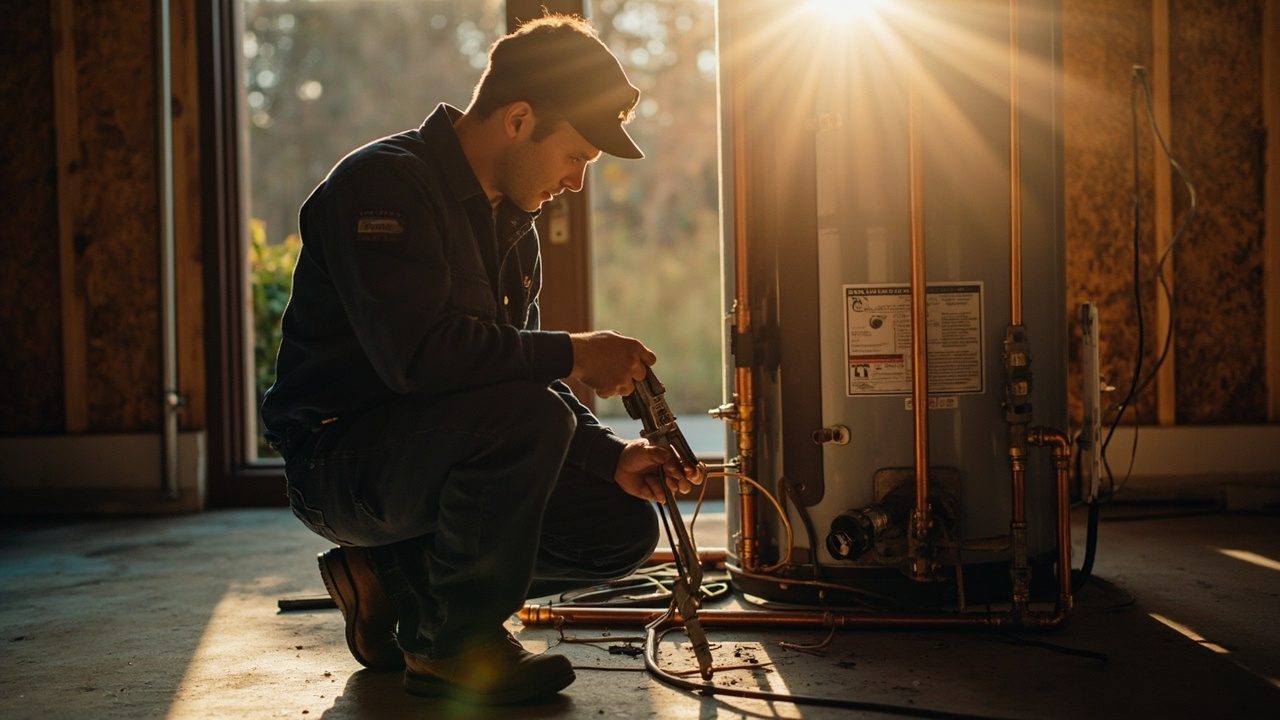
The call and first look
On the phone we ask what the hot tap looks like, where the heater stands and its age if you know it. On site the order follows where the water is going. Every fixture closes and we observe the meter for fifteen minutes to detect leakage. Then isolation of the cold supply to the tank occurs, the gas control or breaker goes off, and the clearance above the tank is measured before the anode rod is pulled. A hardness test at the tap and pressure readings at the hose bib finish the assessment, and you can watch the rod come out.
Approval and the swap
Once you approve the written scope, the cold inlet stays closed, the gas control or breaker stays off, and a hot tap on a lower floor opens so the tank is not under vacuum as it drains. The old tank comes out and the new one sets on the same footprint where clearance allows. Copper meets steel through a dielectric union, the temperature and pressure relief valve gets its discharge line, and a thermal expansion tank goes on where the overnight pressure hold called for it. If corroded fittings or a static reading above 80 psi turn up, we stop and show you before going further.
Testing and handover
Before we leave on a gas unit, a combustible gas detector goes across the fittings and bubble solution goes on each joint, and neither may show an alarm or a growing bubble. Static pressure gets read again with everything off and has to sit in the 45 to 70 psi range. A thermometer at the farthest hot tap, after a full minute of running, should read around 120 degrees, and you choose the final setting by weighing scald risk against a tank that stays clean. We walk you through the rod reading and the hardness result, and you keep the written scope.
Why heaters in slab era closets need local planning
Permits come first in the order of things. Replacing a gas-fired heater usually needs a permit, and a like for like fixture swap usually does not, with the final call belonging to the permit authority for your address. Work inside city limits and work outside them answer to different offices, and outside the city the county or the neighboring town holds that role. That is why the first question on the phone is the address rather than the symptom. A crew that starts before answering it can end up with a finished install that has to be opened again.
Houses from the 1970s through the 1990s around here were built slab on grade, with copper supply run into the slab and the heater positioned in a garage or closet. Three mistakes follow from that layout. A quote written from the label alone skips the headroom check, so the anode rod cannot be pulled and the tank cannot be lifted out the way it went in, and the visit turns into a second trip. Copper stubs meeting a steel tank without a dielectric union corrode at the connection. A new heater fitted with no hardness reading has no descaling or treatment plan, and the new tank faces the same scale the old one did. The relief valve discharge and the expansion tank get checked on every install, because a heater on a closed system with nowhere for expanding water to go reports it at the valve.
Hard freezes and summer heat both reach a garage heater. Arctic fronts drop temperatures into the teens, which splits unprotected lines and hose bibs, and summer afternoons above one hundred degrees stress the tank. In cold weather incoming water arrives colder and the heater works through a larger temperature rise, which is when a tank with scale on its floor runs out during the second shower. Gas units carry one fixed rule. If you smell gas, everyone goes outside, nothing gets switched on the way out, and Texas Gas Service is called from outside.
More detail on tankless water heater services is on its own page.
Permit and inspection questions? Planning & Inspections is the office we coordinate with on every permitted El Paso job.
Working with Bedrock Plumbing El Paso on a heater job
From call to arrival
You call, and we ask what the hot water looks like at the tap, where the heater stands and whether anyone is in the property. Those answers sort an active leak or a no hot water call, which is treated as a same day visit, from a rusty tap that fits a scheduled window. The person who takes your call confirms the window. Arrival windows depend on the job ahead of yours, and if that job runs long, the window moves and you are told before it does.
Protecting garage and closet
Before the tank moves, drop cloths go down along the path from the heater to the door and under the tank itself. The old tank drains through a hose to a floor drain or outdoors, so water never crosses your slab. Scale and sediment rinse out through that hose rather than onto the floor. The old tank leaves with us, the closet or garage corner gets swept, and the last thing we do is wipe down the area around the new unit.
What moves the price
Access moves the job first. A tank in an open garage is a shorter job than one boxed into a closet where a shelf or wall section has to come out. Repair against replacement moves it furthest, and the anode rod decides that. Matching old copper and gas fittings to a new unit adds parts, the grade of heater you choose adds more, and after hours dispatch adds to it. You control the heater grade and the clearing around the tank. We write the scope after the assessment, and nothing starts until you approve it.
How technicians earn sign off
A new technician rides along with a lead before working alone, and the lead signs off on specific tasks: pulling and reading an anode rod, joining copper to a steel tank through a dielectric union, and testing a gas fitting with bubble solution. Dave Parker keeps up with updated Texas codes and modern energy-efficient fixtures. On an unusual install, such as a closet with no headroom, a second technician looks at the site before a scope is written.
You Have Questions,
We Have Answers
Replacement cost moves with tank size, fuel type, access and the code work the swap triggers. A larger gas tank costs more than a smaller one, and a tankless conversion costs more again because gas line size and venting change. Moving the unit, adding a drain pan, or replacing corroded shutoff valves adds parts and labor. Quoting a dollar figure without seeing the heater would be a guess, so the scope gets written after the site is assessed and nothing starts until you approve it.
Homeowners working on their own residence are treated differently from someone paid to do it. A gas heater adds risks a handyman may overlook, such as combustion air, a drafting vent and a leak-free gas joint. Ask any installer who pulls the permit, because that name is the one the inspector will hold responsible.
Sediment buildup on the tank floor is the most common problem, and hard water speeds it along. Minerals settle into a crust that insulates the water from the burner or lower element. Symptoms include popping or rumbling as steam bubbles push through the scale, longer recovery times and hot water that runs out early. Electric units lose lower elements to the crust, while gas tanks overheat the steel bottom. A regular flush slows the process, though heavy scale may need descaling.
A fair price matches the scope written for your specific heater, so compare itemized scopes rather than single totals. Check that each one lists the tank size, a new expansion tank if pressure warrants it, a relief valve discharge line, dielectric unions, gas fitting testing and haul-away of the old tank. A low total that omits those items usually returns as change orders. Permit handling should also be named, since a gas-fired replacement often requires one.
Rumbling or popping from the tank is often the first sign, followed by water that takes longer to warm. Look for a damp patch or rust streaks around the base, small drips at the relief valve, and a pilot flame that burns yellow instead of blue on gas units. Lukewarm showers after the first few minutes point to a crusted element or burner. Metallic-smelling hot water or flakes in the aerator mean the inside of the tank is breaking down.
Labor for a tank swap is driven by how much the site demands beyond the tank itself. A same-spot exchange with good clearance runs quickest. Labor climbs when the gas line must be resized, a vent must be rerouted, the flue needs new pipe, or the tank sits in a tight closet and must be angled out. Replacing old shutoffs, adding an expansion tank and running a discharge line to code each add time. A technician needs to see the location to give a real number.
Labor changes with the work around the heater, so no single average fits every house. Electric swaps skip gas piping and venting and take less time, while gas swaps add flue connection, gas fitting testing and combustion checks. Corroded copper stubs, seized valves and missing drain pans lengthen the visit. Tankless conversions take the longest because they can require a larger gas line, new venting and a condensate drain. Labor is quoted in the written scope once the site has been seen.
Pay for a written scope that lists every part and task. Judge the installer by what that scope includes. It should cover the heater, permit handling where required, a pressure check, expansion control, a correctly piped relief valve and gas leak testing. Payment should follow approval of the scope, not precede it. Be wary of quotes given over the phone with no questions about the location, fuel type or clearance, because those factors change the labor.
A tank heater commonly lasts around eight to twelve years, and tankless units often run longer with regular descaling. Life shortens where water is hard, because scale insulates the tank floor and the anode rod wears out faster. Heat stress in an unconditioned garage, high static pressure and a failed expansion tank each cut years off the total. An annual flush and anode inspection are the routine tasks that stretch a tank toward the upper end.
Corrosion of the steel tank after the anode rod is consumed causes most failures. Once the rod is gone, water attacks the tank wall and pinholes form, usually near welds or at the bottom where sediment holds moisture against the steel. Excess pressure accelerates it by flexing the shell every heating cycle when the expansion tank has failed. A tank that begins seeping from the shell cannot be repaired, and the leak will grow until it is drained.
Why hard water changes water heater installation in El Paso
Homes built from the 1970s through the 1990s are common across the county, and they share a layout: slab on grade, buried copper supply lines, ABS or PVC drains, PVC laterals, and a water heater in a garage or a closet. That layout drives the job. The same headroom that decides whether a rod can be pulled also decides whether a tankless unit's venting has any room, and a condensing unit needs a drain point for its condensate. A garage puts the tank through long hot summers and puts exposed lines within reach of the brief hard freezes that split unprotected piping. The water adds to it. El Paso Water describes its supply as moderately hard to hard and disinfects it with chlorine, and mineral content at the tap typically measures in the high single digits to low double digits in parts per million, so scale is planned for in every heater here.
Inspection follows the permit, and the authority that issues it decides what gets inspected and at which stage. The adopted plumbing code carries local amendments, so the final word on any single item belongs to that office. On a heater the visible items are the ones worth having ready: the gas connection, the venting, the temperature and pressure relief valve with its discharge line, and the expansion tank. Knowing that up front changes the sequence. Parts are staged before the old tank comes out, the gas fittings are tested with a combustible gas detector and bubble solution before anyone else looks at them, and the pressure readings are written down so nobody has to guess. Responsibility for a leak follows a different line. If the meter dial keeps moving with the main closed, the loss is on the street side, and the utility and the authority decide where responsibility sits.
Plumbing Services in The El Paso Area
Explore our service area and locate Bedrock Plumbing El Paso with ease. We're proudly local and serve the surrounding neighborhoods with fast response and honest pricing. Use the map to check our coverage area, or call us and we'll confirm in seconds.
Address:
Bedrock Plumbing El Paso, 221 North Kansas St, Suite 700, El Paso, TX, 79901
Additional Services We Offer
- Backflow Prevention & Testing
- Drain Cleaning & Rooter Service
- Faucet & Sink Repair
- Garbage Disposal Services
- Gas Line Repair & Installation
- Plumbing Services
- Sewer Line Repair & Replacement
- Shower & Bathtub Plumbing
- Slab Leak Detection & Repair
- Sump Pump Services
- Tankless Water Heater Services
- Toilet Repair & Installation
Finding and closing the main shutoff, cleaning an aerator and swapping a braided supply hose are homeowner jobs, and you do not need us for them. DIY stops at anything soldered, anything on the gas line, and anything behind a finished wall or under a slab. A heater visit covers the heater and its connections. If we find a hot line leaking under the slab, we say so on the first visit and scope it separately.
Before you call, know how the hot water looks at the tap first thing and after a full minute, and when that started. Check whether the cold tap runs clear. Find the gas control or breaker, and read the age off the tank label if it shows one. Measure the space above the tank, since headroom decides whether the rod can be pulled. Tell us whether anyone is home.
Last reviewed September 2026 by Dave Parker, Owner.