





What a moving meter dial means for El Paso buildings
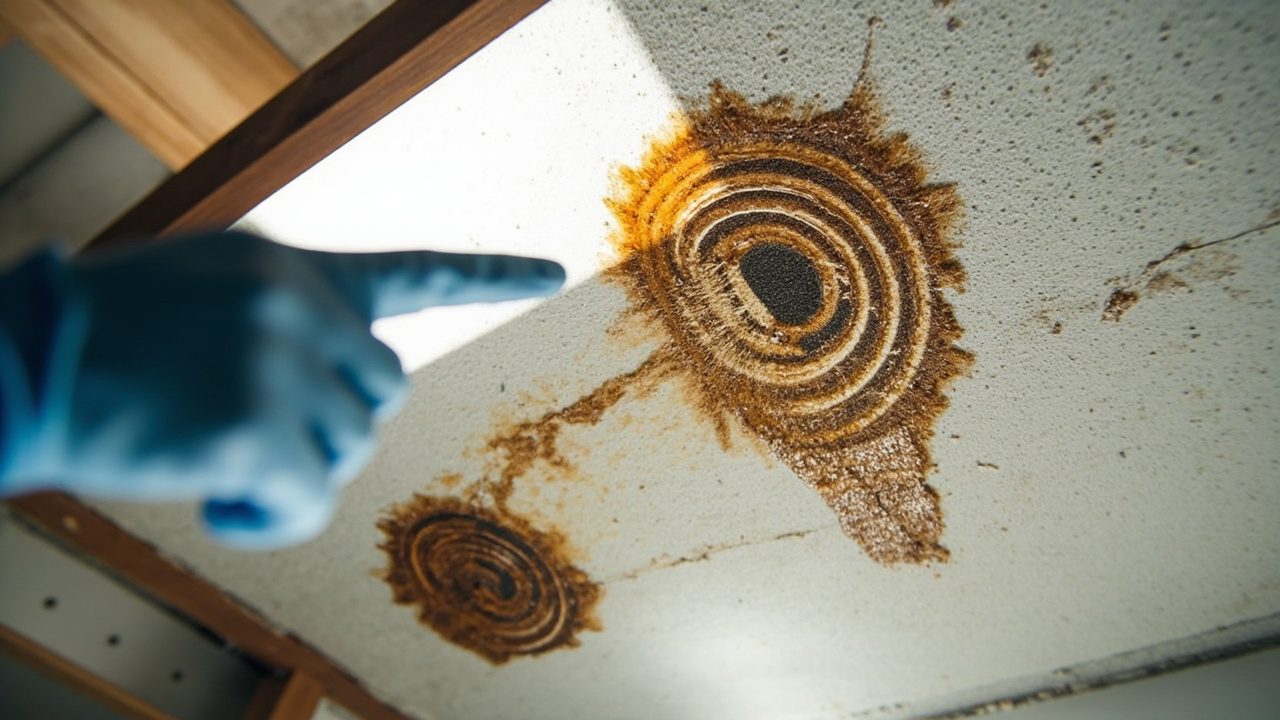
A meter dial that turns with every fixture closed, a brown stain spreading across the ceiling below a restroom, and a water bill that climbed while nothing looks wet all describe the same condition. Pressurised supply water is leaving the pipe somewhere you cannot see. It leaves all night whether anyone is in the building or not, which separates it from a drain, where water escapes only while something upstream runs. A stain that appears after a flush or a wash cycle is a drain question. A stain that keeps growing on a quiet weekend is a supply question.
The symptom places the fault on a segment, and the segment decides the scope. Low pressure on the upper floors only, with the ground floor normal, points at a riser or the branch feeding those floors rather than at the service line. Rust colored water on the first draw of the morning points at galvanized steel closing up from the inside, and the utility names corroding galvanized pipe as the typical cause of discolored water. Two pinholes in the same run of copper mean that run is near the end of its life. A third repair on it is a repair on the same pipe, and the sound decision is the segment, whether that becomes riser replacement or a commercial building repipe taken floor by floor.
El Paso adds two conditions to that failure. The water arrives moderately hard to hard, commonly around ten grains per gallon or more, and above about seven grains scale forms steadily in heaters, valves and fixture cartridges. A building on this water wears out valves and heater elements early, and a scaled valve is a poor isolation point when a branch has to come out of service. The second condition is age. The oldest stock in the county carries galvanized supply, postwar stock carries galvanized or early copper, and the 1970s through 1990s stock carries copper run under or through the slab. Recent construction carries PEX on manifolds. One office building can hold two of those eras behind its walls, and the joint between them needs a dielectric union or a proper transition.
Calling today beats waiting when the meter moves with everything off and a stain is already visible. A hairline supply leak behind tile keeps the framing damp because nothing dries inside a wall, and the pipe repair then turns into a wall rebuild.
More detail on commercial backflow prevention & testing is on its own page.
Your local utility, El Paso Water, publishes service and water-quality information every El Paso homeowner should know.
How we place the loss before a wall gets opened
The work starts at the water meter with every fixture in the building closed and every water using machine stopped. The leak indicator, or the small leak wheel, has to sit still for fifteen minutes, and any movement means water is leaving the system somewhere. Next the main closes and the meter gets watched again. A dial that keeps turning with the main closed puts the loss on the street side of the meter, which moves the job out to the service line. A dial that stops puts the loss inside the building. Riser and branch valves then close one at a time until the movement stops, and that shrinks the problem to a floor or a branch before any surface opens. Above the slab the branch is narrowed by isolating and listening. Below it, listening gear, tracer gas or thermal work on a hot line plus a locator turn the choice into breaking the slab at one point or routing that line overhead.
Static pressure comes next, read with a screw on gauge at a hose bib and every fixture off, because a running fixture hides the real number. A reading in the 45 to 70 psi range is normal. Above 80 psi, fixtures, supply hoses and water heaters start failing early and a pressure reducing valve is normally required, so that valve joins the scope beside the pipe. The gauge stays on overnight, and a morning reading far above the night figure means a heater is expanding water into a closed system, which puts a thermal expansion tank in the scope. A hardness test at the tap decides one more fork. Above about seven grains per gallon scale forms steadily, so flushing, descaling or treatment on the heaters goes into the scope, otherwise new pipe feeds an old scaling problem. The first opening decides the last fork. Pipe of the same age and condition along its length makes the job the segment, whereas one failed fitting on sound pipe stays a repair.
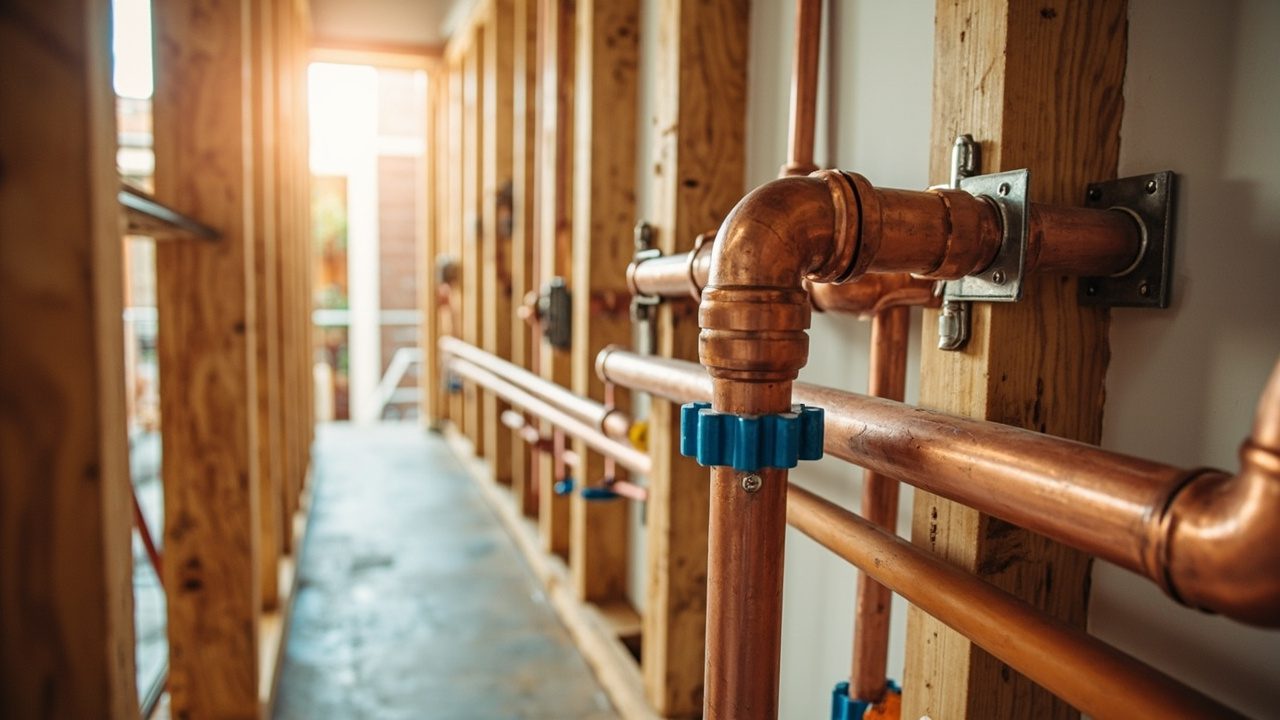
Exposure decides between type L copper and PEX here. Intense sun and heat degrade exposed plastic lines, which keeps rooftop, exterior and mechanical room runs in copper that tolerates heat directly. Inside finished walls the balance shifts, because a PEX home run layout puts fewer joints in the wall and a future repair costs less drywall. Hardness adds scale to heaters and valves under either material, so that problem is answered by descaling or treatment rather than by pipe choice. A floor by floor commercial pipe replacement lets each branch be isolated at its valve while the adjacent floors hold pressure, and the material mix follows what each floor exposes.
Our page on commercial kitchen plumbing covers that side of the work in more depth.
Narrow this to two options before calling, then ask which one suits the house.
| Option | The numbers a buyer weighs | Best suited to |
|---|---|---|
| Type L copper against PEX | Copper is rigid, tolerates heat directly | Repipes where the existing layout sets the method |
| Cast iron drain against PVC or ABS | Cast iron is heavy and quiet and corrodes from the inside over decades | Drain replacement under a finished house |
| Trenchless lining against open cut replacement | Lining cures a new pipe inside the old one with a small loss of inside diameter | Runs under a slab, a drive or mature trees |
| Sump pump selection | Sized by horsepower against the vertical lift plus pipe run it has to push through | Basements with a real lift to the discharge |
How a commercial repipe call runs
Meter test first
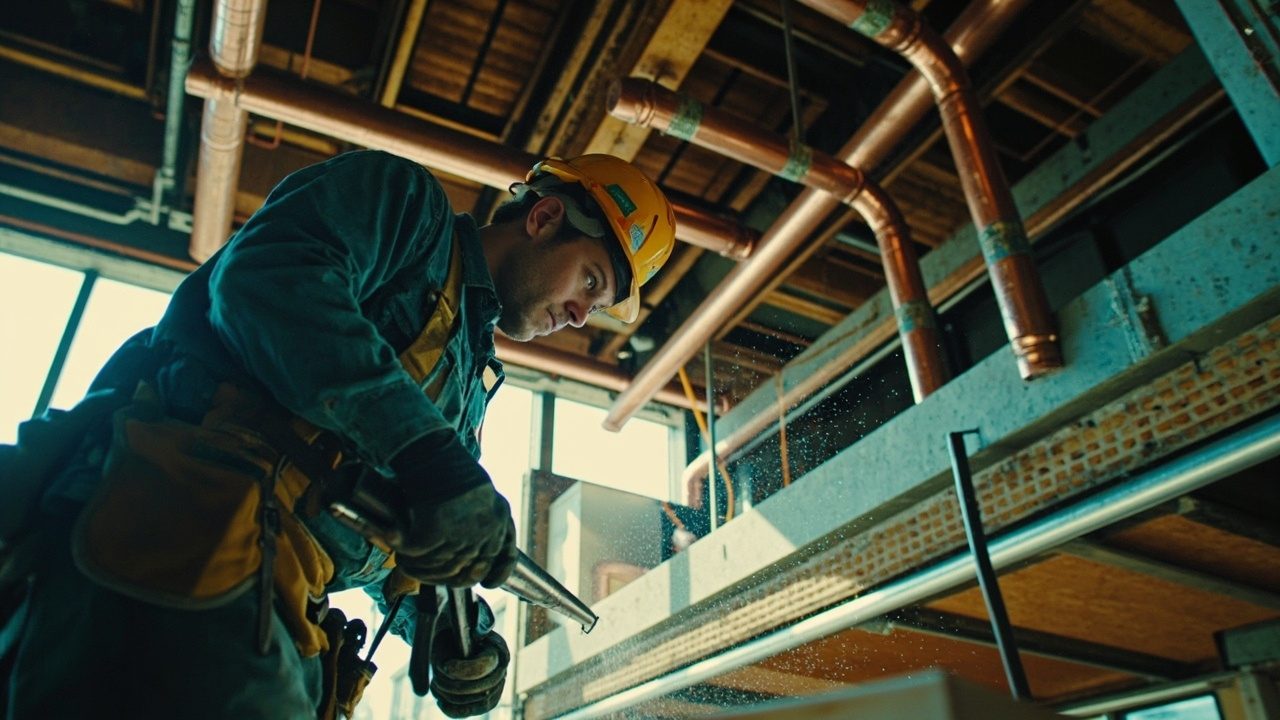
The call covers the number of floors, the pipe material if you know it, where the main shutoff and the riser valves sit, and whether tenants are in the building. On site, the first act is the meter. Every fixture closes, and the leak indicator gets watched for fifteen minutes. Then the main closes and the meter is read again, which places the loss on the street side or inside the building. Riser and branch valves get isolated sequentially to pinpoint which one holds pressure. A pressure gauge connected to a hose bib reads static pressure with everything off and stays on overnight for the hold reading. Only then does anyone decide which wall opens.
Approval and phased work
After you approve the written scope, the branch is isolated at its valve and drained before anything is cut. The old section comes out, and new type L copper is soldered or PEX is run to a manifold, with a dielectric union wherever the new pipe meets galvanized steel. Where the readings called for it, a pressure reducing valve and a thermal expansion tank go in during the same opening. If an opened wall shows corroded pipe beyond the approved section, work stops and you see it before the scope changes. Water returns to that branch, and the work moves to the next floor.
Pressure test and handover
Before leaving each phase, the gauge goes back on a hose bib with everything off and has to read inside the 45 to 70 psi band, the same band used to judge the building before work began. The leak indicator is watched with every fixture on that branch closed, and the dial has to sit still for fifteen minutes. You walk the opening with the technician and see the joints before the wall is patched. You keep the written scope, the before and after pressure readings and the meter result, which together form the record a lender, underwriter or board reviewer asks for.
Why local conditions decide how a repipe gets built
A commercial repipe usually needs a permit when the scope reaches a riser or a main water line, and a like for like fixture swap usually does not, with the final call belonging to the permitting authority. Which office that is depends on where the building sits. Inside city limits the permit comes from the city, and outside them the work falls under the county or the neighboring town, so the first question on any building is which side of that boundary it stands on. Commercial owners treat this as a liability question, since a due diligence reviewer can ask for the permit record on a riser replacement.
The older stock in the county sets the first trap. Galvanized supply closes up from the inside, so a crew that judges a run by its outside surface leaves pipe with a narrowed bore and finds low pressure after the walls are patched. Where new copper meets galvanized steel, a joint made without a dielectric union sets up corrosion at that joint, and the leak returns in the new work. The second trap is climate borrowed from somewhere else. The ground here does not freeze deeply, so burying supply for frost depth gains nothing, while the exposed hose bibs, backflow assemblies and outdoor lines that split in a brief hard freeze go unprotected. The third trap is soil. Caliche hardpan slows trenching on a commercial water line replacement, and a schedule built on soft soil rates slips on the first day of digging.
Response across the county follows the building's occupancy. An active leak or burst line takes the same day slot, and a phased repipe is scheduled so the water-off window for each floor or branch falls when the building can spare it. A property manager sees the isolation valve locations on the scope before the first floor starts, which tells tenants which restrooms lose water and for how long.
If this sounds close but not quite your situation, commercial plumbing contractors may be the better starting point.
What a phased repipe looks like from your side
How scheduling works
You call and answer three questions: which floors show the loss, when it started, and where the main shutoff and riser valves are. Those answers decide whether the visit is same day, which a burst line or active leak gets, or scheduled. You hear the arrival window by phone before anyone travels to the building. If the job ahead of yours runs long, the window moves and you hear about it before it passes. For a phased repipe, work stops and restarts on each floor or branch only after agreement with the building manager.
Protection and cleanup
Before a wall opens, floors and corridors along the work path get covered, and the branch is isolated and drained so water is not spilled at the cut. Dust from drywall and old pipe scale stays behind a sealed barrier at the opening. Tools stage in one room instead of moving through occupied space. Old galvanized and copper sections leave the building in bags and bins with us. The last step is wiping the work path and leaving the opening clean and ready for whoever patches the wall.
What moves the cost
Access moves the job furthest, meaning the finished wall, tile, ceiling below or slab that has to be opened and put back. Excavation depth and length on a water line, one segment against the whole run, and matching old pipe to new come next. Fixture grade and after hours work follow. Shutting off the whole building compresses the schedule and raises downtime, while one branch at a time adds phases and isolation work. You approve the written scope before work starts, and it states what happens if an opened wall shows more.
How technicians are checked
A new technician rides with a lead before working alone, and the lead signs off on tasks the technician has to demonstrate. Those include reading static pressure at a hose bib with everything off, running the meter leak test with the main closed, making a soldered type L joint and setting a PEX B crimp ring. The current plumbing code cycle is studied inside the company as well. On a job with mixed pipe material or a loss below a slab, a second technician looks at it before a scope is written.
You Have Questions,
We Have Answers
A repipe price follows access, pipe length, material and how much wall or slab must be opened. A run through open mechanical space costs far less labor than one behind tile or under concrete. Fixture count matters too, because every fixture adds a branch, a shutoff and a connection. Written scope and readings come first, so the number follows measured conditions instead of a guess. Two buildings with the same square footage can land far apart.
The trap weir should sit no more than 24 inches below the fixture outlet under common plumbing codes. Trap arms commonly sit between 16 and 24 inches below the sink rim. A longer drop can siphon the trap seal. The horizontal arm also needs a slope of about one quarter inch per foot so solids carry along with the water.
Repiping services replace the water supply lines that carry pressurized water to fixtures, heaters and equipment. Drains and vents are separate systems and stay in place unless they are failing too. The work can cover a single riser, one branch, or every supply line, and the new pipe is usually copper or PEX. Crews shut off and drain the section, cut out old pipe, install new lines, then pressure test before closing anything up.
A shower and a toilet can share a drain line when the pipe is sized and vented correctly. The toilet needs a 3-inch drain, and the shower connects through its own trap, commonly 2 inches, into that larger line downstream. Each trap needs a vent within its allowed distance so one fixture cannot pull the water seal out of the other. Common symptoms of a poor layout are gurgling when the toilet flushes and slow shower drainage.
Repiping is worth it when the same supply line keeps failing or the pipe itself has lost capacity. Repeated pinholes, brown water on first draw and low flow at several fixtures at once show a line failing along its whole length. Galvanized steel narrows inside as rust builds, so pressure drops even when nothing leaks. If the meter test places the loss at one fitting on sound pipe, a repair costs less and the repipe waits.
The 135 degree rule usually refers to the maximum turn allowed in a drain before a cleanout is needed. Codes commonly call for a cleanout after total direction changes reach 135 degrees, which is the sum of bends such as three 45-degree fittings. Each added bend slows flow and gives solids a place to catch, so a cleanout gives a snake or camera a path. Long horizontal runs may need additional cleanouts at set spacing.
Repiping a house in Texas is priced by the job, and no dollar figure can be stated here. Slab foundations are common in Texas, so many lines run through or under concrete and can be rerouted overhead through the attic instead of breaking the slab. That reroute choice, the number of bathrooms, the pipe material and drywall patching are the largest cost drivers. Single-story homes with attic access generally need less opening than two-story homes with plumbing walls.
A PEX repipe usually costs less than copper because the tubing is cheaper and needs fewer fittings. Cost still moves with the number of fixtures, whether a manifold home run layout is used, and the drywall or ceiling access needed. PEX-B with crimp rings is common for residential work. A house with easy attic routing takes far less labor than one with finished plaster walls.
PEX suits most interior residential repipes, and copper suits exposed or high-heat locations. PEX is flexible, needs fewer joints inside walls and resists pinholes from aggressive water. Copper tolerates heat and does not degrade in sunlight, though hard water scale can eat at thin walls over decades. Type L copper is heavier than type M and lasts longer under pressure. Many jobs use both, with a transition fitting where they meet.
Why caliche and hard water change commercial repiping in El Paso
El Paso Water supplies a blend of river surface water and groundwater from two aquifers, describes it as moderately hard to hard, and disinfects it with chlorine. A hardness test kit at the tap commonly reads ten grains per gallon or higher, and that reading puts descaling or treatment into the scope of any heater or valve tied into the new piping. Anyone with questions about drinking water quality should read the utility report and send a tap sample to a laboratory, since a plumbing test does not answer that. The ground changes the sequence on a commercial water line replacement. Caliche hardpan layers slow trenching between the meter and the building, and the finer valley soils hold more water. Monsoon thunderstorms run off quickly and collect in low streets and dips, so an open trench needs a plan for runoff before the storm arrives.
Work inside city limits is inspected at stages during construction, and work outside them falls under county or municipal jurisdiction, so the first job on any building is confirming which office applies. A repipe phased over several floors has several openings, and each one has to stay accessible until the inspector has seen the pipe. Sequencing the phases around that avoids closing a wall that then has to be reopened. Whatever the inspector chooses to examine, the gauge readings at the hose bib give the reviewer a number to check rather than an assertion. The city adopts its plumbing code with local amendments, and those amendments settle details a national code book leaves open, so the authority makes the final call on anything unclear. A permit record and a written scope are the two documents required when a building changes hands or is refinanced.
Plumbing Services in The El Paso Area
Explore our service area and locate Bedrock Plumbing El Paso with ease. We're proudly local and serve the surrounding neighborhoods with fast response and honest pricing. Use the map to check our coverage area, or call us and we'll confirm in seconds.
Address:
Bedrock Plumbing El Paso, 221 North Kansas St, Suite 700, El Paso, TX, 79901
Additional Services We Offer
- Apartment Complex Plumbing
- Commercial Backflow Prevention & Testing
- Commercial Kitchen Plumbing
- Commercial Plumbing Contractors
- Commercial Sewer Line Repair
- Commercial Toilet & Urinal Repair
- Commercial Water Heater Systems
- Grease Trap Cleaning & Pumping
- Hydro Jetting Services
- Industrial Pipe Repair
- Medical & Dental Gas Plumbing
- Preventative Commercial Maintenance
Reading the meter and closing the main shutoff is a job for you or your facilities person. Where DIY stops is anything soldered, anything on the gas line, anything behind a finished wall or under a slab. If the meter test shows a leak in the utility's line, we say so on the first visit and tell you to take it to the utility, since that line sits outside the building.
Before you call, know which floors show a stain or low pressure and when it started, and what changed just before. If you can, read the water meter dial with every fixture off and find the main shutoff and any riser valves. Any age you have for the piping, and whether tenants are in the building, helps. Those answers usually tell us whether a branch needs work today.
Last reviewed September 2026 by Dave Parker, Owner.