





A dripping faucet and a damp stop in El Paso homes
You find a damp ring on the cabinet floor under the basin, and the faucet above it drips after the handle is shut. You may already have cleaned the aerator or tightened the handle. Sort the problem into supply or drain first. A drip at the spout and a damp stop are pressurized supply water, and they run all night whether anyone is home. Water that shows only while the basin drains belongs to the p trap or the drain connection and stops when the flow stops.
The water here arrives moderately hard to hard, and a test kit at the tap commonly reads around ten grains per gallon or more. Above about seven grains per gallon, scale forms steadily on every surface the water touches. In the faucet, scale packs the cartridge, so the handle stiffens and the shutoff stops sealing, which is the drip you hear. The same scale crusts the aerator, so flow at the spout drops as the drip starts. Under the basin, scale builds on the stem and the compression nut of the angle stop. An angle stop is rarely turned, so the mineral sets around it and locks it in whatever position it last held. A leaky faucet repair that swaps only the cartridge leaves that stop as the next failure.
Where the damp sits places the fault. A ring directly under the faucet connections with a dry stop points at the braided supply hose. Moisture running down the stop body and collecting at the compression nut puts the fault at the stop. A wet back wall in the cabinet with nothing visibly dripping puts water inside the wall, which turns a faucet call into a leak search behind a finished surface.
A kitchen sink repair that begins at the spout can end at the stop. A weeping angle stop means the compression nut has started to corrode. A corroded nut cannot be snugged, and a stop in that state can snap off in someone's hand during a faucet change, at which point the room takes the full supply through an open pipe. Call the same day when the stop weeps at the stem or the nut, before anyone attempts a faucet replacement over it. Until someone arrives, find the main shutoff, either where the line enters the house or at the meter, and leave the stop alone. A drip at the spout over a dry cabinet floor can wait for a scheduled visit, since the cartridge is wearing and a dripping tap fix at that stage keeps the existing faucet.
More detail on garbage disposal services is on its own page.

Find the sign you have, then read across to see whether it can wait.
| Symptom or first sign | What is already happening | What it becomes if ignored | When to call |
|---|---|---|---|
| A weeping angle stop under a sink | The compression nut corrodes so it cannot be snugged | The stop snaps off in someone's hand during a faucet change | Now, the same day |
| A toilet that runs after flushing | The flapper lets the tank refill all night and the fill valve cycles constantly | The valve wears and sticks open with the overflow carrying it away unnoticed | This week, while it is still one part |
| Incoming pressure above the normal band | The relief valve on the heater starts weeping | The tank seams work harder every cycle and the heater fails years before it should | This week, while it is still one part |
| A hairline supply leak behind tile | The framing stays damp | The pipe repair turns into a wall rebuild | This week, while it is still one part |

Hardness test first, then the stop, then the faucet
The visit runs in the order the water travels. The technician closes the stop under the basin and watches the spout. If the drip stops, the fault sits downstream of the stop, in the cartridge or the aerator. If the drip continues with the stop closed, the stop is passing water and it becomes the job. A stop that will not close moves the isolation up to the main shutoff, and only then does anything come apart. The hardness test on the incoming water comes before any quote, because that number decides what else belongs in the scope. A finished wall opens only after the stops and the main have narrowed the loss to a branch behind it.
Read the kit against the classification soft, moderately hard, hard, very hard. Soft to moderately hard water leaves aerators, cartridges and heater elements alone, so a worn cartridge stays a small repair. The jump from moderately hard to hard is where scale starts showing up on service calls. Water in this area typically measures above seven grains per gallon, and at that threshold scale forms steadily, so the technician plans for flushing, descaling or treatment alongside the faucet. A stop with crusted threads or a corroded compression nut gets replaced with the faucet, since tightening it is the step that breaks it. At a hard or very hard reading, the written scope adds treating the water, because a new faucet on untreated water meets the same scale within a few years.
Type L copper and PEX enter the job only when the stop or the stub-out behind it has to change, and the pipe already in the wall sets the choice. Slab homes from the 1970s through the 1990s carry copper supply, and newer east and west side subdivisions carry PEX from a manifold, where a shutoff at the manifold isolates a single fixture. Scale sets on threads and valve seats in either material, so hardness picks the valve and the treatment plan and leaves the pipe to the era of the house. Under a cabinet PEX sees no sun, so its sun limit falls away, and copper's rigid, heat tolerant run stays the choice where the stub-out is already soldered and sound. In the oldest houses, where galvanized supply still feeds the stop, a dielectric union goes between the galvanized and the new copper, since two different metals in contact corrode faster.
If this sounds close but not quite your situation, backflow prevention & testing may be the better starting point.
Permit and inspection questions? Planning & Inspections is the office we coordinate with on every permitted El Paso job.
Narrow this to two options before calling, then ask which one suits the house.
| Option | The numbers a buyer weighs | Best suited to |
|---|---|---|
| Type L copper against PEX | Copper is rigid, tolerates heat directly | Repipes where the existing layout sets the method |
| Salt softener against a salt free conditioner | An ion exchange softener removes hardness minerals and needs salt and a drain | Hard water houses weighing salt against upkeep |
| Trenchless lining against open cut replacement | Lining cures a new pipe inside the old one with a small loss of inside diameter | Runs under a slab, a drive or mature trees |
| Cast iron drain against PVC or ABS | Cast iron is heavy and quiet and corrodes from the inside over decades | Drain replacement under a finished house |
| Tank water heater against tankless | A tank is judged on capacity in gallons and its first hour rating | Households with long back to back hot water use |
How a faucet repair call runs
The call and first look
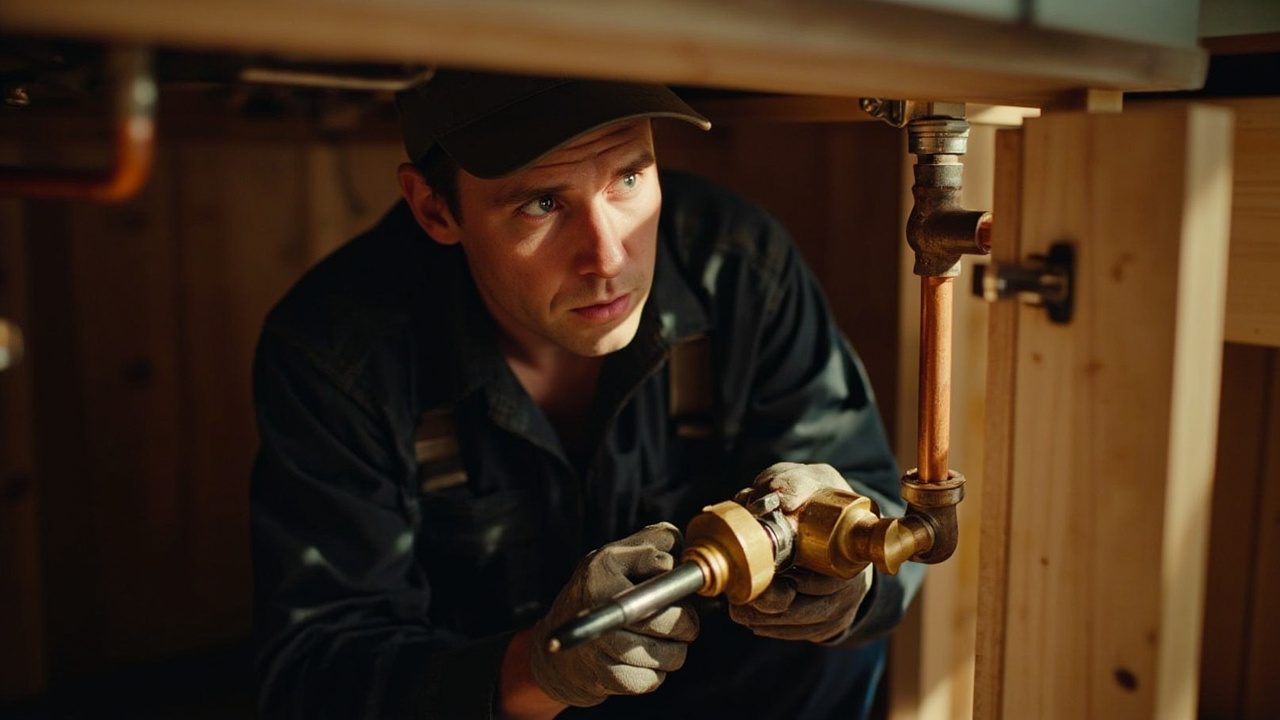
On the phone we ask about water location, handle count on the faucet, and moisture under the basin, because those answers place the fault on the supply side or the drain side. On site, the technician closes the stop and observes whether flow halts at the spout. A continuing drip points to the stop valve leaking past its seal. No drip means the cartridge or aerator holds the fault. The hardness test on the incoming water follows, and the reading goes into the written scope. A finished wall opens only if isolation has confirmed the loss to a concealed branch line.
Approval and the repair
Once you approve the written scope, isolation comes first. The stop for that faucet closes, and if it will not, the main shutoff does. Opening the faucet drains the line, then the handle, the compression nut and the worn cartridge come out, or the faucet lifts off for a full faucet replacement. A new angle stop and braided supply hose go on where the old ones are crusted. Where galvanized meets copper, a dielectric union goes between them. If a joint behind the stop looks worse than the scope described, we stop and show you before going further.
Testing before we leave
The stops open slowly, and the technician cycles each handle while watching the closed spout for any drip. Each supply connection and the stop stem then get wiped dry and checked with a dry towel, which has to come away dry after the line has held supply pressure for a few minutes. Water runs through the faucet and down the drain so the p trap is checked under load. You walk through the finished work with the technician and keep the written scope, which records the hardness reading and the valve and faucet installed.
Why work on hard water runs differently from a standard swap
A like for like faucet swap usually does not need a permit. A bathroom sink installation that adds or moves supply and drain runs usually does, and the final call belongs to the local permit authority. Which authority applies depends on whether the house sits inside the city limits or out in the county, and that answer is worth having before the scope is written.
A crew used to softer water makes three mistakes here. The first is swapping the faucet and reusing the old angle stop. On scaled water that stop has a crusted compression nut, and operating it to change the faucet is the moment it snaps and the room takes the full supply. Another is skipping the hardness test and fitting a new cartridge into water reading around ten grains per gallon or more, so the handle stiffens again as scale repacks it. The last is joining new copper straight to old galvanized with no dielectric union, which sets the joint to corrode where the two metals touch.
Older houses add a fourth. Rust colored water at a kitchen faucet in a house with galvanized supply usually comes from the pipe corroding from the inside, and the water supplier names rusting galvanized pipe as the typical cause of discolored water. A new faucet leaves that color alone, and a pipe that has closed up from the inside limits flow whatever sits on the end of it. A technician who knows the housing stock reads what is behind the stop before promising a same day fix. Galvanized supply runs through the late 1800s to 1930s homes, galvanized or early copper through the 1940s to 1960s, copper through the slab from the 1970s, and PEX after 2000.
Freezing nights come every winter and most hover just below freezing, so a sink line on an exterior wall usually survives them. An arctic front that drops temperatures into the teens finds the coldest, least protected line, and the split shows only after the thaw, when pressure returns and water reaches the cabinet.
See drain cleaning & rooter service for how the related work is scoped and priced.
What the faucet visit looks like from your side
Scheduling and arrival
You call, and the questions are where the water shows, whether the faucet has one handle or two, and whether the cabinet floor is damp. A stop weeping at the nut is a same day visit, and a spout that drips over a dry cabinet is a scheduled one. The person who answers confirms the arrival window with you by phone. If the job ahead of yours runs long, the technician phones you with the new window before it passes.
Protecting the cabinet and floor
Everything stored under the sink is moved out first and returned last. A drop cloth goes down on the cabinet floor and the floor in front of it before anything comes apart, and a bucket sits under the trap and the stop to take what drains from the line. Old cartridges, scale flakes and cut off fittings go into a bag and leave with the technician. The last step is running the new faucet and drying each connection with a towel to check for moisture.
What moves the price
Access moves a faucet job least, because a cabinet opens without cutting anything, and most when the stop is fed from a finished wall that has to be opened and closed again. Repairing at the stop costs less than replacing the segment behind it, and the condition of that run decides which you need. Matching old pipe to new adds fittings. The grade of faucet and valve you choose moves the job in the direction of the grade. The written scope follows the hardness test and the stop check, and nothing starts until you approve it.
How technicians are signed off
A new technician rides along with a lead on faucet calls before working alone. The lead signs off on specific tasks, including closing a weeping angle stop without breaking it, reading a hardness test, and setting a cartridge so the handle moves freely. The whole crew studies the current code cycle. On an unusual job, such as a stop that will not close or galvanized supply behind the wall, a second technician looks at it before a scope is written.
You Have Questions,
We Have Answers
Plumbers price a sink repair by parts, access and the fault itself. A cartridge or supply hose swap sits at the low end. A stop valve replacement costs more, and a leak behind a finished wall costs most because it adds opening and patching. Faucet grade moves the total up as it rises. Two different faults can show the same damp cabinet, so a written scope after diagnosis fixes the number before work starts.
A single lever faucet suits arthritic hands best because it moves with a light push. Look for a long lever handle, a pull-down sprayer on a kitchen sink, or a touch-activated spout that starts flow with a tap on the body. Knob handles demand a wrist turn against friction, which is the motion that hurts most. Tell the technician about hand strength so the cartridge is set for a free-moving handle.
Close both stops and open the faucet to drain the line before touching the handle. Pull the handle cap, screw and handle off the stem. Unscrew the bonnet nut, lift out the old cartridge, and note which way the hot and cold markings face. Compare the old part to the new one, since brands differ in stem splines and length. Grease the new O-rings with plumber's silicone, seat the cartridge fully, tighten the bonnet nut snugly and reopen the stops slowly.
A dripping double handle faucet leaks because one handle's cartridge or seat washer no longer seals. Find the side by closing each stop in turn. When the drip ends after closing one, that hot or cold side holds the worn part. Compression styles use a rubber washer that flattens against the brass seat, and a pitted seat chews the new washer within weeks unless it is resurfaced. Replace the washer and the O-ring together, and inspect the seat with a fingernail for roughness.
A kitchen faucet lasts roughly 10 to 15 years with normal use, and hard water shortens that. Scale packs the cartridge and clogs the aerator, so handles stiffen and flow narrows well before the body fails. Brass bodies outlast zinc alloy ones, and ceramic disc cartridges outlast rubber washer types. Finish wear shows first as pitting near the spout base. A faucet that needs its second cartridge within a few years usually points at the water, not the faucet.
Start by finding what is broken, then shut off the stops under the sink before touching anything. A drip usually means a worn cartridge, a loose spout means a failed base O-ring or mounting nut, and weak flow means a clogged aerator. Unscrew the aerator and soak it in vinegar to dissolve scale. If a stop will not turn fully or shows green crust on the nut, stop and shut the main instead, because forcing it can snap it.
Shut both stops, remove each handle, and inspect the cartridge or stem for wear. Look for a cracked O-ring or a flattened washer. Leaks at the handle base come from the stem O-ring, while leaks at the spout come from the cartridge or seat. Swap parts in pairs on both sides, since the untouched side wears at the same rate and leaks next. Reassemble, open the stops slowly, and cycle each handle while watching the spout for a slow bead of water.
A stainless steel sink can be repaired for scratches, rim dents and drain leaks. A cracked seam or a rust-through pinhole is rarely worth fixing. Light scratches follow the grain and blend out with a fine abrasive pad. A leaking drain flange is a plumber's putty or gasket job. Chips and rust spots usually come from iron contact or carbon steel left wet, so wipe those off before they bore into the surface.
Kitchen faucets commonly fail through worn cartridges, cracked spray hoses, clogged aerators and loose mounting. Pull-down hoses develop pinhole leaks at the crimp, and the counterweight can snag on stored items and stress the hose. Low flow often traces to a debris-clogged aerator after any work on the supply lines. A loose faucet body rocks and wears the base O-ring, which sends water down into the cabinet with no visible drip at the spout.
Yes, plumbers repair and replace faucets as routine work. Repair covers cartridges, seats, O-rings, aerators and supply hoses, while replacement covers a faucet that is corroded or has parts no longer sold. A plumber also checks the angle stop under the basin, since a crusted stop can fail during the swap. Knowing where the water shows and how many handles the faucet has helps decide whether the visit needs to happen the same day.
Why hard water changes faucet and sink repair in El Paso
The kit reading from the first visit, around ten grains per gallon or more, is the local fact that changes the parts list. Scale forms steadily above about seven, so a cartridge and its angle stop are chosen for a house that keeps depositing mineral, and the aerator gets checked on every faucet call. The water supplier also names rusting galvanized pipe inside older homes as the typical cause of discolored water, so a brown first pour after a faucet change often points at the supply line. Housing stock sets what sits under the sink. Late 1800s through 1930s homes carry galvanized supply, cast iron drains and clay laterals. Mid-century homes carry copper through the slab with ABS or PVC drains. Newer homes carry PEX from a manifold. Across the county a crew expects several materials and carries transition fittings to match.
Permitting follows the city limit. Inside it, the city issues plumbing permits and inspects at stages during construction, and outside it the county or the neighboring town holds the authority. The city adopts its plumbing code with local amendments, so a house just past the boundary can answer to a different office than one just inside. A swap onto existing stops usually needs no permit, and a bathroom sink installation with new supply or drain runs usually does, with the ruling theirs to make. On permitted work the trap, stops and supply connections stay open and visible until inspection passes, and the cabinet back is not closed over a joint. The written scope records the hardness reading and the valve chosen, so an inspector or the next owner can see why a stop was replaced. Knowing which side of the boundary a house sits on before arriving keeps a same day faucet job from stalling on a question a phone call settles.
Plumbing Services in The El Paso Area
Explore our service area and locate Bedrock Plumbing El Paso with ease. We're proudly local and serve the surrounding neighborhoods with fast response and honest pricing. Use the map to check our coverage area, or call us and we'll confirm in seconds.
Address:
Bedrock Plumbing El Paso, 221 North Kansas St, Suite 700, El Paso, TX, 79901
Additional Services We Offer
- Backflow Prevention & Testing
- Drain Cleaning & Rooter Service
- Garbage Disposal Services
- Gas Line Repair & Installation
- Plumbing Services
- Sewer Line Repair & Replacement
- Shower & Bathtub Plumbing
- Slab Leak Detection & Repair
- Sump Pump Services
- Tankless Water Heater Services
- Toilet Repair & Installation
- Water Heater Repair & Installation
Cleaning a crusted aerator, swapping a braided supply hose and closing the main shutoff are homeowner jobs. DIY stops at anything soldered, anything behind a finished wall or under a slab, and any drain already backed up past a cleanout. A cracked basin or a rotted cabinet floor is carpentry and countertop work outside plumbing, and if the first visit finds one, we say so then and name who handles it.
Before you call, know whether the water shows at the spout, at the handle or inside the cabinet, and when it started. Say how many handles the faucet has and what changed just before, such as a swapped hose or a turned stop. Any age you have for the faucet helps, and so does knowing where the main shutoff is.
Last reviewed September 2026 by Dave Parker, Owner.