





What a weeping angle stop means in El Paso homes when coolers start
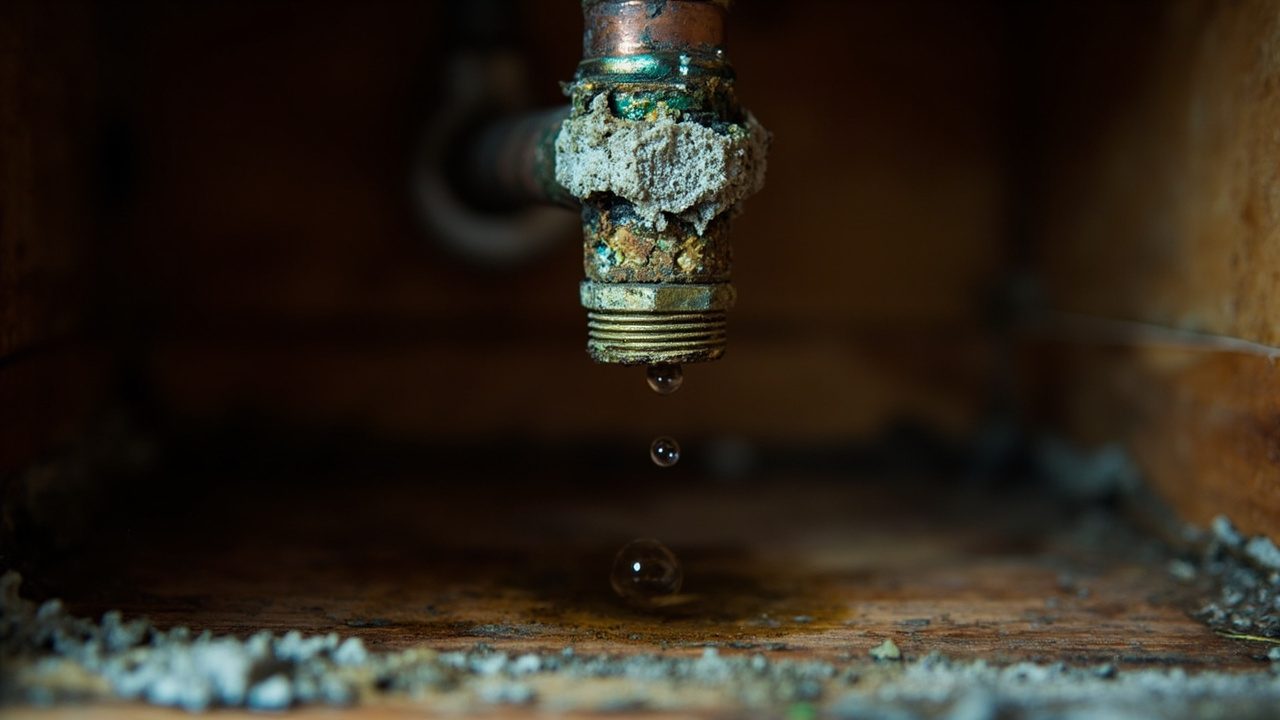
You see a bead of water under the angle stop beneath a sink, a crust of white or green scale on the compression nut, and a cabinet floor that stays dark. Nothing drips into a bucket, so it gets left. The weep sits on the supply side, though, and pressurized water leaves through a weep whether anyone is home or not. A drain only spills while something upstream is running. That difference is why a weeping stop and a slow drain are two different calls.
Dry air hides this failure. In a dry, windy spring the water evaporates before it pools, and the mineral it carried stays behind as the crust on the nut. A compression stop seals when the nut squeezes a brass ferrule onto the tube, and each time the valve is worked that seal loosens a little. Scale between ferrule and tube then keeps it from seating again. The timing adds to it. When evaporative coolers start up across the county, supply lines and float valves that sat dormant come back under pressure, and the stops, fittings and valves that were already weak show themselves at the first full cycle. A float valve that scales open at the cooler runs the same way, with water leaving on its own and nothing switched on. With water that arrives moderately hard to hard, the nut under the crust corrodes until the fitting will no longer seal.
Where the water shows tells you the segment. A single weeping stop puts the fault on one fixture branch, and that branch can be shut at its own stop. A bill that jumped with nothing wet, or a meter dial that turns with every fixture closed, puts a loss somewhere you cannot see, which is a different call. A weep at the stem is the valve, but a weep that returns after a new stop went in points at the pressure behind it. Your part is small. Find the main shutoff before anyone needs it, and leave a crusted nut alone, because the one that gets forced is the one that breaks.
Same day plumbing repair services make sense when the nut will not snug or a faucet change is planned. A weeping angle stop leads to a compression nut that corrodes until it cannot be snugged, and that leads to a stop that snaps off in someone's hand during a faucet change, with the room taking the full supply. Water at that point runs at line pressure until someone reaches the main shutoff, and a household that has not located it yet spends that time searching.
More detail on 24/7 emergency plumbing services is on its own page.
Find the sign you have, then read across to see whether it can wait.
| Symptom or first sign | What is already happening | What it becomes if ignored | When to call |
|---|---|---|---|
| A weeping angle stop under a sink | The compression nut corrodes so it cannot be snugged | The stop snaps off in someone's hand during a faucet change | Now, the same day |
| A hairline supply leak behind tile | The framing stays damp | The pipe repair turns into a wall rebuild | This week, while it is still one part |
| A toilet that runs after flushing | The flapper lets the tank refill all night and the fill valve cycles constantly | The valve wears and sticks open with the overflow carrying it away unnoticed | This week, while it is still one part |
| Roots at one clay joint | Paper and grease catch at that spot every day | The main backs up into the lowest fixture in the building with no warning | Now, the same day |
How we find the cause before we quote the repair
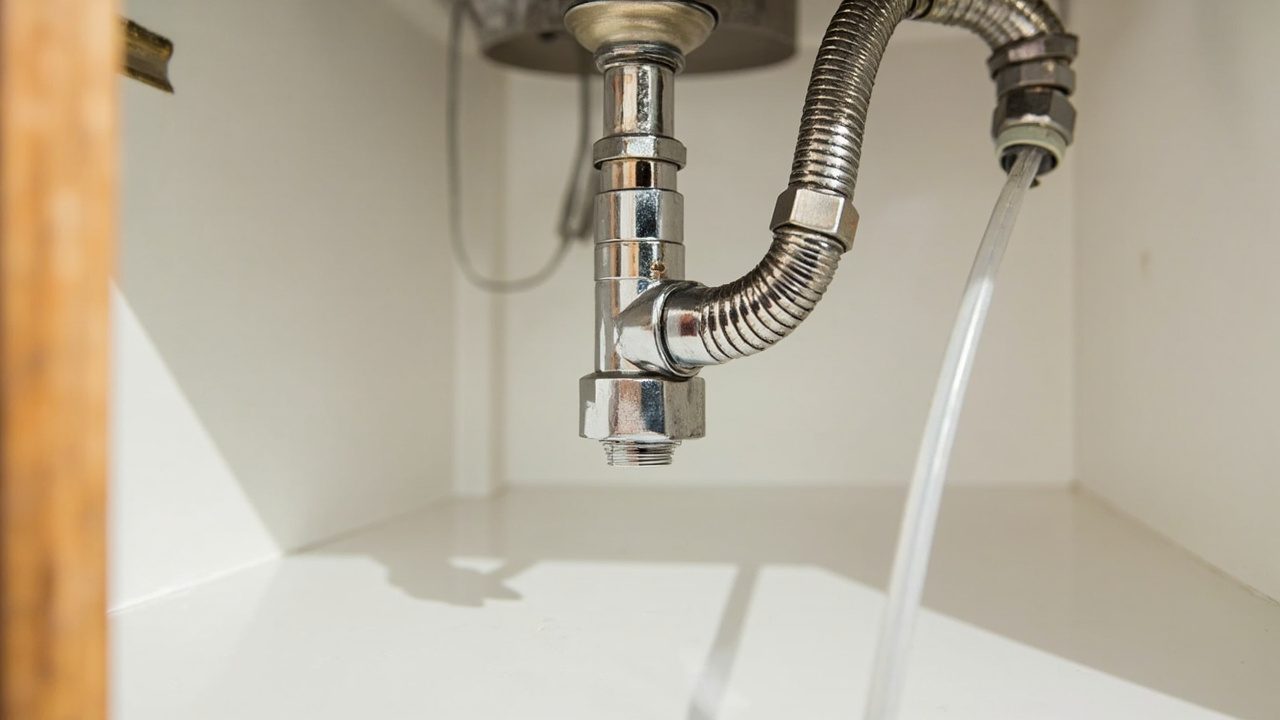
Professional plumbers halve the system before they open anything, and the order follows where the water is going. Every fixture in the house goes off, the cooler float valve included, and the meter leak indicator is watched for fifteen minutes. Any movement means water is leaving the system somewhere out of sight. Then the main closes and the dial gets read again. Movement with the main closed puts the loss on the street side of the meter, and the job moves out to the service line. A dial that stops with the main closed puts the loss inside the house, and stops and branches close one at a time until the movement stops. That segment is where a surface opens, and no surface opens before then.
The screw on pressure gauge goes on a hose bib with everything in the house off, because a running fixture hides the real static number. A reading in the 45 to 70 psi range is normal. Above 80 psi, supply hoses, fixtures and water heaters start failing early and a pressure reducing valve is normally required, so it joins the scope next to the stop that first leaked. Leave the gauge on overnight. A morning reading well above the night figure means the heater is expanding water into a closed system with nowhere to put it, which points to a failed thermal expansion tank, and that gets found in the same visit. A hardness test at the tap settles the other fork. Moderately hard to hard water means the job plans for flushing, descaling or treatment before another valve or heater goes in.
Two supply materials compete for any segment that has to be replaced, type L copper and PEX, and here the desert decides. Intense sun degrades exposed plastic, so garage runs and exterior walls stay copper or get covered, while a home run PEX layout keeps joints out of the walls you cannot see and opens less drywall on a future repair. Hard water scales heaters and valves whichever pipe carries it, so treating the water comes before another heater. Brief hard freezes split unprotected outdoor piping, and the ground does not freeze deeply, so the exposed section is what fails and its routing is the decision. Where a second pinhole opens in the same run of copper, the segment gets replaced and the spot does not get repaired again.
Our page on apartment complex plumbing covers that side of the work in more depth.
Narrow this to two options before calling, then ask which one suits the house.
| Option | The numbers a buyer weighs | Best suited to |
|---|---|---|
| Type L copper against PEX | Copper is rigid, tolerates heat directly | Repipes where the existing layout sets the method |
| Trenchless lining against open cut replacement | Lining cures a new pipe inside the old one with a small loss of inside diameter | Runs under a slab, a drive or mature trees |
| Salt softener against a salt free conditioner | An ion exchange softener removes hardness minerals and needs salt and a drain | Hard water houses weighing salt against upkeep |
| Cast iron drain against PVC or ABS | Cast iron is heavy and quiet and corrodes from the inside over decades | Drain replacement under a finished house |
How a plumbing services call runs
Phone questions and isolation
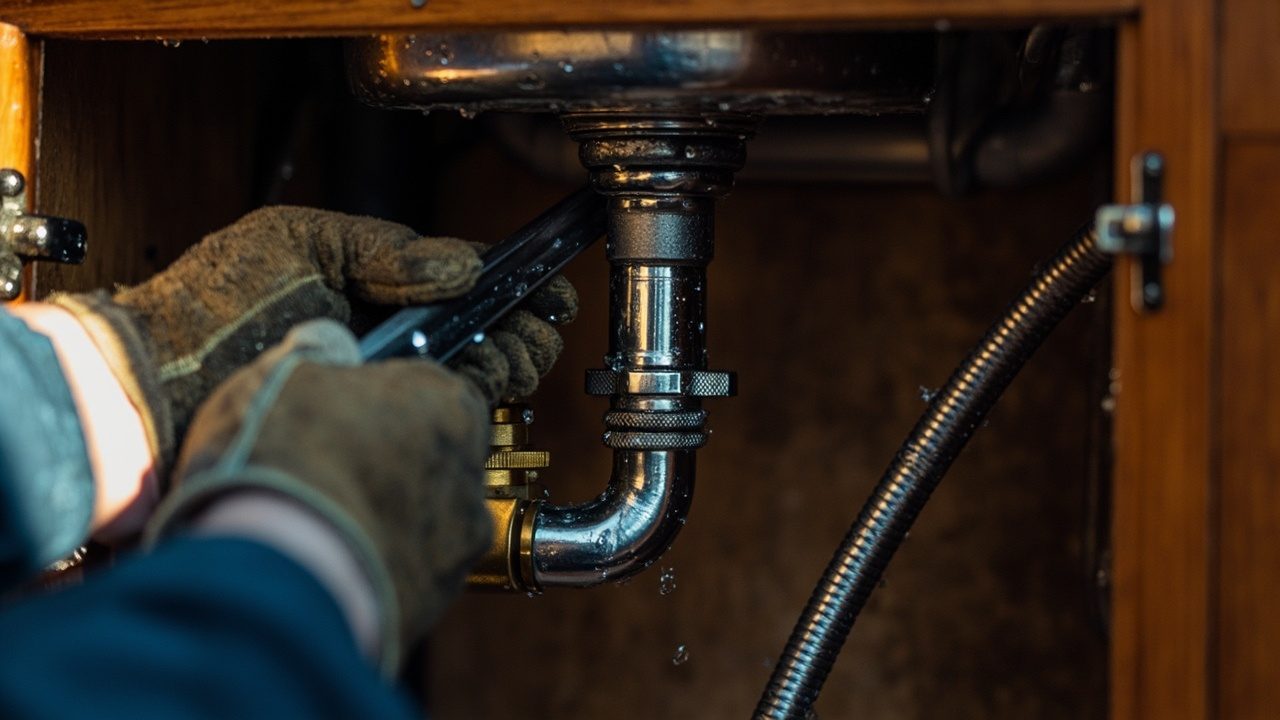
On the phone you are asked about visible signs, when the problem started, occupancy and the main shutoff location, because those answers decide whether the visit is today. On site, everything in the house goes off and the meter leak indicator gets watched for fifteen minutes while you stand where you can see the dial. The main valve closes and a second reading is taken. Each stop and branch then closes individually until the needle stops moving. The screw on gauge goes on the hose bib last, and nothing opens until the loss has been placed on a segment.
Approval and the repair
Once you approve the written scope, water goes off at the smallest segment that isolates the work, which is the fixture stop when it holds and the main when it does not. The old angle stop comes out, the tube is cleaned back to sound metal, and a new stop and braided supply hose go on. Where a run is replaced, that means soldered type L copper or PEX with the joining method the scope names, and a dielectric union wherever galvanized meets copper. If the opening shows more than the scope covered, we stop, show you, and write the change down before going further.
Verification and handover
Before we leave, the gauge goes back on the hose bib with everything off, and the static reading has to sit in the 45 to 70 psi range, the same reading that set the scope. The meter dial gets watched for fifteen minutes and must not move. Each new joint runs under pressure and gets checked for a bead, and a joint that shows one is remade before the water goes back on for good. You get a walkthrough of each part that changed, and you keep the written scope with the readings beside it.
What an unfamiliar crew gets wrong in a county of mixed pipe eras
Permits for plumbing work inside city limits come from the city, and work outside those limits falls under the county or the neighboring town, so the first question on any job is which side of that line the house sits on. Gas work and main line work usually need a permit. A like for like faucet, angle stop or supply hose swap usually does not. The final call belongs to the permit authority, and work that needs a permit is inspected at stages, which means a wall or trench stays open until it has been seen.
The houses set the second set of problems. Homes from the late 1800s through the 1930s carry galvanized supply, cast iron drains and clay laterals. Postwar slab houses, common from the 1940s through the 1960s, put cast iron drains under the slab, and homes from the 1970s through the 1990s run copper supply under or through the slab, which makes a warm spot on a floor a live possibility. Homes built from the 2000s on carry PEX from a manifold. A crew that assumes one material cuts into a wall that holds three.
Unfamiliar crews get specific things wrong. They join copper to old galvanized without a dielectric union, and the joint corrodes at the threads. They quote a yard line dig as soft soil, and caliche hardpan turns the trench into a slower, larger job. They set a tank heater into hard water with no hardness reading and no plan for flushing, and the element or tank scales early. They treat a discolored water call as a cartridge problem when galvanized supply corroding from the inside is the usual cause, and the fix lies in the pipe. Crews from colder places bury lines against deep frost, while here brief hard freezes split hose bibs and exposed lines.
Calls come from the mesas and foothills, where gravel and caliche rule the trench, and from the river valley, where finer soil holds more water. Local plumbers and plumbing contractors who work across the county carry that difference into the scope before the first cut.
See shower & bathtub plumbing for how the related work is scoped and priced.
Permit and inspection questions? Planning & Inspections is the office we coordinate with on every permitted El Paso job.
What a visit from Bedrock Plumbing El Paso looks like
When somebody arrives
You call and get asked what you see, when it started, whether the meter dial moves with everything off, and where your main shutoff is. Those answers sort a supply leak that needs someone today from a fixture or drain job that can take a scheduled window. You hear the arrival window by phone before anyone comes to the door. If the job ahead of yours runs long, the window gets revised by phone and you are not left guessing.
Protection and cleanup
Before a stop or valve comes apart, drop cloths go down and a towel and bucket go under the fixture. The water off point is agreed with you so nothing gets cut while the line is live. Where a wall has to open, the cut stays as small as the isolation allows and plastic sheeting keeps dust in the room. Cut pipe, old parts and packaging leave with us in our own bags, and the last step is wiping the area and running the fixture to look for a bead at each joint.
What moves the scope
Access moves the job furthest, so a finished wall, tile, a slab or a ceiling below raises it and an open stop under a sink lowers it. Depth and length of any dig come next, then one joint against the whole run, where a second failure in the same segment favors replacing it. Matching old material to new, the grade of fixture or heater and after hours dispatch follow. Water off for the whole building or one branch also shapes the plan. The written scope reaches you first, and nothing starts until you approve it.
How technicians are checked
A new technician works beside a lead before working alone, and the lead signs off on isolating a branch, reading static pressure at a hose bib and joining dissimilar metals with a dielectric union. The sign off is on the task itself, watched on a live job. Updated code requirements are reviewed as they change. On anything unusual, such as a meter that keeps moving with the main closed, a second technician looks before a scope is written.
You Have Questions,
We Have Answers
Leaking supply fittings and clogged drains make up most calls, with fixture leaks usually ahead of drains. A toilet that runs after flushing is a common example, because a flapper that has hardened lets water creep past the seat into the bowl. Dropping a few drops of dye into the tank and waiting twenty minutes shows whether the flapper is the culprit. Kitchen and bathroom drain slowdowns follow, usually from grease and hair collecting at the trap arm rather than deep in the line.
Ask what the plumber measures to find the cause before any scope is written. A useful answer names a specific check, such as a pressure reading or a meter test, instead of a guess. Ask how the arrival window is communicated, who handles the permit question, and whether the scope arrives in writing before work begins. Vague replies about the cause usually lead to parts swapped without the loss ever being located.
Compare how each plumber arrives at a quote instead of chasing the lowest number. A quote given by phone without a pressure reading or meter check often grows once a wall opens. Ask each company what drives the scope, such as access, pipe material and fixture grade, and request the scope in writing. Two quotes built on the same written scope can be compared fairly, while two verbal guesses cannot.
Plumbing services fall into repair, replacement, installation, drain clearing, water heater work and leak location. Repair covers stops, valves and supply lines. Installation covers new fixtures, tank or tankless heaters and pressure reducing valves. Drain work spans a clogged fixture trap up to a main line blockage, which may need a camera to see the pipe. Leak location tracks water loss to a segment with a meter and isolation valves. Gas piping is its own category and usually needs a permit.
Bedrock Plumbing El Paso is a strong choice because it reads static pressure and the meter before quoting. Every scope is written down and approved by you before anything starts. Each repair closes with a gauge reading that must land in the 45 to 70 psi range and a meter dial watched for fifteen minutes without movement. Technicians also sign off on tasks like dielectric unions on a live job before working alone. Call (915) 350-8242 to describe your problem and hear the arrival window.
Replacing a faucet, toilet fill valve or flapper is the most common repair in a typical home. Fill valves wear because the rubber seal hardens and grit lodges at the seat, so the tank keeps refilling and you hear a faint hiss. Mineral deposits speed this up in hard water. A replacement kit fits most toilets in a few minutes, but a corroded shutoff underneath can turn a simple swap into a valve replacement, so test that valve first.
A plumber installs, repairs and replaces supply piping, drains, fixtures, water heaters and gas lines. The work also includes locating hidden leaks, clearing blocked drains, setting pressure reducing valves and adding thermal expansion tanks. Some plumbers handle sewer lateral repair, which may involve excavation and a camera inspection. Others also advise on water treatment when hardness is high. A good plumber diagnoses first, explains what was found, and then performs only the work that the findings support.
Pressurized supply plumbing and gravity drain plumbing are the two basic types. Most homes also have a vent system. Supply lines carry water in under pressure through copper, PEX, or older galvanized steel. Drain lines carry waste out by slope alone, commonly in PVC, ABS or cast iron, and the vents let air in behind the flow so traps keep their seal. A slope of a quarter inch per foot is the usual target for drain runs.
Drain clearing, leak repair, water heater service, fixture installation and toilet repair lead the list. Heater work is frequent because sediment builds up in the tank and shortens element or burner life, and a heater that rumbles while heating is often carrying that sediment. Fixture installs come next, especially faucets and disposals. Repiping is less frequent but larger, usually after repeated pinhole leaks in one run of copper or when old galvanized pipe restricts flow.
Cost depends on access, pipe material, dig length and depth, and fixture or heater grade. Open access under a sink lowers a job, while a finished wall, tile or a slab raises it. A second failure in the same run favors replacing the segment over patching it. After hours dispatch adds to the total as well. A firm price requires seeing the problem, so expect a written scope that names each of these factors before work starts.
How hard water and cooler start up shape plumbing in El Paso
Three conditions change how work is planned here. The water arrives moderately hard to hard, commonly around ten grains per gallon or more, and above about seven grains scale forms steadily in heaters, valves and cartridges, so a valve job also plans for flushing, descaling or treatment. In older homes, galvanized supply rusts from the inside, which is the usual cause of discolored water, and a repair there ends at the first sound section of pipe. The ground sets the access. Mesas and foothills are sandy and gravelly with layers of caliche hardpan that slow trenching, while the river valley has finer alluvial soil that holds more water. Spring adds one more, since scale in cooler float valves and supply lines shows up when the coolers restart. Brief hard freezes split hose bibs and unprotected outdoor lines, so exposed sections get insulated or routed inside.
Plumbing permits inside city limits are issued by the city, work outside them falls under the county or the neighboring town, and the plumbing code the city adopts carries local amendments. Which jobs need a permit is therefore the authority's answer, and gas work and main line work are the ones that usually do. Inspection happens at stages during construction, and the inspector looks at pipe while it is still exposed, so a joint buried under a wall or trench cannot be shown afterward. Knowing that changes sequencing. Rough work is planned so the section awaiting inspection stays open, and finish work waits behind it. Responsibility for a leak on the service line is a separate question, answered first by the meter watched with the main closed and then decided by El Paso Water and the authority. For questions about the water itself, read the utility report and have a laboratory test your own tap.
Plumbing Services in The El Paso Area
Explore our service area and locate Bedrock Plumbing El Paso with ease. We're proudly local and serve the surrounding neighborhoods with fast response and honest pricing. Use the map to check our coverage area, or call us and we'll confirm in seconds.
Address:
Bedrock Plumbing El Paso, 221 North Kansas St, Suite 700, El Paso, TX, 79901
Additional Services We Offer
- Backflow Prevention & Testing
- Drain Cleaning & Rooter Service
- Faucet & Sink Repair
- Garbage Disposal Services
- Gas Line Repair & Installation
- Sewer Line Repair & Replacement
- Shower & Bathtub Plumbing
- Slab Leak Detection & Repair
- Sump Pump Services
- Tankless Water Heater Services
- Toilet Repair & Installation
- Water Heater Repair & Installation
Plunging a toilet, swapping a flapper or a braided supply hose and closing your main shutoff are jobs you can do yourself. DIY stops at anything soldered, anything on the gas line, anything behind a finished wall or under a slab, and any drain backed up past a cleanout. If you smell gas, get everyone outside, switch nothing on the way out, and call Texas Gas Service from outside. If the first visit turns up work we do not handle, you hear it then.
Before you call, know when the weep or drip started and what changed just before it, such as a cooler start up or a faucet swap. Locate your main shutoff and check for meter movement when all fixtures are closed. Any age you have for the stop, the heater or the pipe helps, and so does knowing whether anyone is home.
Last reviewed September 2026 by Dave Parker, Owner.