





What a slowing kitchen floor drain means in El Paso
A floor drain in your kitchen that slows only while the dishwasher discharges is telling you where the fault sits. Water leaves a drain only while something upstream runs, so a symptom that follows the wash cycle points to a restriction on the drain side and rules out a leak under pressure. If every fixture on the kitchen branch is slow, the restriction sits at the trap or beyond it. If one sink gurgles, look at that sink's p trap and its branch. An odor in a restroom with nothing wet is a different fault, a dry trap, a vent or the seal at the closet flange. A musty odor at the trap lid on a trap that was pumped on schedule tells you grease is already getting past the outlet.
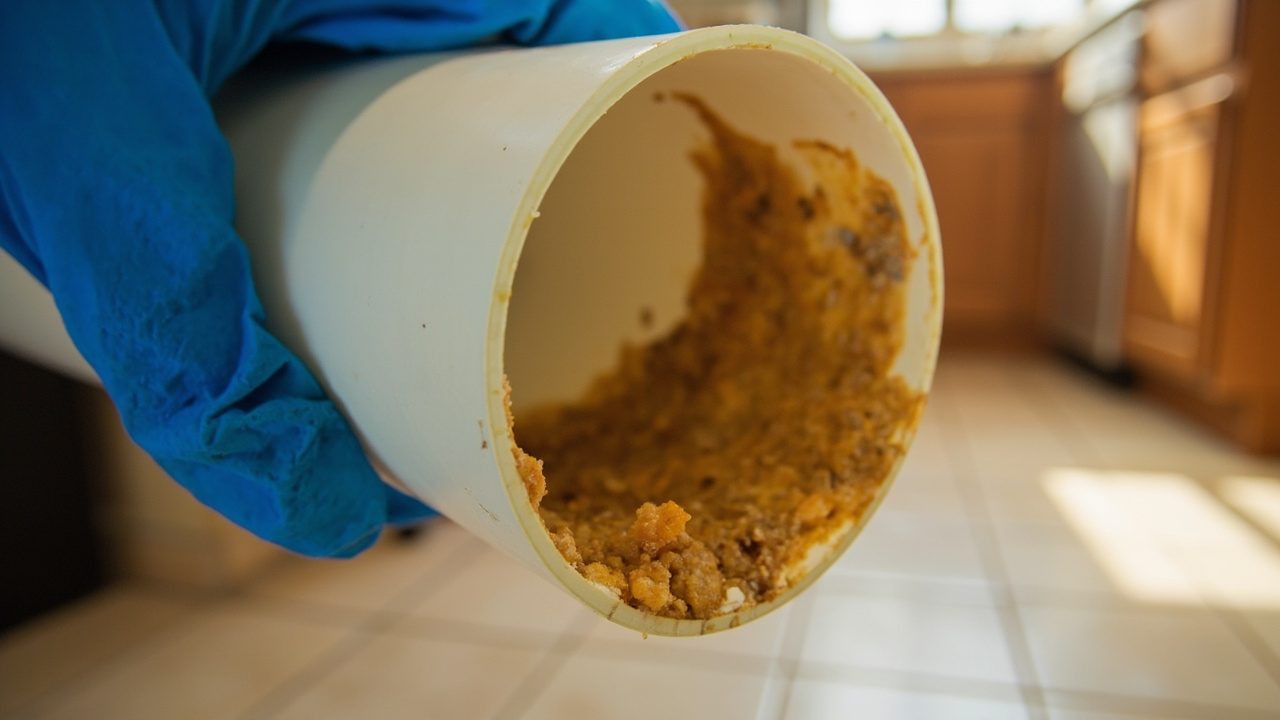
A grease trap holds fat, oil and grease only while it has room. Once the floating layer and the settled solids fill it, each wash cycle pushes grease past the outlet and into the line downstream. A missed pumping sends the grease into the pipe behind the trap, where it collects at the sanitary tee, at joints and at any low spot in the run. Kitchen volume sets the pace. A fryer line running through hours of service loads a trap faster than a short-menu café, and one fixed interval applied to both will be wrong for one of them. Grease trap maintenance and grease interceptor cleaning follow the same logic at different sizes.
The pipe behind your trap is often older than your kitchen. Postwar slab buildings in El Paso County commonly carry cast iron drains under the floor and clay or cast iron laterals, and cast iron corrodes from the inside, which roughens the pipe wall and gives grease a surface to hold. Clay laterals are jointed in short sections, and roots enter at those joints. Caliche hardpan under the mesas and foothills then makes reaching a failed joint slower, so a fault found late costs more to open.
Call the same day when a slow drain that follows the dishwasher is joined by standing water at the lowest floor drain. Roots at one clay joint catch paper and grease at that spot every day, and then the main backs up into the lowest fixture in the building with no warning. In a kitchen that fixture is the floor drain, and the backup arrives during service with the line already full, when jetting and a camera run become a same day job and the dining room closes for it.
Our page on drain cleaning & rooter service covers that side of the work in more depth.
How the line behind the trap gets read before a scope is written
The visit follows the direction the water travels. The trap is pumped and the kitchen branch cleared first, because a full line shows nothing but water on a camera. Next the drain camera with a locator goes in from a cleanout behind the trap, and the run is read from the trap toward the main. Isolation comes before any surface is opened. The branch is closed off, the fault is placed on that branch or on the main, and only then does a floor get cut. If every fixture in the building is slow and the lowest one backs up, the camera goes to the main instead of the branch. The locator turns the picture into a spot and a depth on the floor above, which is what a written scope needs.
Four pictures decide the scope. Continuous fall to the main, clean joints and the pipe wall visible the whole run is a good reading, and the job ends at the pump-out and a jetting pass. Grease coating the wall means the pumping interval is too long, and the fix is a shorter schedule. Standing water part way along a level run is a belly in the line, and that run needs re-laying because jetting cannot lift it. Roots at a joint put the repair at that joint rather than on the whole line. How many times the line has been cleared matters as much as today's picture, since a line cleared repeatedly with the same coat is a maintenance routine that one excavation would end. Each reading goes into a footage record attached to the written scope, so an owner, a property manager or a lender's reviewer sees the same picture the technician saw.
The age of the run you tie into decides the material. Under a postwar slab the existing drain is cast iron, so a section of new plastic joins it with a no hub band transition and never with glue, and noise carried through a shared wall is the tradeoff to weigh. In a building from the 1970s through the 1990s the drains are already ABS or PVC, and matching them keeps the run one material. Caliche hardpan then decides method. Where digging is slow and the host pipe is still round, cured in place lining or pipe bursting avoids a long trench, and where a belly needs its slope corrected only open cut restores it. A finished floor over the run turns depth into a cost driver in either method.
See storm drain cleaning & repair for how the related work is scoped and priced.
Permit and inspection questions? Planning & Inspections is the office we coordinate with on every permitted El Paso job.
Narrow this to two options before calling, then ask which one suits the house.
| Option | The numbers a buyer weighs | Best suited to |
|---|---|---|
| Cast iron drain against PVC or ABS | Cast iron is heavy and quiet and corrodes from the inside over decades | Drain replacement under a finished house |
| Type L copper against PEX | Copper is rigid, tolerates heat directly | Repipes where the existing layout sets the method |
| Tank water heater against tankless | A tank is judged on capacity in gallons and its first hour rating | Households with long back to back hot water use |
| Salt softener against a salt free conditioner | An ion exchange softener removes hardness minerals and needs salt and a drain | Hard water houses weighing salt against upkeep |
How a grease trap call runs
First call and camera run
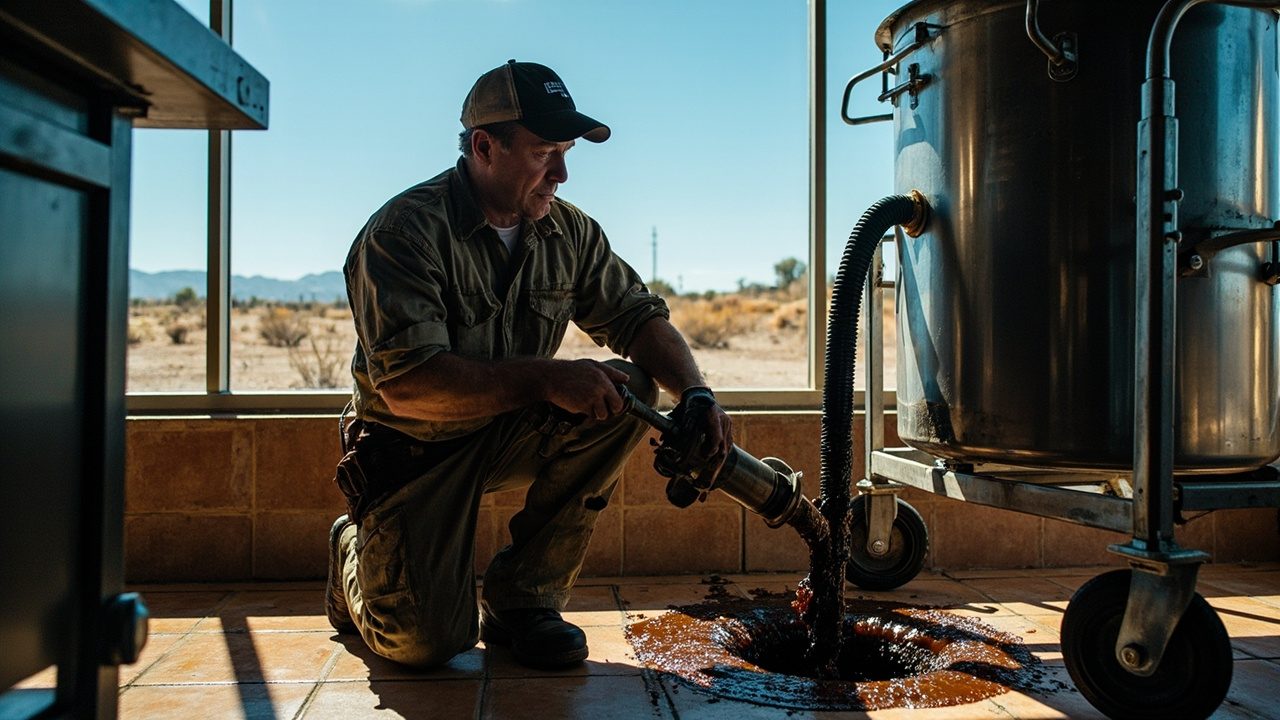
The call starts with four questions. Which drains slow, has the lowest floor drain backed up, when was the trap last pumped, and how many hours does the kitchen run. On site, the trap receives pumping and the kitchen branch receives clearing first, because a saturated line yields only water on the monitor. The camera and locator then enter from a cleanout behind the trap, and you observe the display as the run is read for fall, joints and standing water. The locator marks the spot and depth of anything found on the floor above it, so the scope is written from a location rather than from a guess.
Approved scope, then work
Once you approve the written scope, the kitchen branch is isolated first so water use elsewhere in the building carries on. Pumping and hydro jetting come next when the camera showed a grease coat, and a repair at the joint follows when it showed roots. Where new plastic meets old cast iron, a no hub band transition goes in and the cleanout stays accessible. If a second fault turns up behind a wall or under the slab, work stops and we show you the footage before going further.
Proof before we leave
Before the crew leaves, the camera travels back through the same run to verify continuous slope toward the main, clean joints throughout, and pipe wall visibility with no pooled water at any point. Where a transition was installed, water flows through it under observation. You review the findings on the monitor and retain written documentation of the pump-out and camera results in a format accessible to landlords, property managers and lenders.
Why local ground and old pipe change the plan for a kitchen line
Installing a new trap or interceptor and repairing a main line are the jobs that usually need a permit and staged inspection, while pumping and cleaning existing equipment is maintenance. Which work needs a permit, and at what stage it is inspected, is decided by the local authority, and the final call is theirs. Checking that before the ground opens keeps a repair from stalling with a trench left open.
A crew that does not work this county tends to repeat the same few mistakes, and each one has a physical consequence. Pumping the trap and leaving without a camera run leaves a coat of grease on the pipe wall, and the next backup arrives at the lowest floor drain. Quoting a trench as a short dig in loose soil meets caliche hardpan, which lengthens the excavation and changes the scope halfway through the job. Joining new plastic to old cast iron with glue instead of a no hub band transition leaves a joint that weeps under the slab. Assuming a postwar slab building has plastic drains overlooks cast iron corroded from the inside, so the length of pipe worth replacing runs past the section that failed.
Kitchens back up on the busiest day, and the call comes in during service. Response covers the county and the greater metro, and after hours response belongs to the emergency tier, so a weekend backup reaches a technician who arrives with the camera, the locator and jetting equipment. Older parts of the metro are full of cast iron under slabs and clay laterals, and a crew meeting them for the first time reads the camera picture as if the pipe were plastic. Cast iron shows scale and roughness where plastic shows a smooth wall, and reading that difference decides whether a joint gets repaired or a run gets replaced. The pipe material also determines how much force the jetting equipment can apply without breaching the wall, and that threshold shifts between cast and plastic by a factor that matters to the final outcome.
More detail on diy vs. professional drain cleaning is on its own page.
We install and service equipment from major manufacturers like Rheem to manufacturer specifications.
Working with Bedrock Plumbing El Paso on your grease trap
Scheduling and arrival
On the call you are asked which drains slow down, when the trap was last pumped and how many hours the kitchen runs. Those answers sort a same day visit from a scheduled one. A technician confirms the arrival window by phone before arriving. If the visit ahead of yours runs long, you hear about the new window as soon as it moves. Routine pumping is planned around your service hours where the schedule allows, so the trap is open when the kitchen is quiet.
Floor and kitchen protection
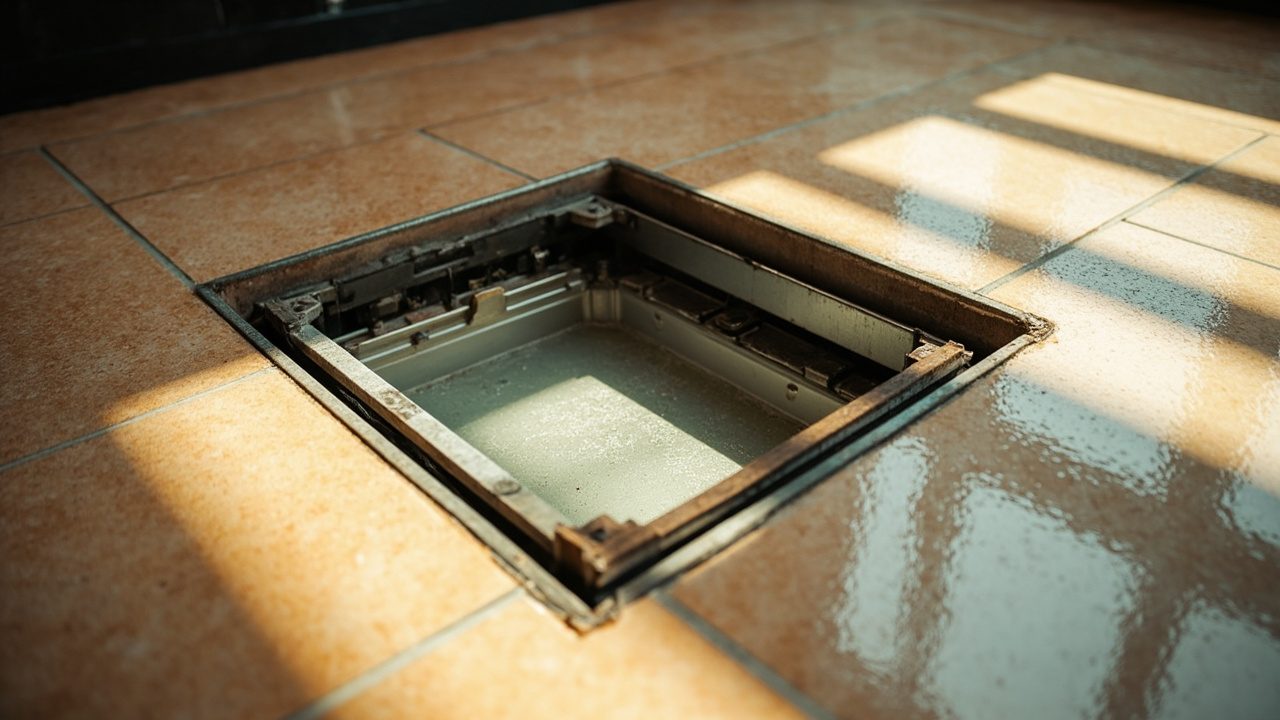
Floor runners and drop cloths go down before the trap lid comes up, and floor drains near the work are covered. Everything pumped from the trap goes into the pump tank and leaves with the crew. A cleanout is opened only after the line is confirmed clear of head pressure, and your staff stay out of the wet area. Tools stage along one wall, the floor is mopped and degreased where wastewater touched it, and the trap lid is reseated last.
What moves the scope
Access moves the scope first. A trap under a finished floor, or a run beneath a slab or a ceiling, adds opening and surface restoration, and reaching the pipe is usually the larger half of the work. Depth and length of excavation follow, then one joint against the whole run, then matching old pipe to new, then fixture grade. After hours, weekend and holiday dispatch raises the job because it turns a planned pump-out into an emergency call. You approve a written scope built from the camera footage before work starts.
How technicians earn sign off
A new technician rides with a lead before working alone, and the lead signs off on three demonstrated tasks. Those tasks are reading a camera run from a cleanout, setting a no hub band transition between cast iron and plastic, and isolating a branch until the backup stops. On roots at a clay joint or a belly in the line, a second technician looks at the footage before a scope is written. The scope carries the findings so you read what they read.
You Have Questions,
We Have Answers
Trap size, access and how much grease has built up set the cost of a cleaning. A larger trap holds more volume to pump and haul, and a trap under a finished floor adds time to open and restore the surface. A trap neglected for months holds a hardened cap of fat that needs breaking up before the pump can pull it. Volume, access and buildup are what a phone conversation sorts out, and the price follows from them.
Clean the trap when fat and solids fill one quarter of its liquid depth. Many kitchens follow that quarter-depth rule because a fuller trap lets grease slip past the outlet baffle on every wash cycle. A high-volume fryer operation may reach that mark within weeks, while a low-volume sandwich counter may take a few months. Measuring the grease cap and settled sludge with a dip stick at a regular interval shows your real pace.
Skimming the surface grease and scraping plates are jobs your staff can do safely. Full cleaning is harder, because the settled sludge on the bottom and the baffles need a pump and a hauling tank. Hauling and disposing of grease waste takes a proper container, since pouring it down another drain only moves the blockage downstream. Lids on many traps are bolted or heavy, and the gases under them are unpleasant and can be hazardous in a closed kitchen.
A routine pump-out on an accessible trap takes about one to two hours. The time includes removing the lid, pumping the floating layer and the sludge, scraping the walls and baffles, and checking the inlet and outlet tees. A trap with a hardened grease cap, a hard-to-reach lid or a full line behind it runs longer. Adding a camera run down the line behind the trap extends the visit further, and heavy buildup extends it again.
Pumping cost follows the gallons removed and the difficulty of reaching the trap. A large interceptor pulls more volume and takes a longer hose run than a small under-sink unit. Waste that has sat past its schedule is thick and slow to pump, so it takes more labor. Emergency timing raises the job too, since an unplanned call outside normal hours takes a technician out of the planned schedule for that day.
Three things set the price of grease trap cleaning: unit size, grease condition and lid access. A trap cleaned on a steady schedule holds soft, thin waste that pumps quickly, while a neglected one holds a hard crust that takes longer to break up and remove. A kitchen that adds a camera run behind the trap adds time. Describing the trap and the kitchen's hours makes the scope clear.
Pump the trap before the combined grease and solids reach a quarter of its depth. Kitchens with deep fryers and heavy dishwashing commonly pump monthly or faster, and low-grease kitchens can stretch to a quarter of a year. A trap smelling sour at the lid or draining slowly between pump-outs shows the interval is too long. Keep a log of each pump-out and the measured depth so the next date is set by data.
Some septic companies pump grease traps, because they own the vacuum trucks and hauling tanks the job needs. Their crews may not carry a drain camera, a locator or jetting equipment, so the line behind the trap goes unchecked. Grease waste also needs a disposal site that accepts it, which differs from where septic waste is taken. Ask any hauler whether the truck is set up for grease and whether they can inspect the pipe after pumping.
Cost to get a trap pumped moves with trap volume, lid access and how long grease has hardened. A small indoor unit under a prep sink needs less hauling than a large in-ground interceptor. Heavy sludge slows the pump and adds scraping time. A visit that also clears the branch line or includes a camera run adds labor. Timing matters too, since a planned pump-out at a quiet hour costs less to schedule than an emergency.
Yes, plumbers handle grease traps, including pumping, line clearing and camera inspection of the pipe behind the unit. A plumber also repairs what a hauler cannot, such as a cracked baffle, a failed inlet tee or a bellied drain behind the trap. Sizing and installing a new trap or interceptor is plumbing work as well, since it involves venting, flow rate and the connection to the sanitary line.
Why caliche and older cast iron change grease trap work in El Paso
Caliche hardpan sits under the sandy and gravelly soils of the mesas and foothills, and it slows any trench cut to reach a failed joint. The river valley has finer alluvial soils that hold more water, so the same repair there is wetter work with different trench walls. Postwar slab buildings from the 1940s through the 1960s commonly have cast iron drains under the floor, which puts the no hub band transition described earlier beneath the slab with caliche above it. Buildings from the 1970s through the 1990s have ABS or PVC drains and PVC laterals, and newer subdivisions use PVC throughout. Water at the tap runs moderately hard to hard, commonly around ten grains per gallon, and above about seven grains scale builds steadily in the water heater feeding the kitchen, so a hardness test kit at the tap belongs in the same visit.
Inside city limits the city issues plumbing permits and inspects work at stages during construction, while work outside city limits falls under the county or the neighboring town. Knowing which side of that line a kitchen sits on settles who is contacted before the ground opens. On a trap installation or a lateral repair, the open run is where inspection happens, so the sequence keeps the fall, the transition and the cleanout access exposed until the inspection is done, and backfill follows it. A camera record of the finished run travels with the job. Familiarity with the staged sequence shortens the work because the trench is not reopened, and it shortens the closure time for a kitchen that is down while the line is out of service.
Plumbing Services in The El Paso Area
Explore our service area and locate Bedrock Plumbing El Paso with ease. We're proudly local and serve the surrounding neighborhoods with fast response and honest pricing. Use the map to check our coverage area, or call us and we'll confirm in seconds.
Address:
Bedrock Plumbing El Paso, 221 North Kansas St, Suite 700, El Paso, TX, 79901
Additional Services We Offer
- Apartment Complex Plumbing
- Commercial Backflow Prevention & Testing
- Commercial Kitchen Plumbing
- Commercial Plumbing Contractors
- Commercial Repiping Services
- Commercial Sewer Line Repair
- Commercial Toilet & Urinal Repair
- Commercial Water Heater Systems
- Hydro Jetting Services
- Industrial Pipe Repair
- Medical & Dental Gas Plumbing
- Preventative Commercial Maintenance
Scraping plates and logging the last pump-out are kitchen jobs, and you do not need us for them. Staff work stops at a drain already backed up past a cleanout, anything under a slab or behind a finished wall, and anything soldered or on a gas line, because a cleanout under head pressure empties onto whoever opens it. If the first visit finds work outside our scope, we say so then and tell you who handles it.
Before you call, know which drains slow down and whether that happens when the dishwasher runs. Note when the trap was last pumped and roughly how many hours a day the kitchen cooks. Find the cleanout behind the trap if you can, and check whether the lowest floor drain has backed up. Any age you have for the drain piping or the building helps.
Last reviewed September 2026 by Dave Parker, Owner.