





What a warm floor and a jumping water bill mean in El Paso homes
Your water bill jumped, nothing in the house looks wet, and one spot on the floor feels warm under bare feet. You have likely checked the toilets for a running flapper and walked the yard for a soft patch, and found neither. That pattern points at a pressurized supply line under the slab. Pressurized water leaves a pipe all night whether anyone is home or not, while a drain leaks only when something upstream is running, so water that shows only at the wash cycle is a different problem with different urgency.
With a concrete slab pipe leak the water has no wall to stain. It soaks the ground under the floor, then travels along cracks and toward the slab edge until it darkens grout, lifts a floor edge or leaves a damp line at an exterior wall. That last sign is why a foundation water leak often gets reported before anyone thinks of plumbing. On a hot line the water heater also recovers more often, because it keeps heating water that is leaving through the leak. A leak that runs for weeks leaves a wider area of floor wet by the time it shows, which is why a late find means a larger opening.
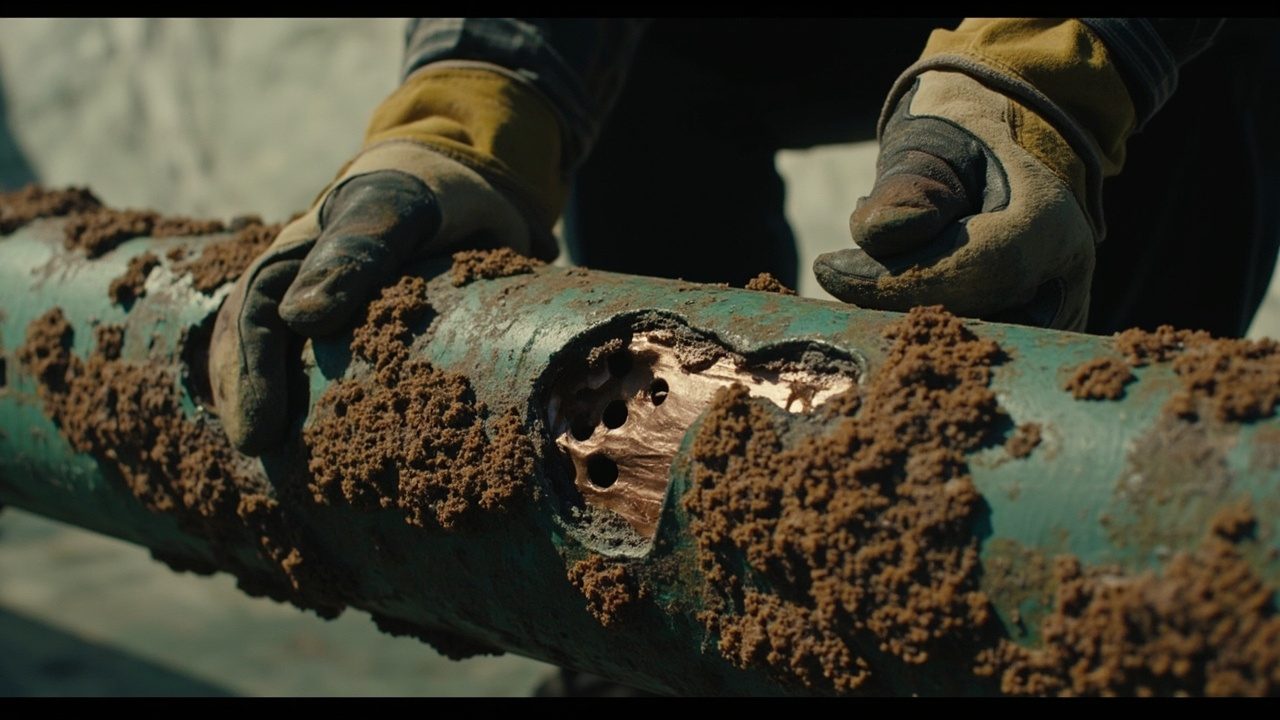
El Paso Water describes the supply as moderately hard to hard, and the utility names rusting galvanized pipe inside homes as the typical cause of discolored water. Both facts matter under a slab. Galvanized closes up from the inside as it corrodes, copper develops pinholes, and a segment that has pinholed once is the same age and the same metal along its whole length. A warm spot on the floor puts the hot line in play, since heated water passing through a leaking pipe warms the concrete above it. Slab homes from the postwar years onward are the ones that carry supply pipe under or through the floor, so the useful question is which run.
A cracked cast iron drain under an older slab produces slow drains and backups, and the two problems get mistaken for each other when water only shows while fixtures run. A supply leak keeps going with every tap closed, and that is the test that separates them. Closing the main shutoff stops the loss, and whether the dial stops turning is the first useful fact you can give us. Call today when the meter dial turns with every fixture closed and the floor stays warm or damp in one place. A hairline supply leak under a tiled floor keeps the flooring, bottom plates and slab edge damp because nothing dries under a sealed surface, and then the pipe repair turns into a wall and floor rebuild. Until someone arrives, the only things you touch are the meter and the main shutoff.
Our page on rapid response leak repair covers that side of the work in more depth.
We install and service equipment from major manufacturers like Rheem to manufacturer specifications.
Find the sign you have, then read across to see whether it can wait.
| Symptom or first sign | What is already happening | What it becomes if ignored | When to call |
|---|---|---|---|
| A hairline supply leak behind tile | The framing stays damp | The pipe repair turns into a wall rebuild | This week, while it is still one part |
| Roots at one clay joint | Paper and grease catch at that spot every day | The main backs up into the lowest fixture in the building with no warning | Now, the same day |
| An anode rod eaten away | The steel tank becomes the sacrificial metal | Rusty hot water arrives first and a split tank arrives after | This week, while it is still one part |

How we place the leak before we quote the repair
The sequence follows where the water is going. With every fixture closed, the water meter leak indicator is watched for fifteen minutes, and any movement at all means water is leaving the system somewhere you cannot see. Before the slab is suspected, the hose bibs and the evaporative cooler supply line are checked, since a split hose bib or a float valve stuck open moves the dial the same way. Next the main is closed and the dial is watched again. A dial still turning with the main closed puts the leak on the street side of the shutoff, which moves the job outside the house. A dial that stops puts it inside, and the branches come next. Stops and branches are closed one at a time, with the heater's cold inlet closed to separate the hot side from the cold, until the loss stops. Only then does anyone listen at the floor, scan a hot line with thermal imaging or use tracer gas, and mark the spot with a locator. A drain follows a different order, cleared first and put under the camera second from a cleanout, since a full line shows nothing but water.
Three readings change the scope. A screw on pressure gauge at a hose bib, read with everything in the house off, should sit in the 45 to 70 psi range. Above 80 psi, fixtures, supply hoses and heaters start failing early, and a pressure reducing valve normally belongs in the job alongside the leaking pipe. Leaving the gauge on overnight adds a second check, since a morning reading far above the night figure means the heater is expanding water into a closed system and a failed expansion tank goes on the scope. The third reading is a hardness test at the tap. Scale forms steadily above about seven grains per gallon, and water here commonly tests around ten or more, so flushing or treatment gets planned. Where a segment has pinholed a second time, the scope becomes the segment instead of the spot.
Type L copper against PEX is the decision when a run gets re-routed overhead instead of laid through the slab again, and the water and the sun here settle it. Copper that has pinholed once in moderately hard to hard water has shown how that water treats the metal, so a straight swap to more copper only makes sense with treatment planned. PEX on a manifold home run puts fewer joints inside walls and makes a later repair a smaller opening in drywall, but intense sun and heat degrade exposed plastic here, so it stays covered and protected where it passes through framing. Copper remains the better fit where the run is exposed to heat or where a soldered tie-in to existing copper is cleaner.
If this sounds close but not quite your situation, backflow prevention & testing may be the better starting point.
Narrow this to two options before calling, then ask which one suits the house.
| Option | The numbers a buyer weighs | Best suited to |
|---|---|---|
| Type L copper against PEX | Copper is rigid, tolerates heat directly | Repipes where the existing layout sets the method |
| Cast iron drain against PVC or ABS | Cast iron is heavy and quiet and corrodes from the inside over decades | Drain replacement under a finished house |
| Trenchless lining against open cut replacement | Lining cures a new pipe inside the old one with a small loss of inside diameter | Runs under a slab, a drive or mature trees |
How a slab leak call runs

Call and meter test
On the phone we ask what the meter dial does, when the bill changed, where the floor feels warm, how old the house is and where the main shutoff sits. On site, every fixture is closed and the water meter leak indicator is read for fifteen minutes. The main is then closed and the dial is read again, and static pressure is taken with a screw on gauge at a hose bib with the house off. Branches and angle stops are closed one at a time until the loss stops. You see the dial, the gauge and the closed valves, and nothing is opened until the leak is placed.
Scope approval and opening
After you approve the written scope, the branch feeding the leak is isolated and drained first. The opening is then made at one point over the located leak, with the slab cut wet to hold the dust down, or the run is capped and re-routed overhead in type L copper or PEX. The failed section is cut out and the new pipe is joined with a soldered joint on copper or a crimp ring or expansion fitting on PEX, with a dielectric union where new copper meets old galvanized. If a second leak or a cracked cast iron drain turns up beside the first, we stop and show you before going further.
Pressure test and handover
Before we leave, the same meter leak indicator you watched at the start goes back under observation with every fixture closed, and the dial has to stay still for the same fifteen minutes. The gauge at the hose bib has to read inside 45 to 70 psi with nothing running. We walk you through the repaired section, the pipe material and where the opening was made. You keep a written record of the cause, the location and the readings, which is what you hand to your carrier if you file a claim.
What an unfamiliar crew gets wrong under a desert slab
The local permit authority sets the rules for this work, and its answer is final. A job that replaces a run of supply pipe usually needs a permit, while a like-for-like fixture swap usually does not. Asking before a slab is opened costs a phone call, and asking afterward can cost a second cut through the same floor.
Crews that do not work these houses make the same few mistakes. Some open the floor where the water shows instead of where the pipe leaks, which leaves a hole in the wrong room and a leak still running. A service line dig gets quoted as if the soil were soft, when caliche hardpan and dense layers make trenching slower here than in softer ground. A drain line of cast iron beneath an older slab gets treated as a supply leak, or the reverse, and the wrong line gets chased. Copper replaced with copper in moderately hard to hard water brings the pinholes back. PEX run where intense sun and heat reach it degrades.
Slab homes sit across the whole metro, from postwar houses to newer subdivisions on the east and west sides, so the first phone questions cover the age of the house, the floor finish and where the water heater sits. Those answers decide which locating gear rides on the truck and whether the replacement pipe is copper or PEX. Slab leak plumbers who skip them arrive without the right material.
Where the heater sits in a garage or a closet, its cold inlet is the first isolation point for a hot line, and a house with a PEX manifold can be shut off branch by branch at the manifold. Both shrink the search before a locator comes out, which is the difference between one small opening and several exploratory ones. Garage heaters and their lines also sit in hot air through summer heat, which stresses them. Cast iron drain runs under a postwar slab change what the camera is for, because a run from the cleanout after the line is cleared separates a supply leak from a drain crack and keeps the wrong stretch of floor from being cut.
More detail on gas leak detection & repair is on its own page.
Permit and inspection questions? Planning & Inspections is the office we coordinate with on every permitted El Paso job.
Working with Bedrock Plumbing El Paso on a slab leak day to day
When someone arrives
You call, and three answers decide the visit. They are what the meter dial does with every fixture closed, when the bill changed and where the floor feels warm. A moving dial and a warm floor put you first in line for the soonest visit, and a slow bill creep is scheduled. The person who took your call confirms the arrival window with you, and if the job ahead of yours runs long, the time is moved and you hear about it before the original window ends.
Floor and furniture protection
Before anything comes apart, runners go down from the door to the work area and the furniture in the room is moved clear and covered. Any cut in the slab is made with water fed to the blade so the dust stays wet, and a wet vacuum runs beside it. Tools are staged on a tarp instead of the floor. Debris leaves with us, the removed section of pipe stays with you on request, and the last step is a wipe down of the path and the work area.
What moves the cost
Slab leak repair cost follows access first, meaning the tile, flooring and slab that must be opened and put back. Depth and length of any dig come next, with what sits on top. The largest fork is one point repaired against a whole segment replaced, and the condition of the rest of that run decides it. Matching old pipe to new, fixture grade and after hours dispatch follow. You control clearing access and adding adjacent work to one opening. The written scope covers what happens if the opening finds more, and you approve it before work starts.
How technicians are checked
A new technician rides with a lead and works the meter isolation sequence on live calls, closing the main and reading the dial again until the lead is satisfied that street side and house side are told apart correctly. The lead signs off before that technician works alone. Pressure readings at a hose bib are checked the same way. Code updates are reviewed with the crew, and on any job where the locate is unclear or the slab is to be opened, a second technician looks at the readings before a scope is written.
You Have Questions,
We Have Answers
Slab leak repair cost rises with the flooring and concrete opened and the length of run replaced. A single accessible point costs less than a full segment swap. Matching finishes like stone tile or hardwood adds labor because those materials are hard to match after removal. A leak found early usually means a smaller opening, since water has not spread under the slab. Pricing is settled in a written scope, and a technician sets it only after the leak is located.
Detection cost is driven by how quickly the leak is narrowed down and which locating methods the job needs. A leak isolated by closing branches takes less time than one needing tracer gas or thermal scanning. Long runs, several hot and cold lines, and finished floors that limit access all add time. Detection that ends in a repair at the same visit usually costs less than two separate trips, because the isolation work already done carries forward into the repair.
Texas homeowners policies often cover the resulting water damage but exclude the cost of repairing the failed pipe itself. Many policies also carry a separate limit or exclusion for damage from long-term seepage, which is how carriers frequently classify a slow slab leak. Sudden and accidental discharge is treated more favorably than leakage over weeks. Read the water damage section and the exclusions for foundation or slab wording, because those clauses decide what gets paid.
Plumbers detect hidden leaks by isolating the system and then confirming the spot with instruments. Closing every fixture and watching the meter shows whether water is leaving. Shutting branches one at a time narrows the loss to a single run. Acoustic listening picks up the hiss of pressurized water in the pipe, thermal imaging shows a hot line warming the concrete, and tracer gas escapes through the smallest crack. A pipe locator then marks the exact point on the surface.
Leak detection cost depends on house size, the number of supply runs and the time isolation takes. A home with a manifold shortens the search because each branch closes separately at one point. Older homes with mixed copper and galvanized lines take longer to sort out. Adding a drain camera inspection when a cracked cast iron line is suspected adds a second procedure. Written scope and estimate come before any floor is opened, so the figure is known first.
A slab leak is serious because pressurized water keeps escaping under the floor until the line is shut off. The water can wash out soil beneath the slab edge, lift flooring, feed mold in bottom plates and drive up the water bill month after month. Hot line leaks also make the heater run longer. The damage grows slowly, so the repair stays modest if found early. Closing the main stops the loss while you wait for a technician.
Getting a claim paid starts with documentation that shows the cause, location and timing of the loss. Photograph the damage, save water bills that show the jump, and keep the written leak report with meter and pressure readings. Contact the carrier before repairs start so an adjuster can inspect if needed, and keep any removed pipe section as evidence. Stop the loss at the main quickly, since policies expect you to limit further damage.
The total for finding and fixing a leak combines locating time, the opening, replacement pipe and surface restoration. Locating is the smaller share when the meter test and isolation narrow the search quickly. Restoration of tile, grout and slab often becomes the larger share because matching finishes takes separate labor. Rerouting overhead in PEX or copper instead of cutting deeper into the slab changes the balance. Every item appears in a written scope approved before work starts.
No single average holds up, because repair cost swings with access, depth and the extent of pipe replaced. A spot repair under bare concrete sits at one end, and a rerouted run under stone tile sits at the other. Pipe age matters, since a segment that has pinholed once tends to fail again nearby. Home age, floor finish and heater location tell a technician most of what shapes the scope before arrival.
Repiping makes sense when the same line has leaked repeatedly or the pipe is failing along its length. Copper that has pinholed in hard water and galvanized pipe that has closed up from corrosion usually point to replacing the run. A single leak in otherwise sound pipe is normally a spot repair. Rerouting overhead avoids reopening the slab, so the choice comes down to how many leaks appear and what the rest of the pipe shows.
Why caliche and postwar slabs change slab leak repair in El Paso
Northeast El Paso built out from the 1950s through the 1970s, and its postwar slab homes commonly carry copper or galvanized supply with cast iron drains under the slab. That pairing gives two separate failures under one floor, a supply line that pinholes or closes up and a drain that cracks or corrodes, so the first job is deciding which one is wet. Homes from the 1970s through the 1990s run copper under or through the slab with ABS or PVC drains, and newer subdivisions use PEX supply on a manifold with PVC drains, which moves the weak point to the fittings. Digging changes with the soil. Caliche hardpan on the mesas and foothills slows excavation, while the finer alluvial soils of the river valley hold more water, so water from a leak lingers around the slab longer.
Whether a repair needs a permit is the local authority's decision, and gas work and main line work are the kinds that usually do. That matters on a slab job because a heater in a garage sits close to the run being re-routed, and disturbing its gas fitting brings gas work into the scope. If an inspection stage applies, the repaired run stays open and under test until it passes, and the slab is closed only after that. Which office issues the permit depends on where the house sits, since work outside city limits falls to the county or the neighboring town. Responsibility for a loss between the street and the house is a separate question with a test behind it. The meter is watched with the main closed, and a dial still moving puts the loss on the utility's side of the shutoff, where the utility and the authority decide who owns it.
Plumbing Services in The El Paso Area
Explore our service area and locate Bedrock Plumbing El Paso with ease. We're proudly local and serve the surrounding neighborhoods with fast response and honest pricing. Use the map to check our coverage area, or call us and we'll confirm in seconds.
Address:
Bedrock Plumbing El Paso, 221 North Kansas St, Suite 700, El Paso, TX, 79901
Additional Services We Offer
- Backflow Prevention & Testing
- Drain Cleaning & Rooter Service
- Faucet & Sink Repair
- Garbage Disposal Services
- Gas Line Repair & Installation
- Plumbing Services
- Sewer Line Repair & Replacement
- Shower & Bathtub Plumbing
- Sump Pump Services
- Tankless Water Heater Services
- Toilet Repair & Installation
- Water Heater Repair & Installation
Closing the main shutoff, swapping a braided supply hose and draining a hose bib are homeowner jobs, and you need no plumber for them. DIY stops at anything soldered, anything on the gas line and anything behind a finished wall or under a slab, because that pipe cannot be seen or pressure tested. If the first visit shows a loss on the street side of the meter, we say so then and tell you who handles it.
Before you call, know when the bill changed and whether water runs when all taps are off. Note where the floor feels warm, what the floor is made of, and the water heater location. Find the main shutoff, and any age you have for the house or its pipe helps. Those answers usually tell us whether the visit is today.
Last reviewed September 2026 by Dave Parker, Owner.