




What weak shower pressure means in older El Paso homes
Your shower runs thin, or the kitchen tap dribbles the moment the dishwasher starts filling. Weak shower pressure and water pressure that drops when a second fixture opens both belong to the supply side of the plumbing, the pressurized water coming into the house, and the drains have no part in it. Supply pressure sits in the pipes all night whether anyone uses it or not, so the reading taken with the whole house quiet is the one that means something. Where the weakness shows tells you which segment to suspect. No water pressure in the kitchen while the bathrooms run normally puts the fault on that branch, at a scaled aerator or an angle stop that no longer opens fully. Weakness at every tap, hot and cold alike, puts it on the pipe between the meter and your first branch, or on the street supply.
In older El Paso houses that pipe is often galvanized steel, and galvanized closes up from the inside as rust and mineral build on the pipe wall. The pipe holds full static pressure while nothing runs and delivers a fraction of the flow the moment a tap opens. That narrowing takes years, so most owners notice it only when the second shower starts, while a sudden drop usually has a single cause such as a stop left partly closed after work, a failed cartridge or a leak. Postwar slab homes often carry galvanized or early copper, and later partial repipes leave new copper joined to old galvanized, where the opening can be smallest right at the union. The water adds its own layer. It arrives moderately hard to hard, commonly around ten grains per gallon or more, so scale packs aerators, shower cartridges and valve seats at the fixture end of the line.
Cold nights add their own version. After an arctic cold front splits a hose bib or an exposed outdoor line, you can lose water at one fixture while the rest of the house works, and a ceiling stain shows up hours later once the ice clears and the pipe is under pressure again. A water bill that jumps while pressure falls means water is leaving the system somewhere you cannot see, and the meter is where that gets settled.
You can unscrew an aerator and rinse the scale out yourself, and that clears many single taps. Look under the sink while you are there. If the angle stop is weeping at the nut, call today before you change the faucet, because the compression nut has corroded so it cannot be snugged, and a stop in that state can snap off in your hand during a faucet change and leave the room taking the full supply.
Our page on discolored or rusty water covers that side of the work in more depth.
Permit and inspection questions? Planning & Inspections is the office we coordinate with on every permitted El Paso job.
How we place the loss before anything gets opened
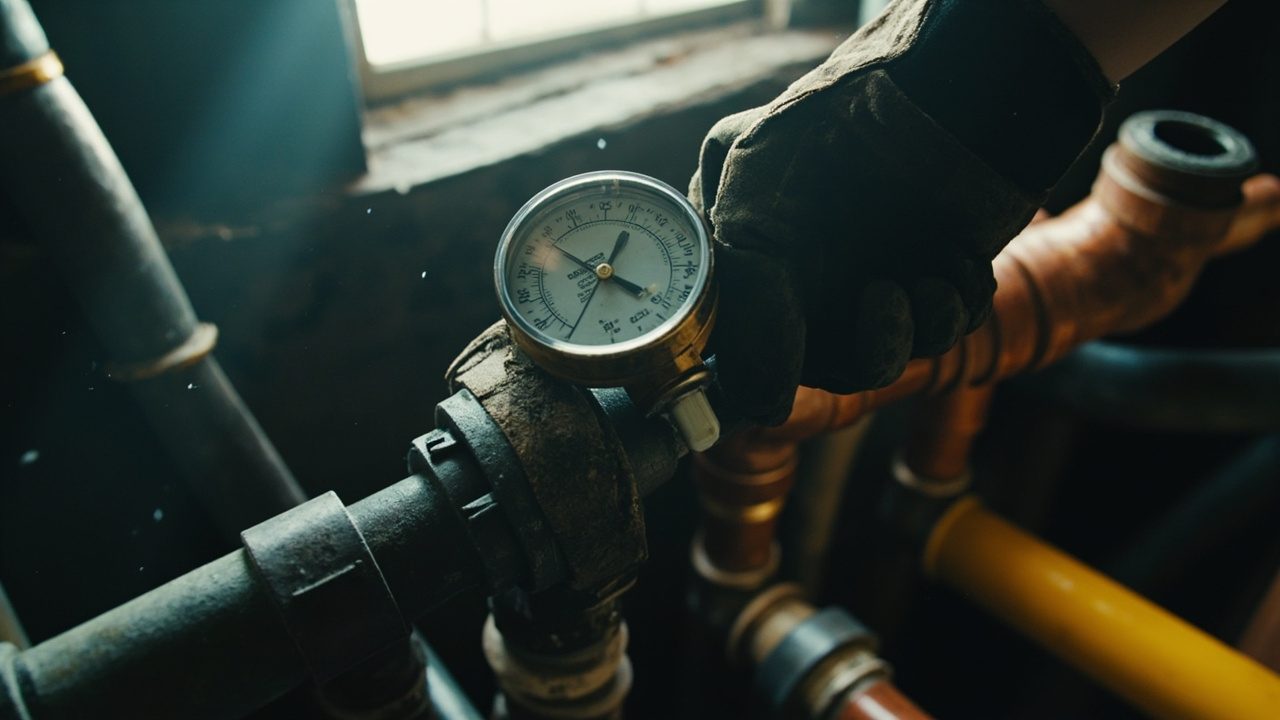
The visit runs on isolation, working outward from the meter until the loss stops. Every fixture goes off and the leak indicator on the meter is read, then the main is closed and the meter is read again, which places any loss on the street side or the house side. Next comes the one reading this page turns on. A screw on pressure gauge goes on a hose bib with the whole house off, because a running fixture hides the real static number. A result inside 45 to 70 psi alongside a weak tap puts the restriction in your piping, and a result well under that band puts it ahead of the house, at the supply or at a pressure reducing valve if one sits on the line. With the gauge still on, the weak tap is opened and the needle watched. Stops and branches are then closed one at a time until the loss stops, and only after that does a wall or a floor get opened.
Three outcomes set the scope. A static number in the band with a needle that falls hard under flow marks a narrowed run between the bib and the weak tap, and the job becomes replacing that segment of old pipe. A number in the band with a steady needle sends the work to the fixture itself, where scale in the aerator or a worn cartridge is the cause. A number well under the band sends the call toward the meter and the utility before any pipe is touched. A hardness test at the tap adds a second decision, because above about seven grains per gallon scale forms steadily and the plan has to include flushing, descaling or treatment. Since a reading sets the scope, you see the written scope with the reading on it and approve it before work starts.
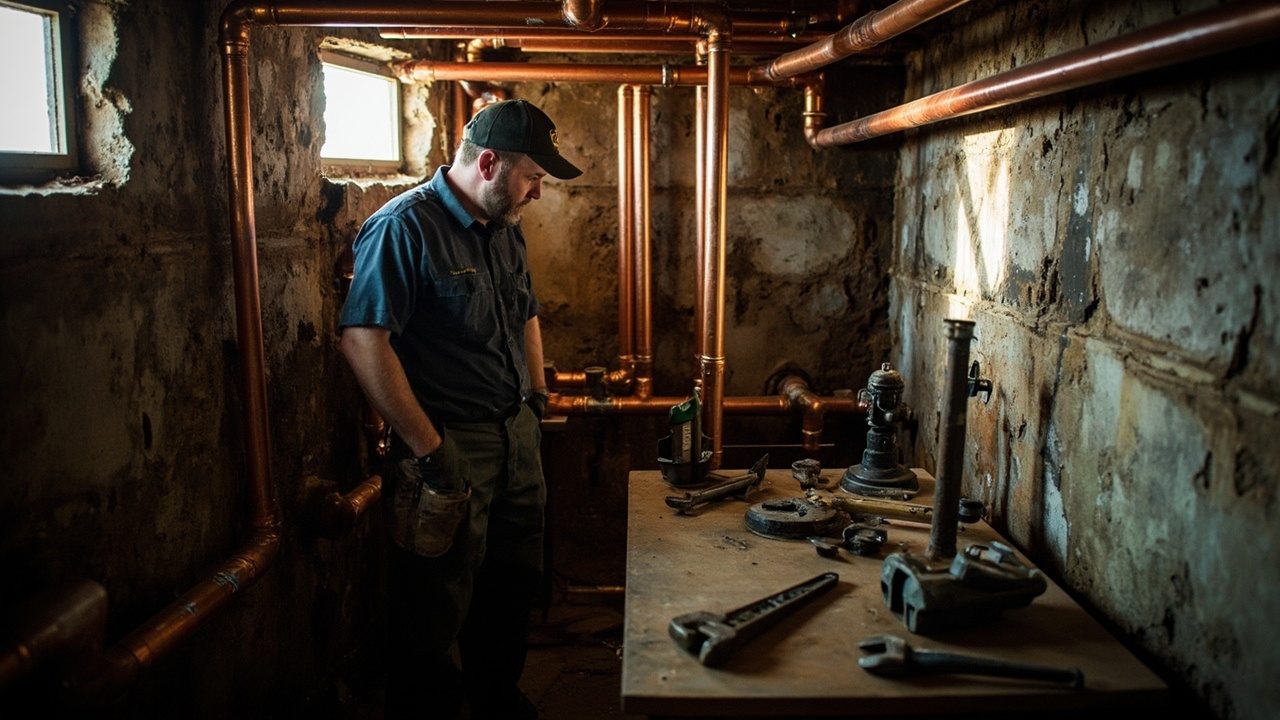
When a segment has to go, the choice is between type L copper and PEX. Soldered copper is rigid, tolerates heat directly and costs more in material and labor. PEX runs flexible from a manifold in a home run layout, which puts fewer joints inside your walls and opens less drywall on a later repair, but it has to be kept out of sunlight and protected where it passes through framing. PEX A takes expansion fittings and PEX B takes crimp rings, so the joining method comes with the material. In a bungalow that mixes galvanized and later copper, the deciding fact is the joint, and where old steel meets new copper a dielectric union goes between them. Hard water pushes toward treating the scale before another heater or cartridge is bought. How much of the run is galvanized decides whether you patch one branch or replace the whole run once.
If this sounds close but not quite your situation, high water bills may be the better starting point.
Ask which of these readings was taken before any part is replaced.
| Instrument | Good reading | Bad reading | What it changes |
|---|---|---|---|
| Screw on pressure gauge at a hose bib | Static pressure sitting in the 45 to 70 psi range with nothing running | Above 80 psi | Fixtures, supply hoses and water heaters start failing early |
| Thermometer at the farthest hot tap | Hot water arriving around 120 degrees | Hot enough at the tap to scald a child in seconds | The first slug of water is whatever was sitting in the pipe |
| Anode rod pull on a tank water heater | The rod still has sacrificial metal along the core wire | A bare core wire with the metal gone | The tank itself is now the part being eaten |
| Combustible gas detector and bubble solution on gas fittings | No alarm at the fittings and no bubble growing on the joint | Any bubble that keeps growing or any sustained alarm | The appliance valve gets closed before anything else happens |
| Drain camera with a locator | Continuous fall to the main, clean joints | Standing water part way along a level run means a belly | Roots at a joint mean the repair belongs at that joint rather than the whole line |
How a low pressure call runs
What we ask and read first
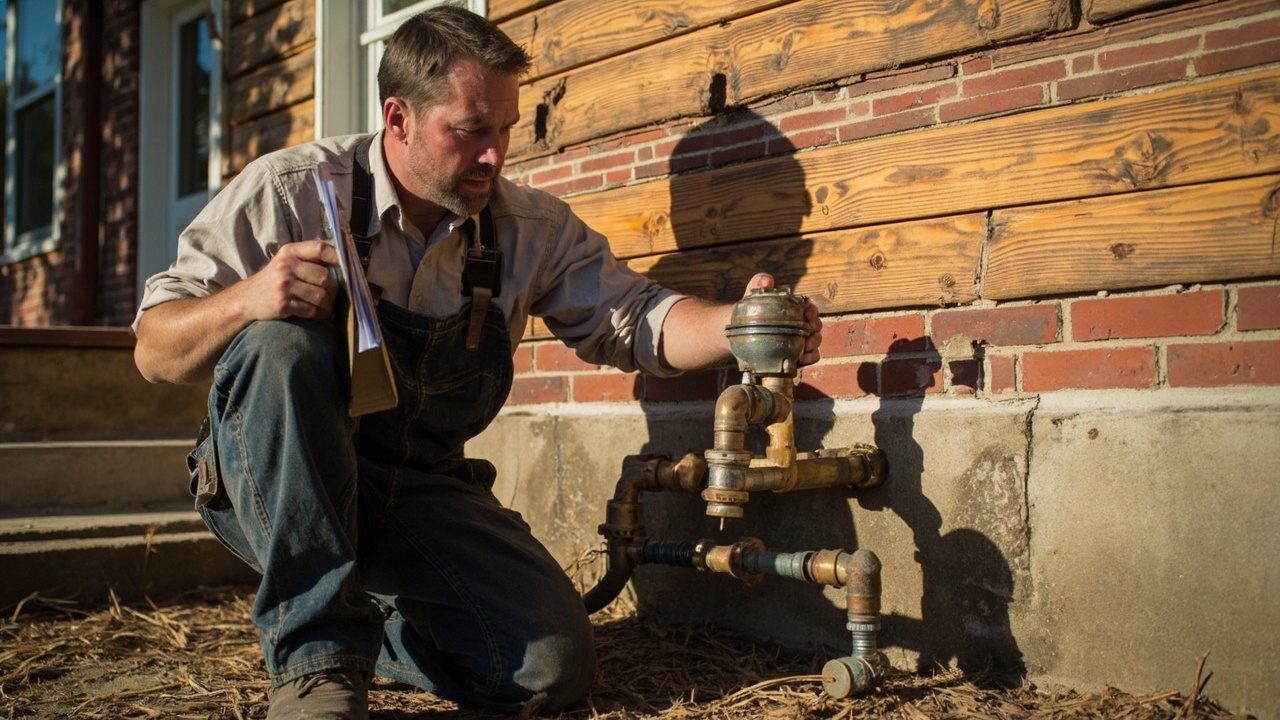
On the phone you are asked which taps are weak, whether hot and cold both suffer, and what changed just before it started. On site the technician asks you to keep every tap closed and reads the meter leak indicator for fifteen minutes, then closes the main and reads it again. The gauge attaches to a hose bib downstream of the suspected line. Stops and branches are isolated sequentially until the loss ceases, and a wall is opened only after that to confirm the leak location.
Approval, then isolation
Nothing gets cut until you have seen the written scope and said yes. Then the branch is isolated at its stop or at the main and the line is drained. A galvanized segment comes out at the nearest sound union, new type L copper or PEX goes in, and a dielectric union sits wherever steel meets copper. An angle stop that will not seal is replaced while the branch is already drained. If a pinhole or a second narrowed joint turns up behind the wall, work stops, you are shown the pipe, and the scope changes only with your approval.
Gauge back on the bib
Before the technician leaves, the gauge goes back on the same hose bib with every fixture off and has to read inside the 45 to 70 psi band. If the street supply itself sits under the band, the reading says so and that is the number you keep. The weak tap is then opened alongside the farthest one, and the needle has to hold. Aerators are pulled and checked for scale, and the hardness test result is shown to you. You are walked through each opened tap and each new joint, and you keep the written scope with the final reading noted on it.
Why mixed pipe eras change a pressure diagnosis in El Paso
Whether a repipe needs a permit is answered by the authority for your address, which differs inside and outside the city limits, and the final call is theirs. A like for like faucet or braided supply hose swap usually does not need one, while replacing a segment of supply pipe usually does. A crew that has worked here asks that question before a wall is opened, since piping closed up ahead of an inspection can mean the drywall comes back out.
The housing stock spans several eras, and each hides a different pipe. Houses from the late 1800s through the 1930s carry galvanized steel supply, cast iron drains and clay laterals. The 1940s through the 1960s brought galvanized or early copper supply on slabs and raised floors. Slab homes from the 1970s through the 1990s run copper under or through the floor, often with the water heater in a garage or closet, and homes built since 2000 typically have PEX manifolds and PVC drains. A crew that treats every house as one material makes predictable errors. It swaps a faucet for a complaint that lives in the pipe behind it, and the weak flow follows to the new fixture. It joins copper straight to galvanized without a dielectric union, and the joint corrodes into the next narrow spot. It reads pressure with a tap running and records a low number that was never the static one. Exposed hose bibs and outdoor lines also split during brief hard freezes, and a crew that checks only indoors misses the split that lowered the flow.
Pressure loss in a slab house can hide under the floor, where a pinhole in a copper line drops pressure and leaves a warm spot on the tile, and a crew that opens the wall first finds nothing. Response works the same way across the county, from postwar streets to newer east side and west side subdivisions with manifold plumbing. The questions on the phone sort the visit by whether water reaches every tap and whether anything is wet, so the technician arrives with the gauge, the fittings for that era and a plan for the joint. Dense caliche layers slow any excavation to a buried line, which is why the meter test comes before anyone talks about digging.
More detail on cold water sandwich effect is on its own page.
Your local utility, El Paso Water, publishes service and water-quality information every El Paso homeowner should know.
Working with Bedrock Plumbing El Paso on a pressure call
How the call becomes a visit
You call, and the person who answers asks which fixtures are weak, whether the hot side is weaker than the cold, and when the drop started. Pressure that is weak at every tap becomes a scheduled visit, and a meter reading that jumps with a wet spot nearby becomes a same day one. The arrival window is given on that call, and if the job ahead of yours runs long, the window moves and you are told before the technician is due.
Protecting floors and walls
Drop cloths go down along the path from the door to the work area before a tool comes out. The fixture stop or the main is closed and the line is drained into a bucket so water stays off the floor. Any drywall opening is cut only as wide as the pipe access needs, and a vacuum catches the dust at the cut. Cut pipe, old galvanized sections and packaging leave with us, and the last step is a wipe of the work area and a run of every tap.
What moves the scope
Reaching the pipe moves the job furthest, so a finished wall, a tiled surface, a slab or a ceiling below adds the most, along with putting that surface back. Repairing one joint costs less than replacing a segment, and the condition of the rest of that run decides which one you need. Matching existing pipe size and material, especially where new copper or PEX must join old galvanized, adds fittings and labor. A higher grade of fixture or valve raises the total, and so does after hours dispatch. The written scope comes from the gauge and meter findings, and you approve it before work starts.
How technicians are checked
A new technician rides with a lead and does not work alone until the lead has watched them read static pressure at a hose bib with the house off and join copper to galvanized with a dielectric union. The lead signs off each task. Updated Texas codes are studied as they change. When a house turns up galvanized, copper and PEX in one run, a second technician looks at it before a scope is written.
You Have Questions,
We Have Answers
A sudden drop usually traces to a valve that changed position or a supply that was interrupted. Check whether a shutoff was nudged after recent work, since a main valve turned only halfway passes water but starves every tap. Municipal flushing or a main repair can also send a burst of sediment that clogs aerator screens within hours. If the drop hit one fixture only, pull its aerator and look for grit. A drop at every tap points upstream of your branches.
Debris loosened by a pressure surge often blocks one fixture screen or cartridge overnight. A washing machine inlet screen, a toilet fill valve and a faucet aerator each hold a fine mesh that packs with sand or flaked scale after the line is disturbed. Compare hot and cold. If only hot is weak, suspect the water heater's shutoff or a sediment-choked outlet. If both are weak at one tap, the fixture is the likely cause.
Clearing restrictions restores pressure, and a pressure reducing valve can raise it when the static reading is low. Start by opening the main shutoff and any meter-side valve fully, then clean aerators and showerheads. If the house has a reducing valve, its adjusting screw turns clockwise to raise outlet pressure, and you watch a gauge while doing it. Most residential plumbing is comfortable well below 80 psi, and readings above that stress fittings and heater relief valves.
Low pressure today after normal pressure yesterday points to a change within the last day. A partly closed valve or a clogged fixture are common causes. Ask whether a neighbor has the same problem, because a shared drop suggests a supply issue outside the house. Note the time of day too. Pressure that sags in the evening while many households draw water and recovers late at night indicates a marginal supply rather than failing pipe.
Restoring pressure means removing the restriction, and the gauge reading tells you where it is. Scale is dissolved with a vinegar soak on aerators and showerheads for a few hours. A pressure reducing valve with a fatigued spring drifts low and can be rebuilt or replaced. Corroded supply pipe cannot be cleaned to its original bore, so that segment is replaced. Confirm the result by reading static pressure again with every fixture off.
Yes, 30 psi sits below the usual 45 to 70 psi range and produces weak showers. At that level a tub filler slows noticeably and a dishwasher may fill late or trip its inlet timing. Some appliances, including certain tankless heaters, need a minimum flow and pressure to fire at all. Confirm the number was taken with every fixture off, since a running tap can pull a reading down by a wide margin.
Start at the meter and confirm the main shutoff is fully open, then check whether neighbors have water. Open the lowest tap in the house, because air trapped after an outage can block flow until it bleeds out. If the meter dial spins with nothing running, close the main to limit damage from a possible break. A frozen exposed line after a hard cold night is another cause, and thawing it slowly avoids splitting the pipe.
Yes, most low pressure problems are fixable once the cause is located. Clogged aerators and stuck valves are quick repairs. A failed reducing valve is replaced as a unit. Narrowed galvanized supply requires replacing the affected segment with copper or PEX. The one exception is weak street supply, which the utility controls. A gauge reading at the hose bib separates those cases before any repair cost is committed.
Texas pressure varies by utility, elevation and demand, so no statewide condition explains it. Homes at higher elevations on a system often see lower static pressure because water must be lifted to reach them. Summer irrigation demand can pull pressure down across a neighborhood in the evening. Hard water scale is common across much of the state and steadily narrows fixtures and pipe, so a pressure complaint often has a local cause on the property.
Close every fixture, attach a gauge to a hose bib and record the static reading. A reading between 45 and 70 psi means the restriction is inside your piping or a fixture. A reading below that points to the supply or a failing reducing valve. Write down which taps are weak and whether hot is weaker than cold, because that pattern narrows the search before anyone touches a wrench.
Why galvanized pipe and hard water change pressure work in El Paso
Manhattan Heights shows the problem inside one neighborhood. Its bungalows from the 1910s through the 1930s often mix original galvanized and cast iron with later partial repipes, so a technician should expect several pipe materials inside one house. The static reading the first visit is built on can land inside the normal band while the pipe behind a weak shower is still narrowed with rust. Each junction between old steel and newer copper then becomes a place to check, and a dielectric union or a full segment replacement is chosen on what the junction looks like once opened. The water adds a second cause. It tests moderately hard to hard at the tap, and mineral deposits accumulate in heaters, valves and aerators, so the plan includes flushing, descaling or treatment alongside any pipe work. Homes built in the 1970s through the 1990s hide copper under or through the floor, which moves the work toward listening and isolating branches before anyone breaks concrete.
The meter separates your side from the utility side. With every fixture closed and the main shut, a dial that keeps moving puts the loss on the street side, and El Paso Water and the local authority decide where responsibility sits from there. The utility also notes that rusting galvanized pipe inside a home is the typical cause of discolored water, so brown water for the first minute and weak flow from the same tap point at the same old pipe. For questions about what is in your drinking water, read the utility report and send a sample of your own tap to a laboratory. Where an inspection applies to a segment repipe, it happens in stages, so the new piping stays open and visible until the inspector has looked at it. Knowing that before the wall is opened shapes the order of the work, and drywall repair waits until after that inspection.
Plumbing Services in The El Paso Area
Explore our service area and locate Bedrock Plumbing El Paso with ease. We're proudly local and serve the surrounding neighborhoods with fast response and honest pricing. Use the map to check our coverage area, or call us and we'll confirm in seconds.
Address:
Bedrock Plumbing El Paso, 221 North Kansas St, Suite 700, El Paso, TX, 79901
Additional Services We Offer
Cleaning an aerator, swapping a braided supply hose and finding the main shutoff are homeowner jobs, and you do not need us for them. DIY stops at anything soldered and anything behind a finished wall or under a slab. If the meter test shows the loss sits on the utility's side, that work is outside what we do from inside your house, and we tell you so on the first visit, before any invoice exists.
Before you call, know which taps are weak, whether hot, cold or both are affected, and when it started. Note what changed just before, such as a new faucet, a heater swap or other plumbing work. Find your main shutoff and the hose bib a gauge would go on, and check whether the meter dial turns with every fixture closed. Any age you have for the pipes helps.
Last reviewed September 2026 by Dave Parker, Owner.