





What a split irrigation backflow assembly means after a freeze
You find the irrigation backflow assembly on the lawn dripping at the body, or ringed with wet soil, and the sprinklers have been off for weeks. Closing the valve at the timer changes nothing, which puts the leak upstream of the zones. Or the meter dial keeps turning with every fixture closed, or the bill climbed and nothing indoors is wet. Each of those puts the loss on the supply side. Supply water sits under pressure, so it leaves a cracked casting all night whether anyone is home or not, while a drain only escapes when something upstream runs.
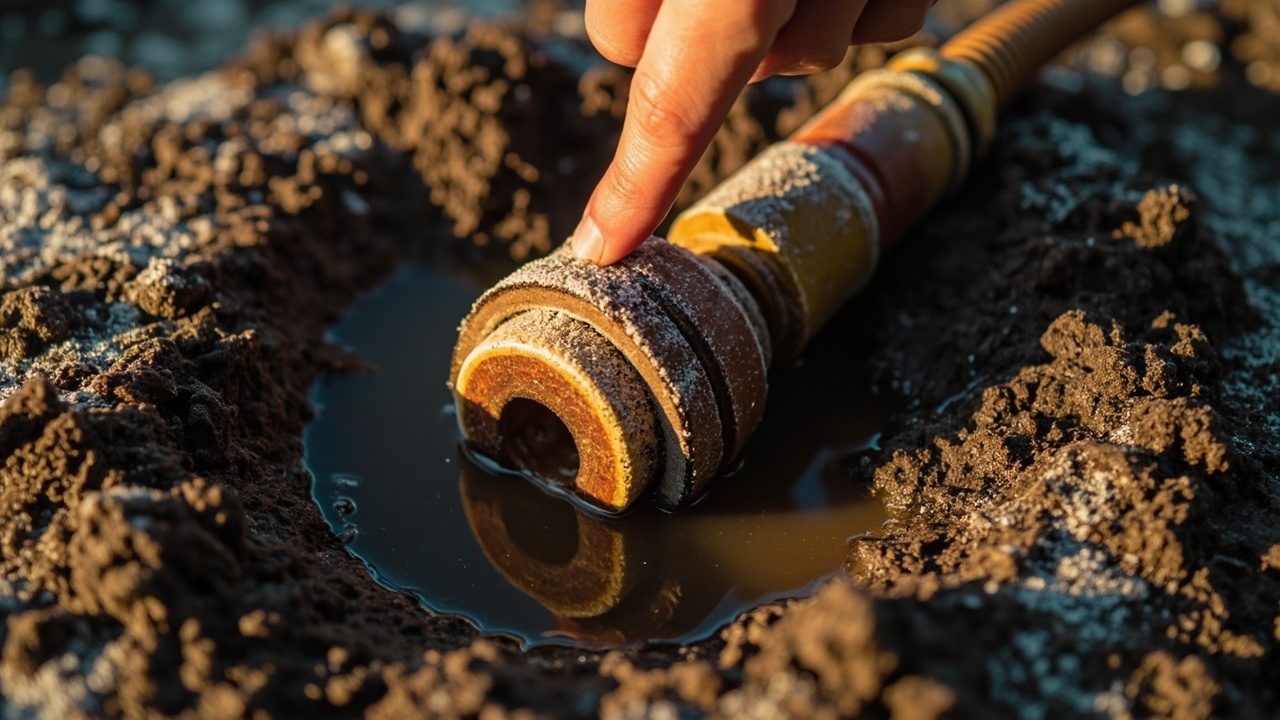
Winter in the county seldom freezes the ground deeply. Most freezing nights hover just below freezing and the afternoon recovers, so buried pipe stays intact. An assembly is different. It stands above the soil on the irrigation line, its body full of water, with nothing around it. When an arctic front drops the temperature well into the teens, that water turns to ice, expands, and splits the body, a check housing or the vacuum breaker cap. The split often holds until the thaw, because ice plugs the crack until it melts and the line is under pressure again. An assembly that passed its test weeks earlier can therefore be spraying the morning after a front, since a test result describes the day it was taken. The freeze season runs from mid November to early March, and exposed hose bibs and outdoor lines split on the same nights.
A crack from mid winter can stay quiet for weeks. Irrigation timers come back on in spring, and a split assembly then waters the bed beside it or the edge of the driveway while the zones downstream run weak. You see a soft patch, a zone that never reaches full spray, or a meter dial turning when no zone is running. Intense sun also degrades exposed plastic lines near the assembly, so a line that survived the front can still be brittle. Hose bib vacuum breakers, the small backflow devices threaded onto outdoor spigots, fail the same way, and a bib that drips after a freeze has split the same way.
A backflow assembly exists to stop water moving backward into the supply, and its check valve can also hold your house closed, so water your heater expands has nowhere to go. Call today when this sequence has started: incoming pressure above the normal band, then the relief valve on the heater starts weeping, then the tank seams work harder every cycle and the heater fails years before it should. A dripping relief valve beside a freeze-damaged assembly means the pressure needs a reading, and each day of waiting adds another cycle to the tank.
Our page on drain cleaning & rooter service covers that side of the work in more depth.
Find the sign you have, then read across to see whether it can wait.
| Symptom or first sign | What is already happening | What it becomes if ignored | When to call |
|---|---|---|---|
| Incoming pressure above the normal band | The relief valve on the heater starts weeping | The tank seams work harder every cycle and the heater fails years before it should | This week, while it is still one part |
| A weeping angle stop under a sink | The compression nut corrodes so it cannot be snugged | The stop snaps off in someone's hand during a faucet change | Now, the same day |
| Roots at one clay joint | Paper and grease catch at that spot every day | The main backs up into the lowest fixture in the building with no warning | Now, the same day |
| A hairline supply leak behind tile | The framing stays damp | The pipe repair turns into a wall rebuild | This week, while it is still one part |
| A toilet that runs after flushing | The flapper lets the tank refill all night and the fill valve cycles constantly | The valve wears and sticks open with the overflow carrying it away unnoticed | This week, while it is still one part |
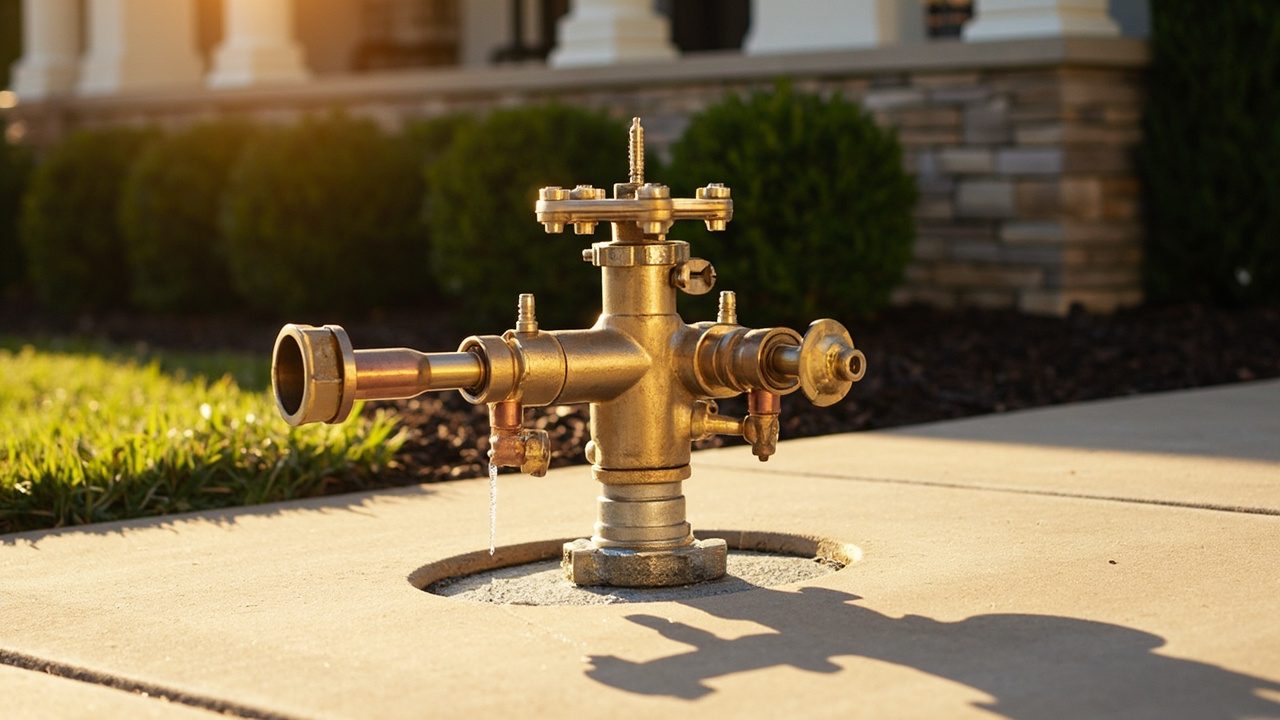
How we read the pressure before we quote the assembly
The first act is shrinking the problem. Everything in the house goes off, including the washer, the dishwasher and every irrigation zone, and a screw on pressure gauge threads onto a hose bib. Static pressure with nothing running is the number that matters, because a running fixture hides it. Then stops and branches close one at a time until the loss stops, which places the fault on the irrigation branch, the house side or the service line. Above the slab the leak narrows by isolating branches and by listening. Below it, the choice is between breaking the slab at one point and re routing that line overhead. Nothing gets opened until the water is isolated to one segment.
A static reading of 45 to 70 psi is the normal band, and inside it the job is the assembly. Above 80 psi is where fixtures, supply hoses and water heaters start failing early, and a pressure reducing valve is normally the fix, so the scope grows to include it along with a look at the thermal expansion tank. Without that, a new assembly meets the same pressure that wore out the old one. The overnight hold decides the other fork. The gauge stays on, and a morning reading close to the night figure means expanding water has somewhere to go. A morning reading far above it means the heater is pushing water into a closed system where the expansion tank has failed or was never fitted. That single measurement is why a quote for backflow preventer installation sometimes carries a second line, and why the second line reaches you in writing before work begins.
Type L copper against PEX is the material question, and exposure decides it here. The short run between the wall and the assembly stands in sun and takes the arctic fronts, and intense sun degrades exposed plastic. That segment goes in type L copper, which is rigid and tolerates heat directly. Inside the house, PEX gives a home run layout with fewer joints in the walls, and it stays out of sunlight and protected where it passes through framing. Where the two meet, a transition fitting made for both materials does the joining and glue does not. A second pinhole in the same copper segment means we replace the segment and leave the spot alone.
See commercial backflow prevention & testing for how the related work is scoped and priced.
Permit and inspection questions? Planning & Inspections is the office we coordinate with on every permitted El Paso job.
Narrow this to two options before calling, then ask which one suits the house.
| Option | The numbers a buyer weighs | Best suited to |
|---|---|---|
| Type L copper against PEX | Copper is rigid, tolerates heat directly | Repipes where the existing layout sets the method |
| Salt softener against a salt free conditioner | An ion exchange softener removes hardness minerals and needs salt and a drain | Hard water houses weighing salt against upkeep |
| Trenchless lining against open cut replacement | Lining cures a new pipe inside the old one with a small loss of inside diameter | Runs under a slab, a drive or mature trees |
| Cast iron drain against PVC or ABS | Cast iron is heavy and quiet and corrodes from the inside over decades | Drain replacement under a finished house |
| Tank water heater against tankless | A tank is judged on capacity in gallons and its first hour rating | Households with long back to back hot water use |
| Sump pump selection | Sized by horsepower against the vertical lift plus pipe run it has to push through | Basements with a real lift to the discharge |
How a backflow call runs

Call, then the gauge
The call comes first. We ask what the assembly or hose bib is doing, when it began, whether a cold night came before it, and where the main shutoff and the irrigation branch stop are. On site, everything in the house goes off and we take a static reading at a hose bib. We then isolate stops and branches sequentially until the loss halts, identifying the fault location. Only then does anyone open a surface or pull the assembly apart.
Approval, then isolation
Once you approve the written scope, isolation comes first. The irrigation branch stop closes, the assembly drains, and the house keeps its water unless the main has to go off for one segment. Removal and backflow device repair or replacement follow, with the new assembly set on a type L copper stub and a proper transition fitting where it meets PEX. If corrosion, a second pinhole or a scaled valve turns up behind the first finding, we stop and show you before going further, and the scope changes only when you agree to it in writing.
Test before we leave
Before we leave, the same gauge goes back on the hose bib with everything off and has to read inside 45 to 70 psi, the band we measured against on the first visit. The assembly's check valves are tested, and the result goes on a test report. We walk you through the report and the assembly's shutoff, and show you how to drain the hose bib ahead of the next freeze. You keep the written scope and the test report, which is the paperwork behind annual backflow certification wherever the authority asks for it.
Why an unfamiliar crew gets desert freeze work wrong
Installing a new assembly is the kind of backflow preventer installation that usually goes through a plumbing permit, and a like for like swap of a hose bib vacuum breaker usually does not. The final call belongs to the authority for your address. The city adopts the International Plumbing Code with local amendments, and work outside city limits falls under the county or the neighboring town, so the first question on any job is which side of that line the property sits.
Freeze habits are the first thing outside crews get wrong. A crew from a colder region designs for a deep frost line, but here the ground does not freeze deeply, so the danger sits in the exposed stub, the vacuum breaker and the assembly body above the soil. A crew from a milder region leaves those bare. Caliche hardpan is the second mistake. A quote written for soft soil runs long when a relocated line meets hardpan, and the trench takes a different tool and a different day. Scale is the third. A crew that swaps a failed check for a new one without reading the hardness meets the same scale on the next test, because moderately hard to hard water is what the assembly sees every day. Test timing is the fourth. A crew that tests the new assembly and leaves has recorded one afternoon, and the first arctic front decides how the assembly does over the rest of winter.
Calls arrive in waves. A front that crosses the county splits hose bibs, outdoor lines and assemblies within the same few hours, and those calls fall between mid November and early March. Spring brings a second wave when irrigation systems and evaporative coolers start up, and a test done before that start up describes a system nobody has run under load. We sort every call by one physical fact, whether water is escaping under pressure or only while something runs, because that decides between tonight and a scheduled morning.
More detail on understanding backflow testing is on its own page.
What a backflow call looks like from your side
When someone arrives
You call, and the questions are short. What is dripping or spraying, is the water near a ceiling or a circuit, and can you reach the main shutoff or the irrigation branch stop. Those answers sort tonight from tomorrow morning, because pressurised water escapes all night, while an assembly with its branch stop closed can wait for a scheduled visit. The person who answers gives you an arrival window before the call ends. If the job ahead of yours runs long, the window moves and you hear about it before it closes.
Protecting your lawn and floors
Before anything comes apart, we close the irrigation branch stop and confirm the water is off at the assembly. Drop cloths go down on any floor the crew crosses, and tools stay on a tarp beside the work instead of on the lawn bed. The old assembly body, cut fittings and solder scraps go into our bags and leave with us. The last step is running the irrigation zone once and looking for any wet spot around the new work.
What moves the scope
Access moves the scope first. An assembly in the open is reached easily, while one in a valve box, behind a finished wall or under a slab takes more, and putting the surface back adds again. Trench depth and length come next, and caliche hardpan lengthens both. Repair at one joint stays smaller than replacing the run, and matching old pipe to new adds work. Permit and inspection requirements weigh on new installation more than on a faucet. You approve the written scope, including what happens if the opening finds more, before work starts.
How technicians are checked
A new technician rides with a lead before working alone, and the lead signs off on reading static pressure at a hose bib with everything off and on isolating the irrigation branch stop. The current code cycle is studied as a group. On anything unusual, such as an assembly with no working stop or a reading above 80 psi, a second technician looks at it before a scope is written. That second look happens before you see a number.
You Have Questions,
We Have Answers
An annual test confirms the check valves still seal, because springs weaken and rubber seats harden between visits. A check disc can pass one year and leak the next once debris lodges on its seat. The test measures pressure drop across each check, and a small drift shows up before any water reverses. Catching that drift on a schedule means the fix is a rebuild kit rather than a full assembly replacement.
A single assembly test usually takes 30 to 45 minutes once the tester has access to the test cocks. Time grows when the assembly sits in a flooded valve box or has seized shutoffs. The tester closes the downstream valve, hooks up a differential gauge, and records each check and the relief valve in sequence. A failed reading adds time because repair parts are fitted and the whole sequence is run again.
The property owner pays for testing, because the assembly sits on the owner's side of the meter. Landlords usually carry the cost for rental property unless the lease assigns it to the tenant. Repairs found during the test, such as a worn seat or a cracked bonnet, are billed separately from the test itself. Commercial accounts with several assemblies often have them tested in one visit to keep the trips down.
Backflow prevention testing is a pressure check confirming each check valve in an assembly still stops reverse flow. The tester attaches a differential gauge to the test cocks and measures how many psi each check holds. A double check must hold a set minimum differential, while a reduced pressure assembly must also open its relief port at the right pressure drop. Results are written on a test report.
A test is needed when an assembly is newly installed, repaired, moved, or due for its periodic check. Water utilities and local authorities often require documented results for irrigation systems, fire lines and commercial plumbing. A sudden drop in pressure, discolored water after a main break, or an assembly that spits water from its relief port are also reasons to test outside the normal schedule, since each can signal a fouled check.
Homeowners can inspect an assembly by eye, but the official test needs a calibrated gauge kit and an accepted tester. Looking for drips at the relief port, cracked bonnets and leaning risers is a fair homeowner check. Turning test cock valves in the wrong order can dump water or damage a seat. Gauge kits also drift out of calibration, so a borrowed one gives readings that reports cannot rely on.
A self-run test will not count on paper where the authority requires a recognized tester's report. The steps involve closing shutoffs, bleeding air from hoses, and reading a differential gauge to a fraction of a psi, and a gauge that has not been calibrated recently can pass a failing check. What you can do is confirm the shutoffs move freely and clear leaves and mulch from around the assembly before the tester arrives.
Most residential tests finish in under an hour, with the gauge readings themselves taking about 15 minutes. The rest goes to setup, opening the enclosure, and flushing the test cocks so debris does not foul the gauge. Pressure that fluctuates during the reading, often from a neighbor's irrigation zone running, forces a repeat. Assemblies in tight valve boxes take longer because hoses have to be routed around the pipe.
Most assemblies need testing once every 12 months, with an extra test after any repair, relocation or replacement. Some water authorities set the schedule for high-hazard connections, such as boilers, fire systems or commercial irrigation with chemical injection, and those may be tested more often. Keep each report, because the authority may ask for the record of past results, and a missed cycle can trigger a notice on the account.
A routine test should run between 30 minutes and an hour when the assembly is accessible and passes. A test that runs past 90 minutes points to a problem such as a stuck relief valve, a shutoff that will not close fully, or a check fouled with scale. The tester should stop at that point, tell you which component failed the reading, and explain the repair before continuing.
Why short arctic freezes change backflow testing in El Paso
Three local conditions change this job before a wrench turns. The first is the freeze pattern. Freezing nights arrive every winter, most stay just below freezing and end in a mild afternoon, and occasional severe cold snaps push readings into single digits, which is when exposed hose bibs, backflow assemblies and outdoor lines split. Where the assembly stands decides its cover and its routing. The second is the sun. Desert summers push many afternoons past one hundred degrees, and heat degrades exposed plastic, so the exposed stub is copper and PEX stays protected. The third is the water. The blend of river surface water and aquifer groundwater tests moderately hard to hard, commonly around ten grains per gallon or more. Above about seven, scale forms steadily in valves, so a check disc that will not seat on a test may need a rebuild or descaling, and treatment may belong in the conversation. Caliche hardpan slows any trench for a relocated line.
Work like this is inspected at stages while it is open, and that shapes the sequence of a job. When a new installation carries an inspection stage, the trench and the connections stay accessible until that stage passes, and a like for like repair is usually not held for one. The authority makes the final call on what needs a permit, so we ask for the address early and plan around the answer. Summer monsoon storms add a second detail. Runoff from the high ground moves through arroyos and channels and collects in low streets and dips, so the written scope notes where the assembly stands relative to ponding, and the test is planned around it. Spring adds a third. Irrigation systems start up and evaporative coolers put float valves back into service, so pressure and scale are read again before the first zone runs for the season. Knowing this order keeps the first visit from turning into a second one.
Plumbing Services in The El Paso Area
Explore our service area and locate Bedrock Plumbing El Paso with ease. We're proudly local and serve the surrounding neighborhoods with fast response and honest pricing. Use the map to check our coverage area, or call us and we'll confirm in seconds.
Address:
Bedrock Plumbing El Paso, 221 North Kansas St, Suite 700, El Paso, TX, 79901
Additional Services We Offer
- Drain Cleaning & Rooter Service
- Faucet & Sink Repair
- Garbage Disposal Services
- Gas Line Repair & Installation
- Plumbing Services
- Sewer Line Repair & Replacement
- Shower & Bathtub Plumbing
- Slab Leak Detection & Repair
- Sump Pump Services
- Tankless Water Heater Services
- Toilet Repair & Installation
- Water Heater Repair & Installation
Draining a hose bib before a freeze, closing the main shutoff and swapping a braided supply hose are homeowner jobs, and you do not need us for them. The line stops at anything soldered, anything on the gas line and anything concealed in the structure. Sprinkler heads, timers and zone valves are irrigation work. If the first visit puts the fault downstream of the assembly, we say so then and tell you who handles it.
Before you call, know what the assembly or hose bib is doing and which morning it started, especially whether a cold night came first. Locate both the main water shutoff and the irrigation branch valve, note whether the relief valve on your water heater is dripping, and say whether anyone is home. Any age you have for the assembly or the heater helps.
Last reviewed September 2026 by Dave Parker, Owner.