





Why a dripping heater valve leads to gas work in desert homes
A bead of water hangs from the discharge pipe on your water heater, or the pan underneath stays damp, and the heater is now the thing on your mind. That drip comes from the temperature and pressure relief valve, which opens when the tank sees more pressure than it should. You may have replaced the valve once already, or turned the thermostat down, and the drip came back. Most people respond by pricing a new heater, and in a house with a gas tank heater the price often turns on a condensing tankless unit. A tankless swap usually means a larger gas line, new venting and a different condensate path, so the gas work can outweigh the heater itself.
A water heater is a closed system, and heating water makes it expand. When incoming pressure runs above the normal band, or the thermal expansion tank has failed, that expansion has nowhere to go, and the relief valve cracks open a little on every heating cycle. Local water adds a second load. It tests moderately hard to hard, commonly around ten grains per gallon or more, and above about seven grains per gallon scale forms steadily inside tanks, tankless heat exchangers and valves. Scale is why a second heater inside a few years is a water problem, and it is why a tankless unit needs a plan for flushing or descaling before it goes in.
The gas line is the other half of the same decision. A gas line for stove use where an electric range used to stand needs a new run from the nearest branch, and a dryer or a tankless heater needs one too. Each run is natural gas plumbing that gets sized against everything already on that branch, permitted where the authority requires it, and leak tested before the appliance valve is opened. Gas pipe repair and gas leak repair begin at a fitting, and the fitting gets found and proved on the first visit. If you smell gas or rotten eggs, do not touch a switch or a phone charger. Get everyone outside, leave the door open behind you, and call the gas utility from outside. In this area the gas utility is Texas Gas Service.
Incoming pressure above the normal band makes the relief valve on the heater start weeping, then the tank seams work harder every cycle, and the heater fails years before it should. A weeping valve on a heater you plan to replace with a tankless unit is the moment to call, before the unit is ordered, because the gas line has to be sized for it first.
More detail on sewer line repair & replacement is on its own page.
Your local utility, El Paso Water, publishes service and water-quality information every El Paso homeowner should know.
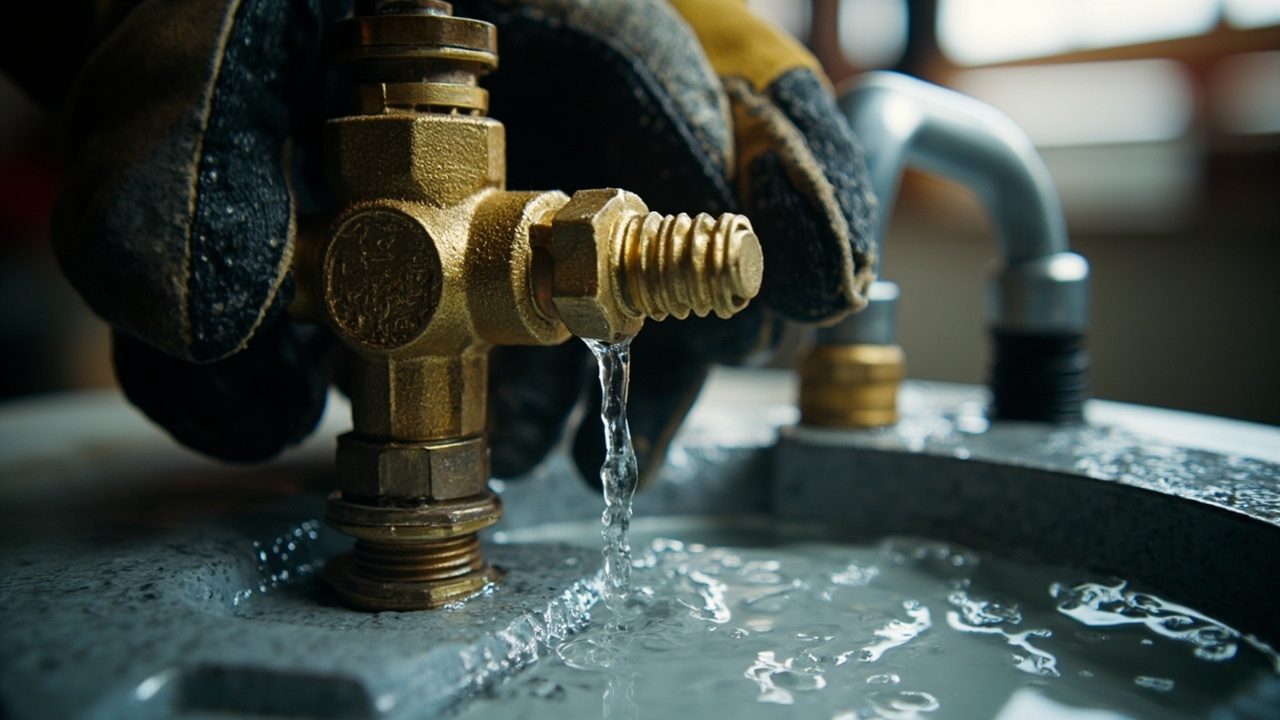
Find the sign you have, then read across to see whether it can wait.
| Symptom or first sign | What is already happening | What it becomes if ignored | When to call |
|---|---|---|---|
| Incoming pressure above the normal band | The relief valve on the heater starts weeping | The tank seams work harder every cycle and the heater fails years before it should | This week, while it is still one part |
| A hairline supply leak behind tile | The framing stays damp | The pipe repair turns into a wall rebuild | This week, while it is still one part |
| Roots at one clay joint | Paper and grease catch at that spot every day | The main backs up into the lowest fixture in the building with no warning | Now, the same day |
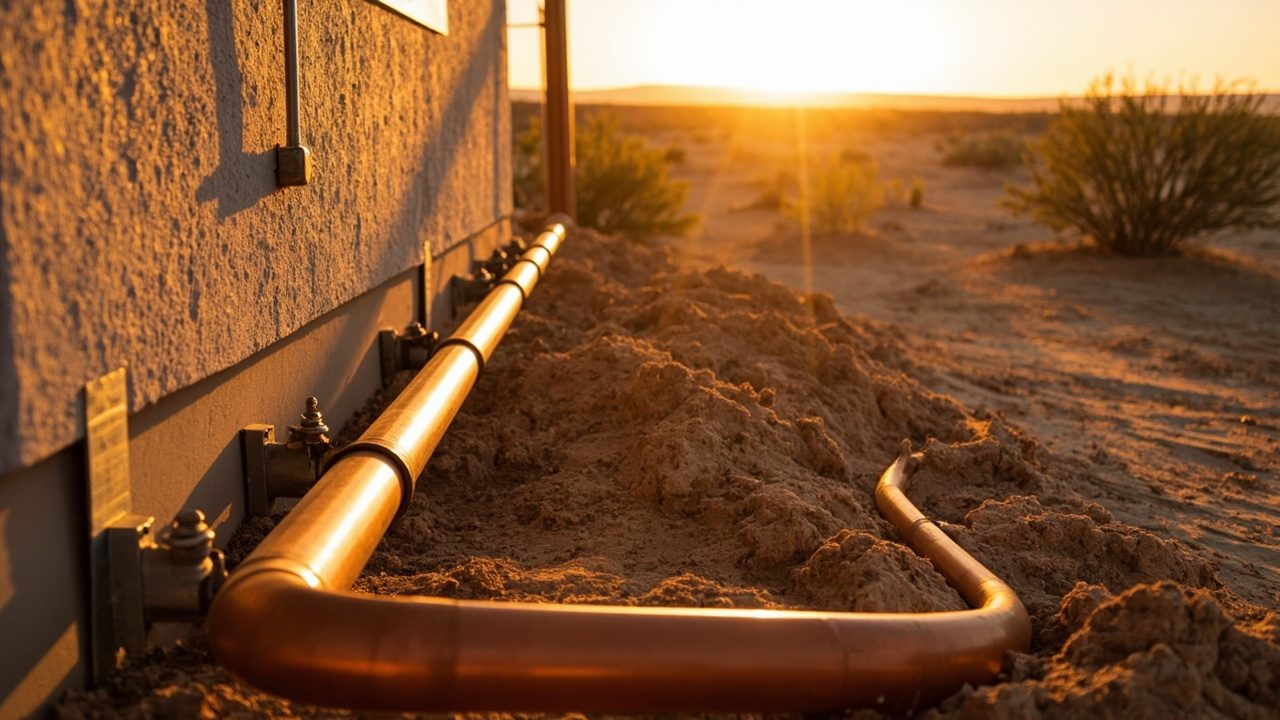
How we find the leak or size the run before we quote
On a gas job the first move is isolation. The technician closes the appliance valve on any suspect appliance, then works down the run in halves until one segment holds the fault, and nothing gets opened until that segment has a name. The combustible gas detector goes along the run first because it finds where to look, and bubble solution goes on the joint it points to because a growing bubble proves the leak. It takes both. A new run follows the same discipline. The line is built and sized against everything else on that branch, then every fitting gets the detector and checked with bubble solution during the initial startup.
The reading decides the scope. No alarm at the fittings and no bubble growing on the joint means the run passes, and no repair gets written. Any bubble that keeps growing or any sustained alarm means the appliance valve closes before anything else happens. From there the fork is one joint or the segment. Bubbles at one fitting scope as a repair at that fitting. Bubbles at several fittings on the same run scope as the segment, because the rest of that run is the same age as the part that failed. Access then decides how the fix is reached. A run behind a finished wall or under a slab is either opened at one point or re-routed overhead, and the number of failed fittings tells you which is worth doing. On a heater job the water side gets read during the same visit, and incoming pressure above the normal band moves a pressure reducing valve and an expansion tank into the scope alongside the gas work.
Tank against tankless is a choice with numbers on both sides, and one local condition decides it here, which is the water. Local water tests moderately hard to hard, with mineral content at seven grains per gallon or higher causing scale buildup over time, so a tankless heat exchanger requires regular descaling and a tank requires flushing and anode rod inspection. That pushes the decision toward treating the water first, with a salt softener or a salt free conditioner chosen by the tested hardness and by whether a drain is available. A tank swap keeps the existing gas connection. A tankless swap requires upgrades to the supply line, vent termination and drain configuration. If the household will service a tankless unit, the gas line gets sized once for that load, and if it will not, a tank on this water is the simpler fit.
Our page on commercial sewer line repair covers that side of the work in more depth.
We install and service equipment from major manufacturers like Rheem to manufacturer specifications.
Narrow this to two options before calling, then ask which one suits the house.
| Option | The numbers a buyer weighs | Best suited to |
|---|---|---|
| Tank water heater against tankless | A tank is judged on capacity in gallons and its first hour rating | Households with long back to back hot water use |
| Type L copper against PEX | Copper is rigid, tolerates heat directly | Repipes where the existing layout sets the method |
| Cast iron drain against PVC or ABS | Cast iron is heavy and quiet and corrodes from the inside over decades | Drain replacement under a finished house |
How a gas line call runs
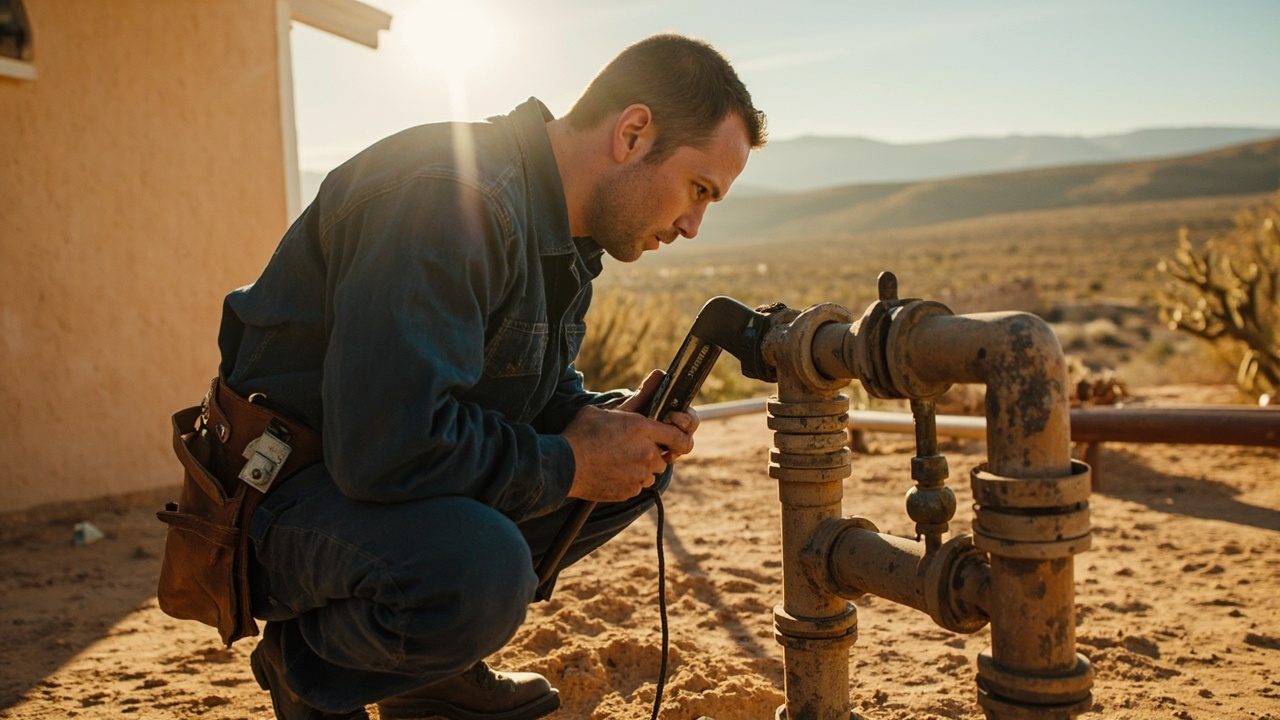
The call and the walkthrough
On the phone we gather details about the odor or visible signs, which appliance is involved, when it started and where its appliance valve sits. On site the technician closes that valve when a leak is suspected, then walks the run with a combustible gas detector to find where to look. Bubble solution goes on the fitting the detector points to and proves it. The run is worked in halves, appliance side and supply side, until one segment holds the fault, and only then does anything get opened. A new run is measured against everything else that shares its branch before any pipe is cut.
Approval and the work
You see the written scope and approve it before any pipe is cut. The gas to that branch is closed first, then the run is cut back to sound pipe, fittings are made up and the new run is routed and supported. The appliance valve stays closed through the whole job. On a tankless connection the venting and the condensate path sit in the same scope as the gas line, so you approve them together. Where a permit applies, the inspection stage is set before the wall closes. If a second failed fitting turns up behind the first, we stop and show you before going further.
Testing and handover
Before we leave, the combustible gas detector goes back along every fitting we touched and has to stay silent, and bubble solution on each joint has to show no bubble growing. Only then is the appliance valve opened and the appliance lit. On a heater job the water pressure gets read the same visit, and it has to sit inside the normal band. We walk you through where each joint sits and where the valve is. You keep the written scope, and where a permit applied, the inspection record stays with it.
Why local permits and ground conditions shape gas work
The City of El Paso Planning and Inspections Department issues plumbing permits inside city limits, and a new gas run for a range, dryer or tankless heater is the kind of work that usually needs one. A like-for-like appliance swap on an existing connection usually does not, and the final call is theirs. Work is inspected at stages during construction, so the run stays open until the stage that needs it has passed. Outside city limits the county or the neighboring town holds the authority, so the address decides who gets asked.
A crew unfamiliar with this area makes a short list of mistakes. It sizes the line for the one appliance on the wall today, and when a tankless heater joins that branch later, the line gets opened a second time. It quotes a yard gas line as if the ground were soft, then meets caliche hardpan, which slows excavation and turns a short dig into a long one. It plans a tankless swap without allowing for scale, when local water sits at moderately hard to hard and the heat exchanger needs flushing or descaling on a schedule. It treats a gas smell as a puzzle to solve alone, when the gas utility gets the first call and the appliance valve gets closed before any diagnosis. Each of those shows up late, at inspection or at the appliance, when a run closed behind drywall before its stage passed has to be reopened.
The housing stock adds its own demands. Brick, adobe and frame homes from the late 1800s through the 1930s sit on raised floors or shallow foundations, which gives access from below for a new run. Postwar slab homes from the 1940s through the 1960s carry cast iron drains under the slab, so a new gas run stays out of the slab and routes overhead. One block can hold a raised floor home next to a slab home, so the scope is written per house and the route is chosen after the first walkthrough. Work across the county and the greater metro is planned around the same facts, and summer monsoon thunderstorms that flood low streets and dips are allowed for in the arrival window.
If this sounds close but not quite your situation, gas leak detection & repair may be the better starting point.
Working with Bedrock Plumbing El Paso on a gas line job
When someone arrives
You call, and we ask what you smell or see, which appliance is involved and whether its valve is closed. Those answers sort a suspected leak from a planned installation, and a suspected leak is scheduled first. A planned run for a stove, dryer or tankless heater is booked as a scheduled visit with an arrival window. You get the window when the visit is booked. If the job ahead of yours runs long, the window shifts and you hear about it by phone.
Protection and cleanup
Before a range comes away from the wall or a wall gets opened, floor runners go down and the appliance moves onto a protected surface. Tools stay staged on a mat beside the work area. Drilling through framing and cutting drywall happen with a vacuum at the cut, so dust stays out of the kitchen or laundry room. Cut pipe, old fittings and packaging leave with us. The last thing we do is wipe bubble solution off every joint and show you where the appliance valve sits.
What moves the cost
Access moves the job first. A finished wall, a ceiling below or a slab in the way of the run adds opening and restoring work. Depth and length of a yard trench come next, then one joint against the whole run, then matching old pipe to new. Permit and inspection steps apply to gas work more than to a faucet and add to the scope. Heater grade and after hours dispatch move it further. The written scope arrives before work starts, with what happens if the opening finds more, and you approve it first.
How technicians are checked
A new technician rides along with a lead before working alone. The lead signs off on specific tasks: running a combustible gas detector along a run, proving a joint with bubble solution, and closing the appliance valve first when a bubble keeps growing. Technicians study the adopted plumbing code and its local amendments, and on an unusual job such as a run behind finished tile, a second technician looks at it before a scope is written.
You Have Questions,
We Have Answers
Fixing a gas line costs more when the leak sits behind a finished surface. A single exposed fitting costs less. A loose flare or threaded union on an accessible run is a short repair. Corroded black iron that needs a segment replaced takes longer, since pipe must be cut back to sound metal and re-threaded. Tell the person on the phone the pipe material and whether the run is exposed, because those two details shape the scope more than anything else. Dollar figures stay out of these answers.
Repair cost tracks how many joints failed and how hard they are to reach. One weeping fitting on an exposed run is a small job, while several leaking joints on the same run usually mean replacing the segment, since neighboring fittings share the same age and exposure. Old flexible appliance connectors are a separate, cheaper swap. Corrosion at pipe threads, common near outdoor meters and hose bibs, often forces a longer cut-back than the visible rust suggests. A written scope sets the number before pipe is cut.
Plumbers install gas lines for ranges, dryers, water heaters, fireplaces and outdoor grills. The work covers sizing pipe to the combined load on the branch, choosing material such as black iron, CSST or polyethylene for buried runs, and pressure testing before the appliance is lit. Sizing uses the BTU rating on each appliance nameplate plus the run length, because a long branch feeding a tankless heater needs larger diameter than a short stub to a stove. Buried yard lines also need a tracer wire or marked route.
Plumbers work on gas lines routinely, including leak repair, appliance connector replacement, shutoff valve installation and rerouting. Gas piping shares tools and skills with water piping, but the joints differ, using tapered threads with gas-rated sealant rather than solder or push fittings. A common call is a stiff or seized appliance shutoff that will not quarter-turn closed, which is worth replacing before any other work on that branch. Interior appliance faults, such as a failed gas valve or burner assembly, belong to an appliance repair tech.
Installation cost depends on run length, pipe material and whether the path is open or concealed. A short stub from an accessible branch to a dryer is the light end of the range. A long buried yard line for a grill or generator sits at the heavy end because trenching, tracer wire and depth requirements add labor. Larger pipe for a tankless heater raises material cost. A written scope after a walkthrough replaces guessing from averages.
Installation becomes expensive when the route is difficult, not when the appliance is unusual. Three things push cost up: distance from the nearest branch, obstacles such as finished ceilings or concrete, and a load large enough to force a bigger pipe diameter. An open basement or crawlspace ceiling keeps a run inexpensive because pipe can be hung directly. Adding a pressure test, a permit stage and a drywall patch each add a line to the scope. Ask for the scope in writing.
Coverage usually applies to sudden, accidental gas line damage and usually excludes wear, corrosion or age. A line struck during a covered event is the typical example. Policies often treat resulting fire or explosion damage differently from the pipe itself. The leaking pipe is commonly a maintenance item, while collateral damage may be covered. Read the gas and water sections of the policy, then ask the carrier before work starts, and keep photos plus the written repair scope for the claim file.
Gas line repair stays modest when one accessible fitting fails and grows costly when the leak hides behind finished surfaces. Opening a wall, ceiling or slab, restoring drywall and re-testing add labor beyond the pipe work itself. A leak at a flexible appliance connector is among the least expensive repairs, since the connector is replaced at the valve. Repairs multiply when corrosion has thinned several feet of steel pipe. Cost then follows how much sound pipe must be reached.
Repair cost comes down to the failed part, the access, and the length of pipe that must be replaced. A bad connector or valve is the lowest tier, a single threaded joint is next, and a corroded or damaged segment is the highest. Buried lines add excavation, and steel that has rusted through at a threaded elbow often shows thinning well past the leak. Testing at working pressure after the repair is part of the scope. The written scope states the price before work begins.
Black iron gas pipe can last fifty years or more indoors. Flexible appliance connectors are commonly replaced after about ten to fifteen years. Lifespan depends on moisture, since threads corrode first where condensation or soil contact keeps metal damp. Buried steel needs coating or cathodic protection to reach long life, whereas polyethylene underground resists corrosion but can be damaged by digging. CSST holds up well when correctly grounded to the electrical system. Visible flaking rust, yellow-stained threads or a failing shutoff signals it is time for inspection.
Why hard water and caliche change gas line work in El Paso
El Paso Water supplies a blend of surface water and groundwater and describes it as moderately hard to hard, so scale in heaters, heat exchangers and valves arrives on a steady schedule. That shapes whether a tankless swap is worth the larger gas line it needs. Under the yard, desert soil on the mesas and foothills is sandy and gravelly with caliche hardpan layers, and a trench for a yard gas line takes longer there than the same trench in soft ground. The river valley has finer alluvial soil that holds more water. Indoors the era sets the route. Slab on grade homes from the 1970s through the 1990s run copper supply under or through the slab and often keep the heater in a garage or closet, which limits where new venting and a larger line can go. Homes from the 2000s onward on the east and west sides use PEX supply with manifold style distribution and PVC drains, so a new run has an easier path.
Gas work gets inspected in stages, and the stage that matters most is the one taken while the run is still exposed, because a joint behind drywall cannot be re-tested without opening the wall. An inspector typically looks at the run, its joints and the appliance connection, and the city or the county decides what applies to a given address. Knowing that up front changes the sequence. The run is built and leak tested first, the wall stays open until the inspection stage passes, and the drywall goes back after. On a tankless swap the gas line, the venting and the condensate path are laid out together, so the wall is opened once. Familiarity shortens the job because the crew already knows which stage comes next. The final say on what needs a permit and what gets inspected stays with the authority.
Plumbing Services in The El Paso Area
Explore our service area and locate Bedrock Plumbing El Paso with ease. We're proudly local and serve the surrounding neighborhoods with fast response and honest pricing. Use the map to check our coverage area, or call us and we'll confirm in seconds.
Address:
Bedrock Plumbing El Paso, 221 North Kansas St, Suite 700, El Paso, TX, 79901
Additional Services We Offer
- Backflow Prevention & Testing
- Drain Cleaning & Rooter Service
- Faucet & Sink Repair
- Garbage Disposal Services
- Plumbing Services
- Sewer Line Repair & Replacement
- Shower & Bathtub Plumbing
- Slab Leak Detection & Repair
- Sump Pump Services
- Tankless Water Heater Services
- Toilet Repair & Installation
- Water Heater Repair & Installation
Replacing a braided supply hose on the water side is a homeowner job and you do not need us for it. Where DIY stops is anything on the gas line, anything soldered and anything concealed in the structure, because a joint made without a leak test cannot be trusted. If the first visit finds a fault inside the appliance itself, we say so then and tell you who handles it.
Before you call, know which appliance is involved, when the problem started and what changed just before it, such as a new range or a heater swap. If you smell gas, everyone goes outside first and the gas utility gets called from outside before you call us. Find the appliance valve and note the age of the appliance if you know it. For a planned run, know what else will share that branch.
Last reviewed September 2026 by Dave Parker, Owner.