





What a moving meter dial tells you about a yard water line leak
Do these three things in the next five minutes, in this order. First, shut the water off. If the leak is at one fixture, close the stop under it. If it comes from the yard or from where the line enters the house, close the main at the house or at the meter. Second, if water has reached an outlet, the panel or a ceiling fixture, kill that circuit before anyone steps into the water. Third, if you smell gas or rotten eggs, touch no switch and no phone charger. Get everyone outside, leave the door open behind you, and call the gas utility from outside. Stay at the meter, the stops and the main shutoff. Leave the wet ground alone.
The leak wheel on your water meter keeps turning while every tap, the washer and the ice maker are off. Or the bill doubled and nothing in the house looks wet. Both put the loss on the supply side, and pressurized water leaves the line all night whether anyone is home or not. A drain only spills while something upstream runs, so a leak that shows only at the wash cycle is a different problem. One fixture with no water while the rest of the house works points to a branch or a stop. Weak flow at every tap with the dial turning points to the main line between the meter and the house.
Soil decides where that water goes. On the mesas and foothills, sandy and gravelly ground sits over layers of caliche hardpan, and dense layers can send water sideways, so a soft patch in the yard may sit well away from the break. In the river valley, finer alluvial soil holds water, and a yard water line leak can soak in without surfacing at all. After a monsoon storm, ponding in low spots and dips looks like a leak too. The wet spot and the break are two different locations until a locator says otherwise. The same hardpan slows the trench to the break, and the house stays without water for as long as that dig takes.
Call today when the dial moves with everything off and your line reaches the house behind tile or a finished wall. A hairline supply leak there leaves the framing damp because nothing dries inside a wall, and the pipe repair then turns into a wall rebuild.
If this sounds close but not quite your situation, how to shut off main water valve may be the better starting point.
Permit and inspection questions? Planning & Inspections is the office we coordinate with on every permitted El Paso job.
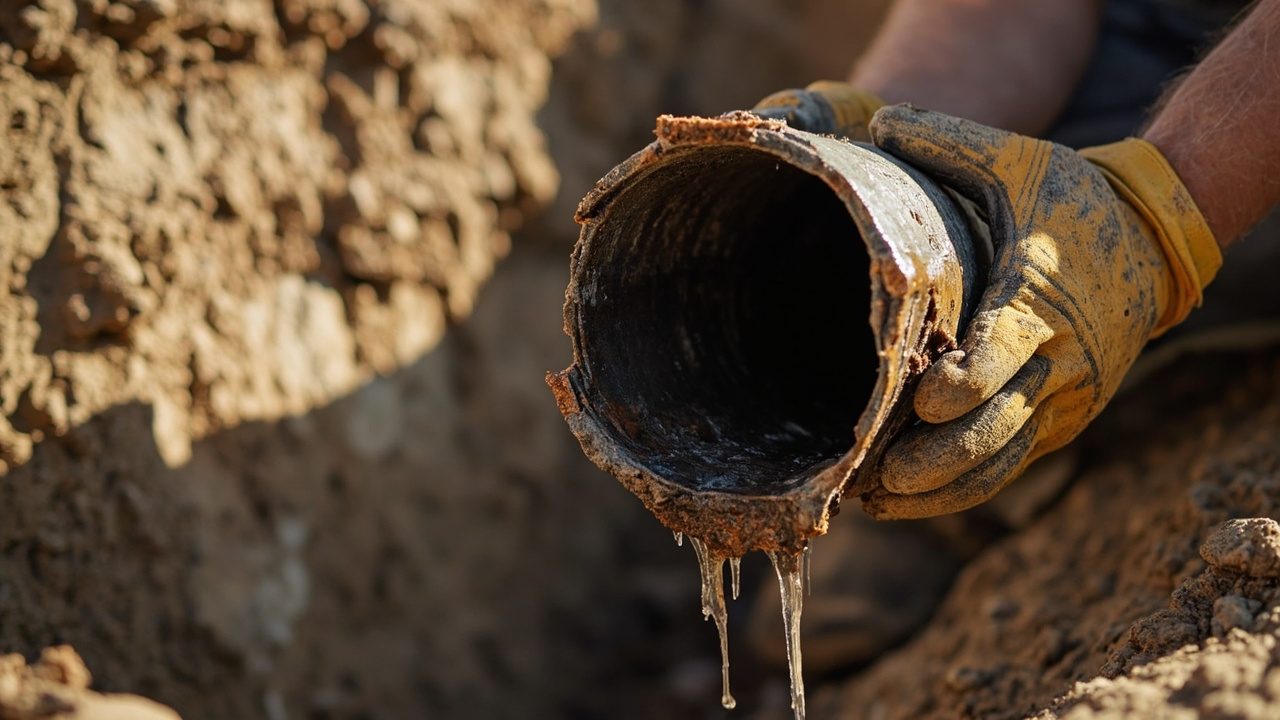
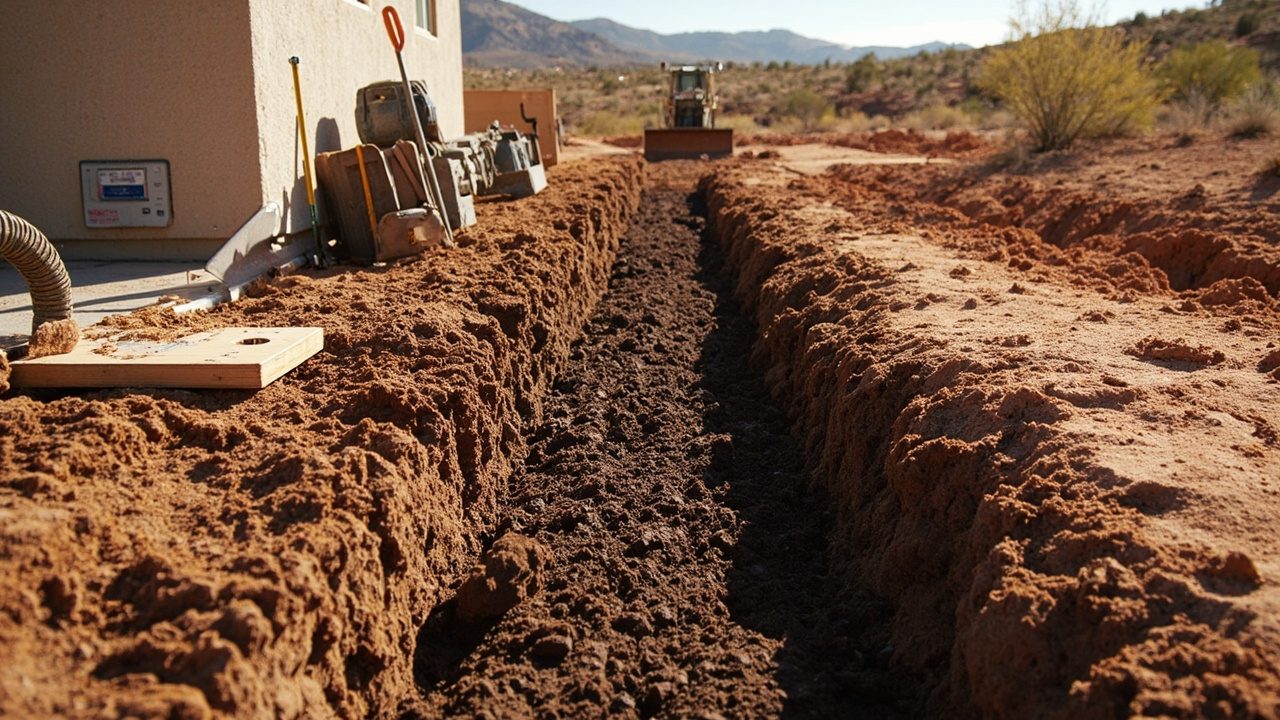
How we place the break before anything gets dug
A technician works out where the water is going before deciding what to open, and the meter is the first stop. With every fixture closed, the leak wheel is watched for fifteen minutes. Then the main at the house is closed and the wheel is read again. Branch stops and fixture stops close one at a time until the loss stops. Only after that sequence has shrunk the problem to one segment does a surface get opened. Across a yard or under a slab, listening gear and a locator narrow that segment to a spot and a depth before a trench gets marked.
Any movement of the leak wheel with every fixture closed means water is leaving the system somewhere you cannot see. That one reading decides this job. The second reading, with the main closed, sorts the fault by location. A wheel that stops puts the loss inside the house, and the search moves to branches and the wall or slab. A wheel that keeps moving puts it on the street side of your shutoff, out on the service line, and the job becomes a yard dig with a depth to find. Pressure and hardness readings taken on the same visit settle a separate question, whether a pressure reducing valve, an expansion tank or water treatment belongs in the scope.
Once the break has a spot and a depth, the choice is method. A line snapped at one point still needs that point dug out, so the question is how much of the rest of the run gets a trench. Open cut restores full diameter and lets you see every foot of pipe replaced. Lining cures a new pipe inside the old one, gives up a little inside diameter and needs a host pipe that is still round. Pipe bursting is the other trenchless route. Depth, length and what sits on top of the line, whether a driveway, a slab or a patio, decide between them. Caliche hardpan slows every foot of trench, so a long run under open yard weighs differently from a short run under concrete. For water service line replacement, type L copper is rigid and tolerates heat directly, while PEX A uses expansion fittings, PEX B uses crimp rings, and either one has to stay out of sunlight where the line rises at the house wall.
See emergency water heater repair for how the related work is scoped and priced.
Our technicians follow the workmanship standards promoted by the Plumbing-Heating-Cooling Contractors Association.
Ask which of these readings was taken before any part is replaced.
| Instrument | Good reading | Bad reading | What it changes |
|---|---|---|---|
| Water meter leak indicator with every fixture closed | The dial or the small leak wheel does not move over fifteen minutes | Any movement at all with the whole house off | Water is leaving the system somewhere you cannot see |
| Anode rod pull on a tank water heater | The rod still has sacrificial metal along the core wire | A bare core wire with the metal gone | The tank itself is now the part being eaten |
| Thermometer at the farthest hot tap | Hot water arriving around 120 degrees | Hot enough at the tap to scald a child in seconds | The first slug of water is whatever was sitting in the pipe |
| Drain camera with a locator | Continuous fall to the main, clean joints | Standing water part way along a level run means a belly | Roots at a joint mean the repair belongs at that joint rather than the whole line |
| Screw on pressure gauge at a hose bib | Static pressure sitting in the 45 to 70 psi range with nothing running | Above 80 psi | Fixtures, supply hoses and water heaters start failing early |
How a main line break call runs
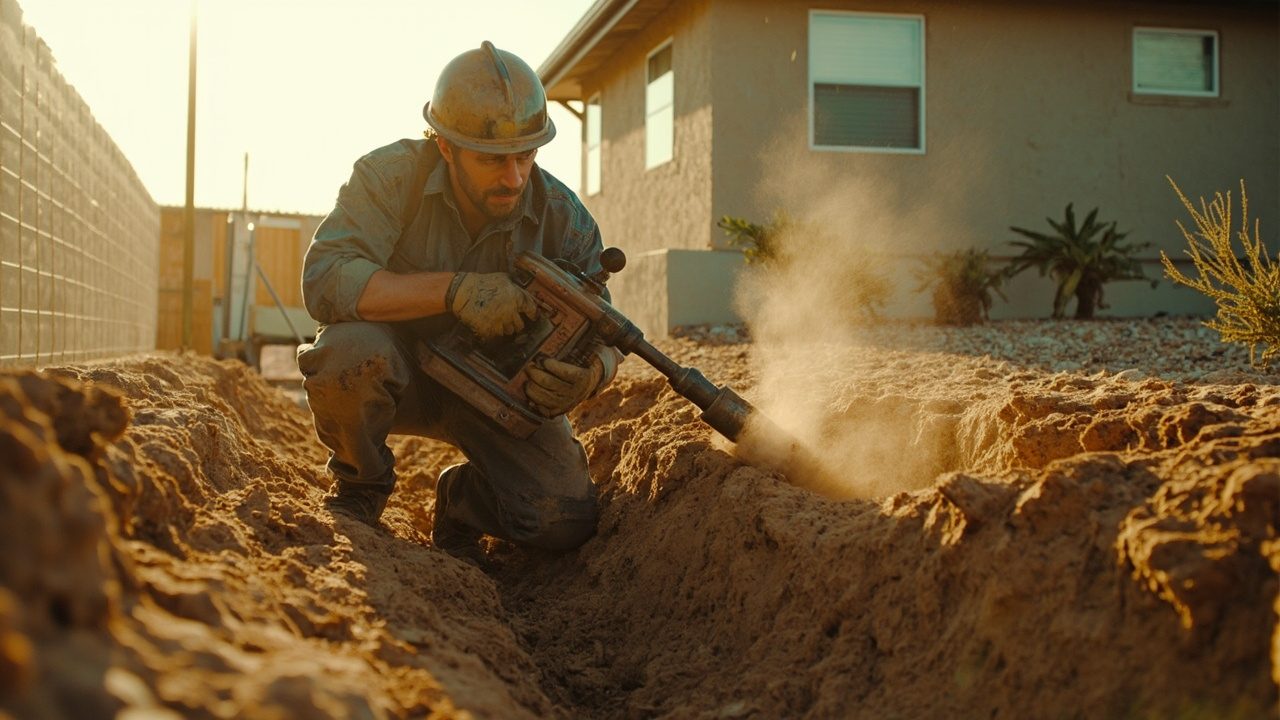
Questions, then the meter
On the phone you are asked whether the dial moves with everything off, whether water has reached an outlet or ceiling, where your main shutoff is, and whether anyone is in the house. On site the first tool is the meter. All fixtures are sealed and the indicator is monitored for fifteen minutes. The main is then shut and the reading is taken again. Supply lines are isolated sequentially until the loss stops. A locator and listening gear turn that segment into a spot and a depth. Nothing gets opened before that, and you can watch each step at the meter.
Approved scope, then the dig
Once you approve the written scope, isolation comes first. The main is closed, the whole building is without water, and only the segment under repair is opened. Hand digging near the line keeps the pipe from being nicked. Water service line replacement goes in as type L copper or PEX, with a dielectric union wherever galvanized meets copper. If the trench shows more corroded pipe than the scope described, work stops and you are shown the pipe before we go further. Toilets will not refill from the tap until water returns, so a bucket poured into the bowl flushes them.
Readings before we leave
Before we leave, the screw on gauge goes back on your hose bib and has to read static pressure inside 45 to 70 psi with nothing running. The leak wheel is then watched again for fifteen minutes with every fixture closed, the same test that found the break, and it must not move. Cold taps run until the flow is clear, and the aerators get cleaned because grit collects there first. We go through each reading with you at the meter, and you keep the written scope with the pipe material and the route of the new line.
What a crew that expects soft soil gets wrong here
A full replacement of a main line usually needs a permit and inspection, and a like-for-like fixture swap usually does not. The permitting authority makes the final call, and work outside city limits falls under the county or the neighboring town. Where a permit applies, we pull it and the work is inspected in stages. Owners call it a broken water main. The stretch between the meter and the house is the service line, and that stretch is where main line leak repair happens.
Houses from the late 1800s through the 1930s carry galvanized steel supply lines that corrode from the inside. Slab homes from the 1970s through the 1990s run copper under or through the slab, and newer subdivisions on the east and west sides use PEX to a manifold. Each one changes the job. A crew that expects soft soil and one pipe material quotes a short trench, meets caliche at the first cut and leaves the house without water longer than it said. A crew that digs on the wet patch opens ground beside the break. A crew that joins galvanized to copper without a dielectric union leaves a corroding joint in a brand new line. A crew that leaves PEX exposed at the wall lets sunlight degrade it.
Calls come from across the county, from mesa and foothill ground with hardpan to the river valley where soil holds water. Soil type, pipe age and the dial reading with the main closed decide how the visit is planned. Arctic cold fronts that reach the teens split exposed hose bibs and backflow assemblies, and because the ground does not freeze deeply, a freeze mostly reaches exposed pipe. Those are supply leaks too, and they close at their own stops without a trench. The visible signs guide the work: water pooling in a yard, a wet foundation wall or pavement that cracks in a line across the lawn all point to where the line fails. Water pressure that drops suddenly when a fixture opens points to a partial blockage or a crack that lets air in. Meter spin with all fixtures closed confirms flow where none should be.
More detail on emergency water shut-off service is on its own page.
What a main line break call looks like from your side
When someone arrives
You call and answer three questions: does the dial move with everything off, has water reached an outlet or ceiling, and where is your main shutoff. Those answers sort the call into tonight or a morning visit, and after hours calls go through the same questions. You hear the arrival window for your address before you hang up. If the job ahead of yours runs long, you are told the shifted window before the first one closes.
Protecting yard and floors
Before the first cut, drop cloths cover the path from the door to the work. Sod and topsoil are lifted and set on a tarp apart from the caliche, so they can go back on top. Spoil and broken pipe stay on tarps beside the trench and never on the driveway. Hardpan chunks and the old pipe leave with us, and the last steps are raking the backfill level and wiping the entry.
What moves the scope
Reaching the pipe moves the scope most, meaning what has to be cut and put back, from lawn to driveway or slab. Excavation depth and length come next, and caliche adds time to both. One repair point costs less than a replaced segment, and the condition of the rest of the run decides which. Old to new pipe matching, fixture grade and after hours dispatch follow. You approve a written scope before work starts, and it states what happens if the opening finds more.
How technicians are checked
A new technician rides along with a lead before working alone, and the lead signs off on three tasks. They are reading the leak wheel with every fixture closed, joining galvanized to copper with a dielectric union, and reading static pressure at a hose bib. Code updates are studied as they are released. On anything under a slab or in dense hardpan, a second technician looks before a scope is written.
You Have Questions,
We Have Answers
Coverage for a burst pipe usually applies when the failure was sudden and accidental. Adjusters look for a dated event, so photograph the wet materials before drying starts and keep the failed pipe section if it comes out. Long-term seepage, corrosion and neglected maintenance are the usual grounds for denial. Policy wording on water damage varies, so read the exclusions section and ask your carrier which documents it wants before any demolition begins.
Run each cold tap until the water looks clear, which usually takes a few minutes per fixture. Open the tap farthest from the house entry first, then work inward, so air and loosened grit leave through the outermost outlets. Sputtering means trapped air, and brown or gritty flow means sediment is still clearing. Afterward, remove and rinse the aerators and showerheads, because debris lodges in their screens. Flush the hot side last so the heater is not pulling sediment into the tank.
Ownership of the failed stretch decides who pays, and the water utility or local authority sets that boundary. Usually the owner carries the line from the meter to the house, while the utility handles its side of the meter. Damage inside the home falls to the homeowner's own policy if the carrier accepts the loss as sudden. Where a utility-side failure caused the flooding, a written claim to the utility is the route, so keep dated photos and the meter reading.
Cost rises with depth, run length, surface restoration, pipe material and how much of the line is replaced. A short repair in open yard sits at the low end, while a long run under a slab or driveway sits at the high end. Hardpan adds hours, and after-hours dispatch adds to the total. A written scope shows each of these before work starts, so the number reflects your actual line and not an average from other properties.
Standard homeowners policies usually cover resulting interior damage from a sudden break but often exclude the buried line itself. Many carriers treat the underground service line as a separate item, sold as an endorsement, sometimes called service line coverage. Check your declarations page for that wording. Wet drywall, flooring and belongings usually fall under the main coverage, while the dig and pipe replacement outdoors may fall outside it. Ask your agent about both parts separately.
Coverage depends on where the line failed and why it failed. Sudden breakage inside the home is typically covered, along with the water damage it causes. A buried yard line often needs an added endorsement, and wear, freezing of neglected pipe or corrosion may be excluded. Carriers also separate the cost to reach the pipe from the cost to fix it. Read the policy sections on water discharge and underground piping, then confirm with your carrier before authorizing work.
Cost rises with depth, trench length and the surface above the line. Lawn is cheaper to restore than concrete. Replacing a whole segment costs more than repairing one point, and copper, PEX and galvanized transitions change materials and labor. Trenchless methods trade less surface repair for equipment needs. Since a leak can hide beside a wet patch, locating first prevents paying for a dig in the wrong place.
Water escapes under full pressure around the clock, so the meter keeps spinning and the ground softens. Soil can wash out beneath slabs, driveways and walkways, and pressure at the taps drops or fluctuates. Left running, the loss can undermine footings, saturate framing and produce a very large bill. Sediment may also enter the line through the break when pressure falls, which is why discolored water sometimes appears before any wet spot does.
Close the main valve at the house first, then the meter valve if the leak continues. Next, open the lowest tap to drain remaining pressure and stop flow through the break. Photograph the damage and note the meter reading before you touch anything else. A curb key or meter wrench may be needed for the meter valve, and some valves are stiff from years without use, so turn gently to avoid snapping the stem.
The property owner generally repairs the pipe running from the meter to the home. The water utility handles its own main and the meter. Boundaries differ by property, so the utility confirms where its side ends. Read the meter with the house main closed to see which side is leaking. If the loss continues after closing your valve, the break sits ahead of it. A plumber can locate the segment before anyone digs, and that reading gives the utility something concrete to check.
Why caliche hardpan changes water line break repair in El Paso
Desert soil on the mesas and foothills is sandy and gravelly with layers of caliche hardpan, and hardpan makes a yard line dig slower than softer ground. The trench is therefore planned around depth and length before the day is set, since the hours spent in hardpan are hours your house has no water. The river valley has finer alluvial soil that holds more water, so a trench there can stand wet and a leak can soak in without a sign at the surface. The water in the pipe adds a second condition. It tests moderately hard to hard, and above about seven grains per gallon scale forms steadily in heaters and valves, so a new service line leaves that scale where it was. The utility names rusting galvanized pipe inside homes as the typical cause of discolored water, and that house side pipe stays after the service line is replaced. Intense sun degrades exposed plastic where the line rises at a wall.
Where a permit applies, the work is inspected in stages, and the authority that issues the permit sets those stages. We leave the trench open until the stage the authority names has been seen. A break outside city limits answers to the county or the neighboring town, so the first question on a call is which side of that line the property sits on. The meter test places the break, and the water utility and the permitting authority say who owns the stretch it sits on, which is why the reading goes with you when you call them. Knowing the sequence up front changes when the trench gets backfilled, because a hole covered too early has to be reopened for its inspection. A swapped angle stop or supply hose usually sits outside that process.
Plumbing Services in The El Paso Area
Explore our service area and locate Bedrock Plumbing El Paso with ease. We're proudly local and serve the surrounding neighborhoods with fast response and honest pricing. Use the map to check our coverage area, or call us and we'll confirm in seconds.
Address:
Bedrock Plumbing El Paso, 221 North Kansas St, Suite 700, El Paso, TX, 79901
Additional Services We Offer
- 24/7 Emergency Plumbing Services
- Basement Flooding Pump-Out
- Burst Pipe Repair
- Emergency Sewer Backup Cleanup
- Emergency Sump Pump Failure
- Emergency Water Heater Repair
- Emergency Water Shut-Off Service
- Frozen Pipe Thawing & Repair
- Gas Leak Detection & Repair
- Overflowing Toilet Repair
- Rapid Response Leak Repair
- Septic Tank Emergency Pumping
Closing the main and reading the meter are homeowner jobs. DIY stops at anything soldered, anything on the gas line, anything behind a finished wall or under a slab, and any drain backed up past a cleanout. We do not decide who owns a broken stretch, because the water utility and the local authority do. If the break turns out to sit on their side, you hear it from us on the first visit and not after the invoice.
Before you call, know whether the dial at your meter keeps moving with every fixture closed and where your main shutoff is. Note when the yard turned soft or the bill jumped, and what changed just before. Any age or pipe material you know for the line, galvanized, copper or PEX, helps, along with whether anyone is in the house and whether water has reached an outlet.
Last reviewed September 2026 by Dave Parker, Owner.