




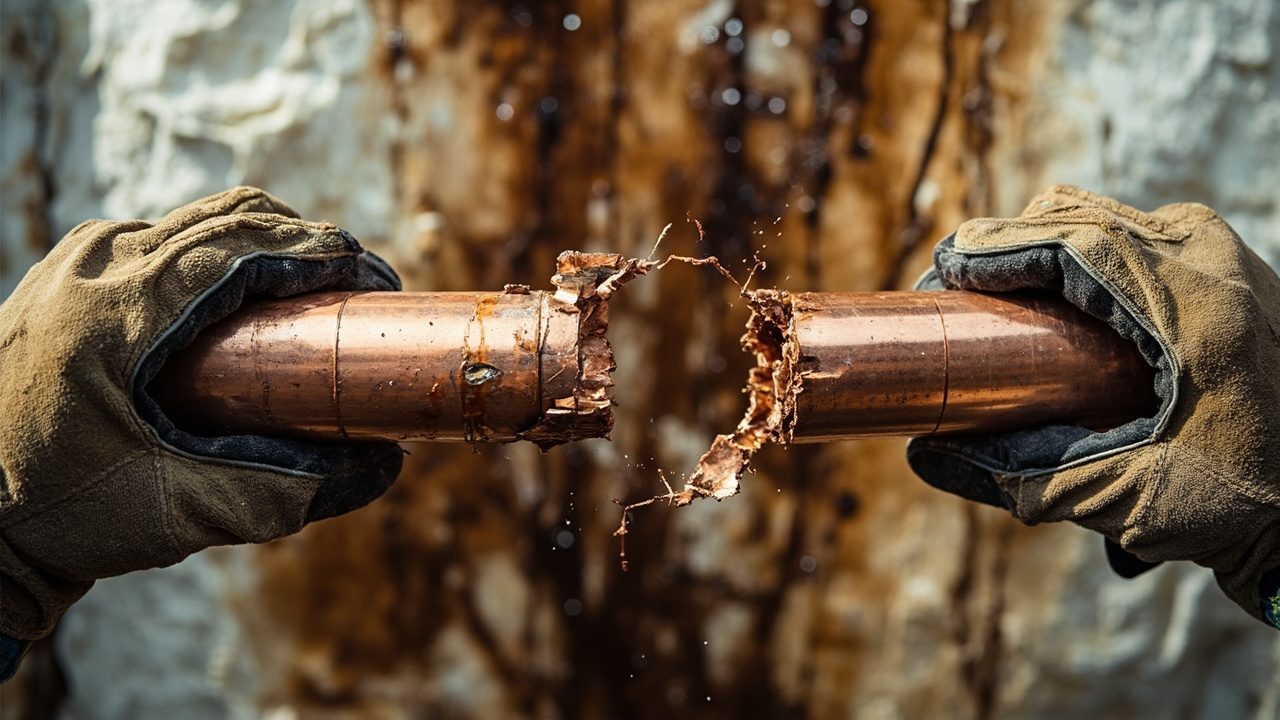
What a split pipe after an El Paso freeze looks like
The first five minutes, in order. Shut the water off at the stop under the nearest fixture. Without a stop, close the main where the line enters the house or at the meter. Where water has reached an outlet, a panel or a ceiling fixture, kill that circuit before anyone steps into the water. For a split at the water heater, close the cold inlet on top of the tank, turn the gas control or the breaker off, then open a hot tap on a lower floor so the tank is not under vacuum. If you smell gas or rotten eggs, do not touch a switch or a phone charger. Get everyone outside, leave the door open behind you, and call the gas utility from outside.
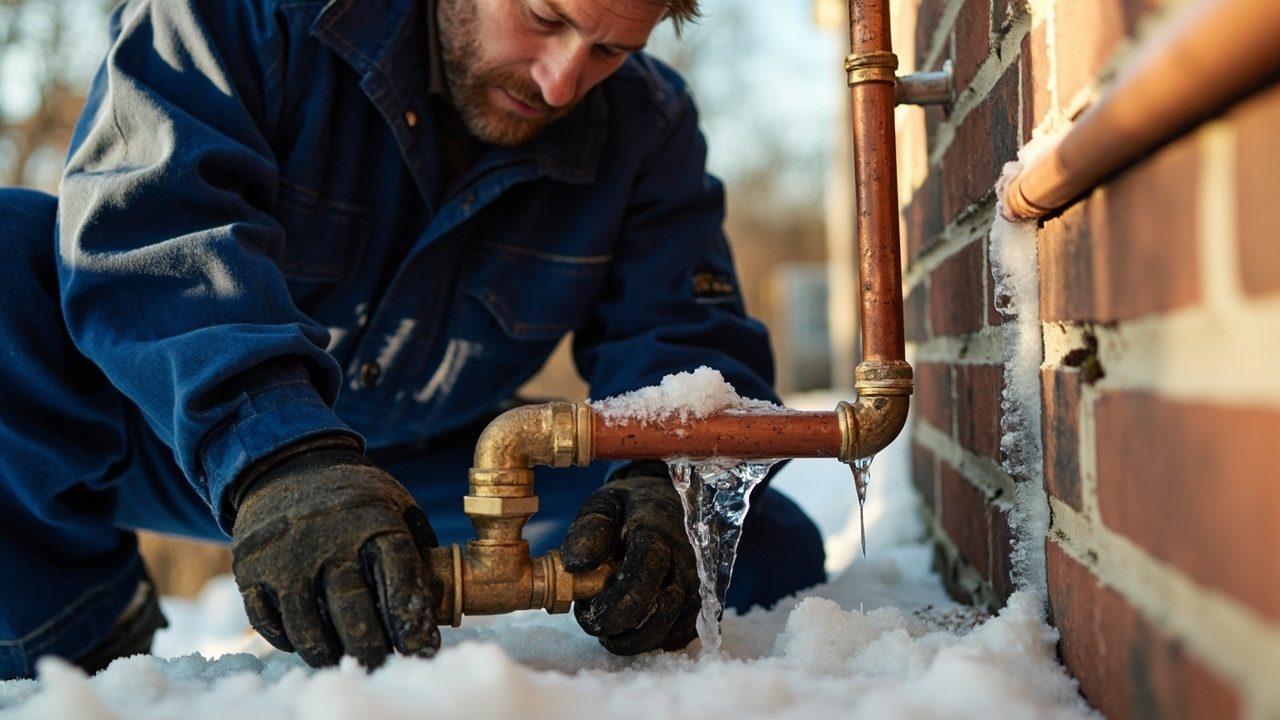
Most freeze calls sound alike. One fixture has no water while the rest of the house works. Another shows a stain on a ceiling hours after the temperature recovered. Ice splits a pipe at its coldest, least protected point. Nothing shows until the ice clears and the line is under pressure again. Across the county, the nights that do this hover just below freezing and give way to mild afternoons, so the ground does not freeze deeply. That leaves the damage in exposed pipe, such as a hose bib, a backflow assembly, an outdoor line or a run in a wall on the cold side of the house. An arctic front into the teens splits several of them in one night.
Sort supply from drain first. Pressurized water escapes all night whether anyone is home or not, while a drain only escapes when something upstream runs. A stain that grows with nothing running is supply, and a pipe burst in wall framing or above a ceiling behaves exactly that way. A wet spot that appears only during the wash cycle is a drain. A warm patch on the floor in one place points to the hot line under the slab. A meter dial that turns with every fixture closed tells you water is leaving somewhere you cannot see. Touch only the meter, the fixture stops and the main shutoff. Leave the wall, the slab and any standing water alone.
Call today when water is moving inside a wall or a ceiling. A hairline supply leak behind tile keeps the framing damp because nothing dries inside a wall, and the pipe repair then turns into a wall rebuild. Broken water pipe repair on one segment means one small opening. The same leak left damp for days means cutting out the drywall and the framing around it.
Our page on frozen pipe thawing & repair covers that side of the work in more depth.
Your local utility, El Paso Water, publishes service and water-quality information every El Paso homeowner should know.
How we isolate the split before we quote the repair
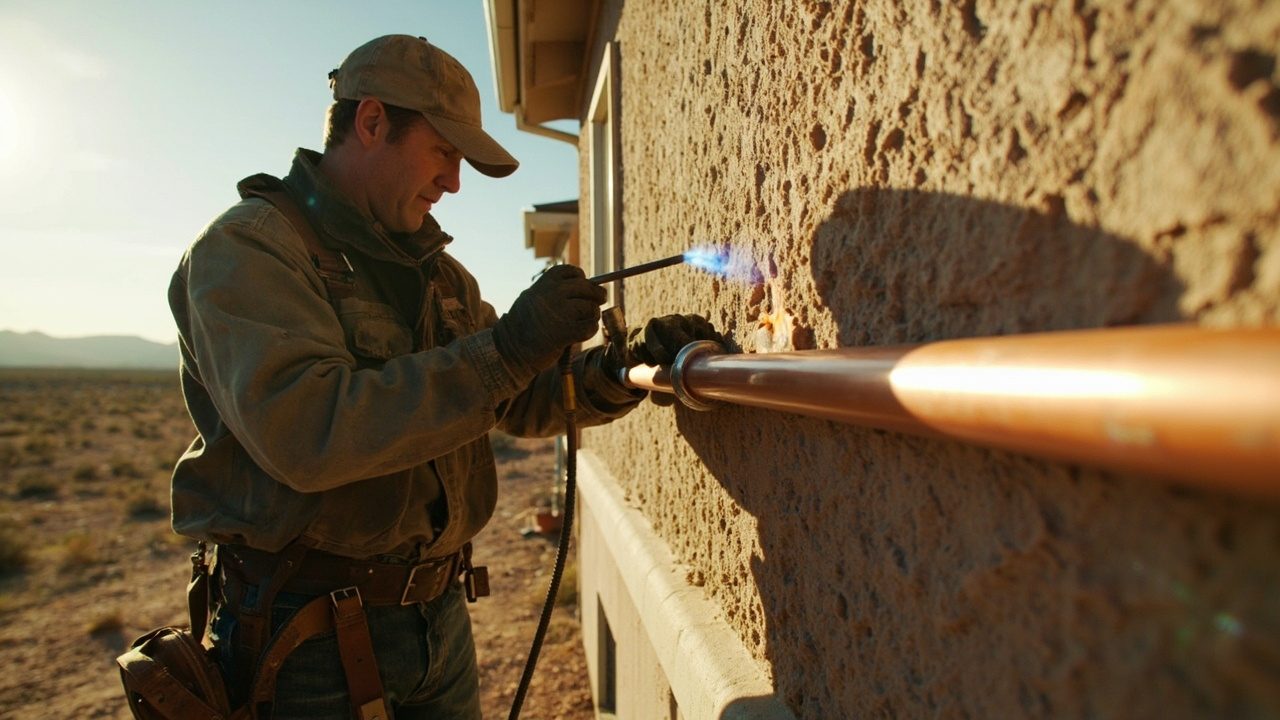
A ruptured pipe fix starts with where the water is going. With every fixture closed, the meter gets read. The main then closes and the meter gets read again. A dial that keeps moving with the main closed puts the loss on the street side of the meter, and a dial that stops puts it inside your house. From there we close stops and branch valves one at a time until the loss stops, which shrinks a house wide problem to a single branch. Above a slab, listening and further isolation narrow that branch to a wall or a ceiling. Only then does anyone open drywall, and the opening goes where the isolation pointed. When a branch can be shut off alone, the unaffected portions of your house retain water while the split is repaired.
The reading this page turns on is static pressure, taken with a screw on gauge at a hose bib that survived the freeze, with everything in the house off, because a running fixture hides the real number. Inside the 45 to 70 psi band, the job stays a repair of the split segment. Above 80 psi, a pressure reducing valve and a thermal expansion tank belong in the scope, since that force is what makes fixtures, supply hoses and water heaters fail early, and a new segment on an unregulated line meets the same force. The decision gets made before the wall opens, so pressure correction happens in the same opening rather than in a second visit.
Once the split segment is out, the replacement run is a choice between soldered type L copper and PEX, and inside PEX between PEX A with expansion fittings and PEX B with crimp rings. Copper is rigid, takes heat directly and costs more in material and labor. PEX is flexible, so a home run layout from a manifold puts fewer joints inside your walls and a later repair opens less drywall. PEX has to stay out of sunlight and needs protection where it passes through framing. Local water that tests moderately hard to hard leaves scale on stops and valves, which favors replacing a worn stop while the wall is open. Freeze exposure decides routing more than material does, since a line moved off the cold side of the house is a line the next front reaches less easily. What decides the choice is what the isolation and the gauge found, and how much of the run is the same age as the split.
If this sounds close but not quite your situation, industrial pipe repair may be the better starting point.
Price-checking is smart: marketplaces like Thumbtack publish typical cost ranges you can hold any quote against, including ours.
Ask which of these readings was taken before any part is replaced.
| Instrument | Good reading | Bad reading | What it changes |
|---|---|---|---|
| Screw on pressure gauge at a hose bib | Static pressure sitting in the 45 to 70 psi range with nothing running | Above 80 psi | Fixtures, supply hoses and water heaters start failing early |
| Overnight pressure hold with the gauge left | The morning reading is close to the reading taken the night before | A reading far above the night figure | The heater is expanding water into a closed system with nowhere to put it |
| Water meter leak indicator with every fixture closed | The dial or the small leak wheel does not move over fifteen minutes | Any movement at all with the whole house off | Water is leaving the system somewhere you cannot see |
| Drain camera with a locator | Continuous fall to the main, clean joints | Standing water part way along a level run means a belly | Roots at a joint mean the repair belongs at that joint rather than the whole line |
How a burst pipe call runs
Phone questions and isolation
The call starts with your meter location, whether water has touched electrical wiring, and where your main shut-off sits. On site, the order follows the water. Every fixture goes off and the meter gets read. The main closes and the meter gets read again, which places the loss on the street side or the house side. Then we isolate each branch valve in sequence until the flow stops. You can watch the dial with us. Only after that does anyone choose where a wall opens, and the opening goes exactly where the isolation pointed.
Approval, then the repair
Once you approve the written scope, isolation of the affected branch comes first, so the rest of the house keeps water. The split segment is cut back to sound pipe, and the new run goes in as soldered type L copper or as PEX with the joining method the scope named. A dielectric union goes in where dissimilar metals meet. Water is brought back slowly on the isolated branch so each joint can be watched. If damp framing or a second split turns up behind the wall, we stop and show you before going further.
Pressure test and handover
Before we leave, the screw on gauge goes back on the hose bib with everything in the house off, and it has to read between 45 and 70 psi. The repaired branch is watched at every joint, and the meter is checked with all fixtures closed. We walk you through the opening, the new joint and the number on the gauge, and you keep the written scope with what was found. The stops and the main that isolated the branch are shown to you.
Why a brief freeze breaks pipes differently than a long one
A crew from a colder region looks in the wrong place first. Where ground freezes deep, a split is assumed to be underground. Here the ground does not freeze deeply, so the splits sit in exposed pipe at a hose bib, in a backflow assembly or running through a cold wall. A crew that starts digging a yard line spends its first hour on the wrong pipe while the wet drywall keeps soaking. Caliche hardpan makes any trench that is needed slower than the plan assumed.
A second mistake is fixing the visible split and restoring pressure in one move. After an arctic front several exposed points can be split, and the second one only shows when the line is under pressure again. Pressure comes back in stages on the isolated branch while each exposed point is watched.
Old stops cause the third mistake. Moderately hard to hard water leaves scale in valves, and galvanized supply in older houses closes up from the inside. Reading static pressure at a running tap on a galvanized house gives a low number that hides the real one. A stop that will not close, or a compression nut that cannot be snugged, sends a small job to the main shutoff and takes the whole house off water. A local crew tests the stops before promising that one branch can stay on.
Gas work and main line work usually need a permit, while a like for like swap of one fixture or one split segment usually does not. The final call belongs to the authority, and where a permit applies it is in hand before the wall closes.
Cold nights reach the whole county at once, so calls cluster in the same morning during a front. The phone questions come first for that reason. They ask whether water is still running, whether it has reached a circuit, and whether a stop you can reach isolates it. A burst you have already isolated waits behind one that is still running, and that ordering gets said plainly on the call.
See 24/7 emergency plumbing services for how the related work is scoped and priced.
Working with Bedrock Plumbing El Paso on a burst pipe
From call to arrival
You call and we ask where the water is showing, whether it has reached an outlet or a ceiling, and whether you can reach a stop or the main. Those answers separate a visit that needs to happen now from one that can be scheduled. You hear the arrival window before the call ends, and if the job ahead of yours runs long, the new window is passed to you before the first one closes. A split you have already isolated at a stop is a lower priority than one still running.
Protecting floors and walls
Before anything comes apart, drop cloths run from the door to the work area, and the floor under the wall is covered. The drywall opening is cut square and kept as small as the isolation allows, which leaves a clean edge for the patch. Damp material goes into bags instead of across your rooms, and standing water comes up with a wet vacuum. The last thing we do is walk the route back to the door and show you the opening and the finished joint.
What moves the scope
Access moves the scope furthest. A finished wall, tile, a ceiling below or a slab raises it, and so does restoring that surface. Deep or long excavation and a full run replacement raise it, and a repair at one joint holds it down. Matching old pipe to new, a higher grade of fixture or heater, and after hours dispatch each add to it. Water off for one branch costs less labor than water off for the whole building. You approve the written scope before work starts, and anything the opening finds is agreed in writing first.
How technicians earn sign off
A new technician rides with a lead before working alone. The lead watches three tasks: reading static pressure at a hose bib with everything off, isolating a branch with the stops, and making a soldered or crimped joint that holds under the gauge. The lead signs off each one. On an unusual job, such as a split behind tile or a run of mixed old materials, a second technician looks at it before a scope is written, and code changes are reviewed with the crew.
You Have Questions,
We Have Answers
Most homeowners policies cover sudden, accidental water discharge from a burst pipe, though your policy sets the exact terms. Coverage usually applies to the resulting damage to floors, drywall and belongings. Repair of the pipe itself is often excluded, and so is long-term seepage or neglect. Photograph the damage before anything is moved, keep the removed pipe section if you can, and keep every receipt. Adjusters commonly ask for a plumber's written description of what failed and where, so the scope document matters for the claim.
Your carrier often pays for a sudden burst, but the payout depends on the cause and your deductible. Adjusters separate an abrupt rupture from a slow leak that ran for weeks, and the slow leak is frequently denied as maintenance. Damage below your deductible may not be worth filing. Mitigation duties also apply, meaning you are expected to stop the water promptly, so note the time you closed the shutoff. Ask your carrier whether a claim on record affects renewal before you file.
Flex Seal will not hold a pressurized leaking pipe for any meaningful time. The coating needs a clean, dry surface to bond, and a supply line under 45 to 70 psi keeps the pipe wet and pushes water beneath the film until it blisters and peels. Splits in copper also keep lengthening as metal fatigues at the crack tips. A rubber-coated patch can hide the drip while water tracks into framing. A cut-out and new segment is the lasting correction.
A homeowner can shut off the water and drain the line, but a plumber should make the permanent repair. Type L copper needs a dry joint, since any trace of water in the line turns to steam and blows out the solder. PEX needs the correct ring or expansion tool for its type. Pipe inside a wall also raises the risk of missing a second split. Temporary clamps can bridge a short gap until help arrives.
A burst pipe is an emergency while water is still moving. Once a stop or the main isolates it, the urgency drops. Running supply water can release hundreds of gallons in a few hours, soaks insulation and drywall, and can reach wiring. After the flow stops, damp materials still need attention within a day or two, before mold starts on paper-faced drywall. Water near outlets or a panel raises the urgency at once, so shut off that circuit first.
Cost depends mainly on access, pipe material and how much surface needs restoring. A split at an exposed spot with a shutoff nearby stays small. A split inside a finished wall, under tile or beneath a slab grows with each layer opened and rebuilt. Full run replacement costs more than a single segment, and after-hours work adds to it. Damage from water sitting in framing is billed apart from the plumbing itself, and the written scope shows each part.
A policy typically responds when a pipe bursts suddenly, covering the water damage but often not the failed pipe. Wording varies, so check for exclusions on freezing, especially if the home sat vacant or the heat was off. Some carriers require you to have kept the house heated to a set temperature. Your deductible applies first. A plumber's report naming the failed segment and the likely cause gives the adjuster something concrete to work from.
You can repair a burst pipe yourself only on a short, accessible section with the right tools. Copper requires a fully drained, dry line before soldering, and PEX requires a matching crimp or expansion tool. Push-fit couplings can bridge a clean split on straight pipe, though they are not rated for every location. Hidden splits, galvanized pipe that crumbles when cut, and anything near gas or electrical lines are better left to a plumber.
The homeowner is generally responsible for a burst pipe on the house side of the water meter. The utility handles the service line up to the meter, so a meter dial that keeps turning with the main closed points to the street side. Renters should tell the landlord right away, since the owner usually carries repair duty for the building's plumbing. Condominium and shared-wall units follow the association documents, which specify what belongs to the unit and what belongs to the building.
Yes, a plumber isolates the branch, cuts back to sound pipe and installs a new segment. The plumber also checks static pressure afterward, since high pressure stresses new joints. Copper needs a soldered joint that stays dry under the gauge, while PEX needs the fitting matched to its type. Drywall, tile and drying work after the repair fall to other trades, and a plumber will say so when the opening shows it. Cost and scope depend on what the wall reveals once it is open.
Burst pipe repair in El Paso after a brief hard freeze
A hard freeze in this county finds the pipe the house left unprotected. Most freezing nights sit just below freezing and turn mild by afternoon, so the ground does not freeze deeply and the split shows up in exposed hose bibs, backflow assemblies, outdoor lines and runs on a cold wall. The first freeze averages mid November and the last comes in early March, and subfreezing temperatures in the single digits rupture several of these in one night. Era then decides what the open wall shows. Homes from the 1940s through the 1960s carry galvanized or early copper supply with cast iron drains under the slab. The 1970s through the 1990s brought copper under or through the slab, with water heaters often in garages or closets. Homes from the 2000s on run PEX from a manifold, which keeps joints out of the walls. Mineral deposits from moderately hard to hard water clog stops and valves, and that buildup shapes every emergency pipe repair here.
Inside city limits, the city issues plumbing permits and inspects the work at stages during construction. Outside city limits the county or the neighboring town holds that role, and a split line can sit on either side of the boundary, so the first question on a county call is which office applies. Where an inspection applies, the joint, the transition where old pipe meets new and the support through framing need to be visible while the inspector looks, so drywall waits for that call. Backflow assemblies that a freeze split carry their own local rules, and a replacement gets checked with the authority and the water utility before a part is bought. Knowing this in advance changes the sequence. The repair and the pressure check happen with the wall open, the inspection follows where it applies, and the patch comes last, which keeps a wall from being opened twice.
Plumbing Services in The El Paso Area
Explore our service area and locate Bedrock Plumbing El Paso with ease. We're proudly local and serve the surrounding neighborhoods with fast response and honest pricing. Use the map to check our coverage area, or call us and we'll confirm in seconds.
Address:
Bedrock Plumbing El Paso, 221 North Kansas St, Suite 700, El Paso, TX, 79901
Additional Services We Offer
- 24/7 Emergency Plumbing Services
- Basement Flooding Pump-Out
- Emergency Sewer Backup Cleanup
- Emergency Sump Pump Failure
- Emergency Water Heater Repair
- Emergency Water Shut-Off Service
- Frozen Pipe Thawing & Repair
- Gas Leak Detection & Repair
- Main Water Line Break Repair
- Overflowing Toilet Repair
- Rapid Response Leak Repair
- Septic Tank Emergency Pumping
Closing the main, swapping a braided supply hose and draining a hose bib before a freeze are homeowner jobs, and you do not need us for them. DIY stops at anything soldered, anything on the gas line, and anything behind a finished wall or under a slab. Drying a soaked structure and rebuilding finished drywall or tile sit outside plumbing work. If the first visit finds that, we say so then and tell you who handles it.
Before you call, know where the water is showing, when you first noticed it, and whether a freeze came through just before. Find your main shutoff and note whether the water heater sits in a garage or a closet. Any age you have for the plumbing helps, and so does knowing whether anyone is in the house and whether water has reached an outlet.
Last reviewed September 2026 by Dave Parker, Owner.