





What fading hot water flow usually means in El Paso homes
Your shower starts hot and then thins out. Open a second tap and the first one drops to a trickle, or the far bathroom never reaches the temperature the unit is set to. Cold water still runs at full strength. You may have cleaned the shower head already, which helps when the crust sits at the tap and does nothing when it sits in the heat exchanger. A single slow tap points at a crusted aerator or a worn cartridge on that branch, and every hot tap running weak while cold stays strong points at the on demand water heater itself.
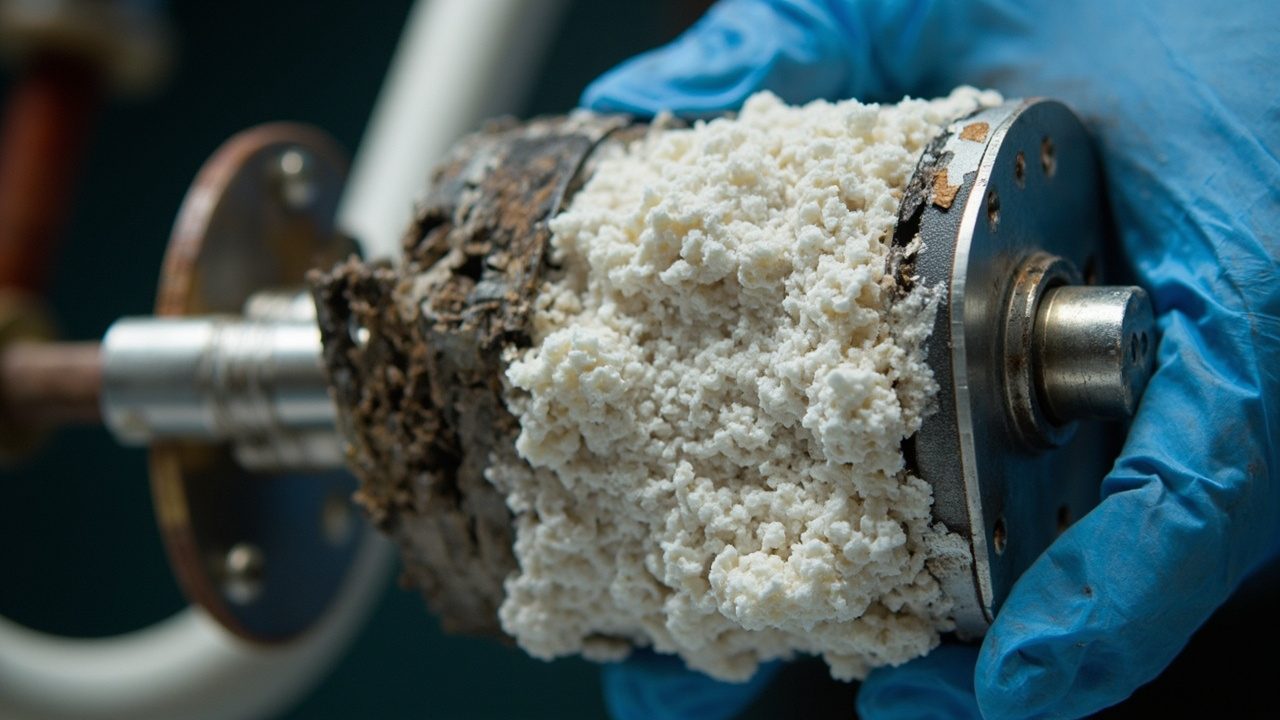
Water across the county runs moderately hard to hard, commonly around ten grains per gallon or more, and above about seven grains per gallon scale forms steadily on hot metal. An instant hot water system of this kind pushes water through narrow passages in a heat exchanger and lifts its temperature in seconds. Dissolved minerals leave the water on those hot walls and stay behind as a layer. The layer narrows the passage, so the unit delivers fewer gallons per minute at its rated temperature rise. It also insulates the metal, so the burner runs longer to move the same heat into the water. Flow declines gradually, and most people notice only when a second shower runs.
A tank heater collects the same scale as sediment at the bottom, where it has room to sit. A tankless unit has no such room, so the loss shows up as lost flow first. Cold mornings sharpen it, because incoming water arrives colder and the unit has to lift it through a larger temperature rise with a passage that has already narrowed. The same scale collects in faucet cartridges and valves, so a scaled heater usually means scaled fixtures too. Rusty or discolored water is a separate cause, since corroding galvanized supply in older homes discolors the water from the inside, and the color at the tap tells you which problem you are chasing. An early tankless water heater flush clears loose deposits. A layer left to build for years moves the job toward descaling and tankless heater repair.
Pressure adds a second way for a heater to fail early. On a tank heater, incoming pressure above the normal band makes the relief valve start weeping, then the tank seams work harder every cycle and the heater fails years before it should. A drip from that valve is the point where calling today beats waiting. A screw on gauge at a hose bib shows the static number, and you read it with everything in the house off, because a running fixture hides the real figure. Above 80 psi is where fixtures, supply hoses and water heaters start failing early.
Our page on commercial water heater systems covers that side of the work in more depth.
Your local utility, El Paso Water, publishes service and water-quality information every El Paso homeowner should know.
Find the sign you have, then read across to see whether it can wait.
| Symptom or first sign | What is already happening | What it becomes if ignored | When to call |
|---|---|---|---|
| Incoming pressure above the normal band | The relief valve on the heater starts weeping | The tank seams work harder every cycle and the heater fails years before it should | This week, while it is still one part |
| Roots at one clay joint | Paper and grease catch at that spot every day | The main backs up into the lowest fixture in the building with no warning | Now, the same day |
| A weeping angle stop under a sink | The compression nut corrodes so it cannot be snugged | The stop snaps off in someone's hand during a faucet change | Now, the same day |
| A hairline supply leak behind tile | The framing stays damp | The pipe repair turns into a wall rebuild | This week, while it is still one part |
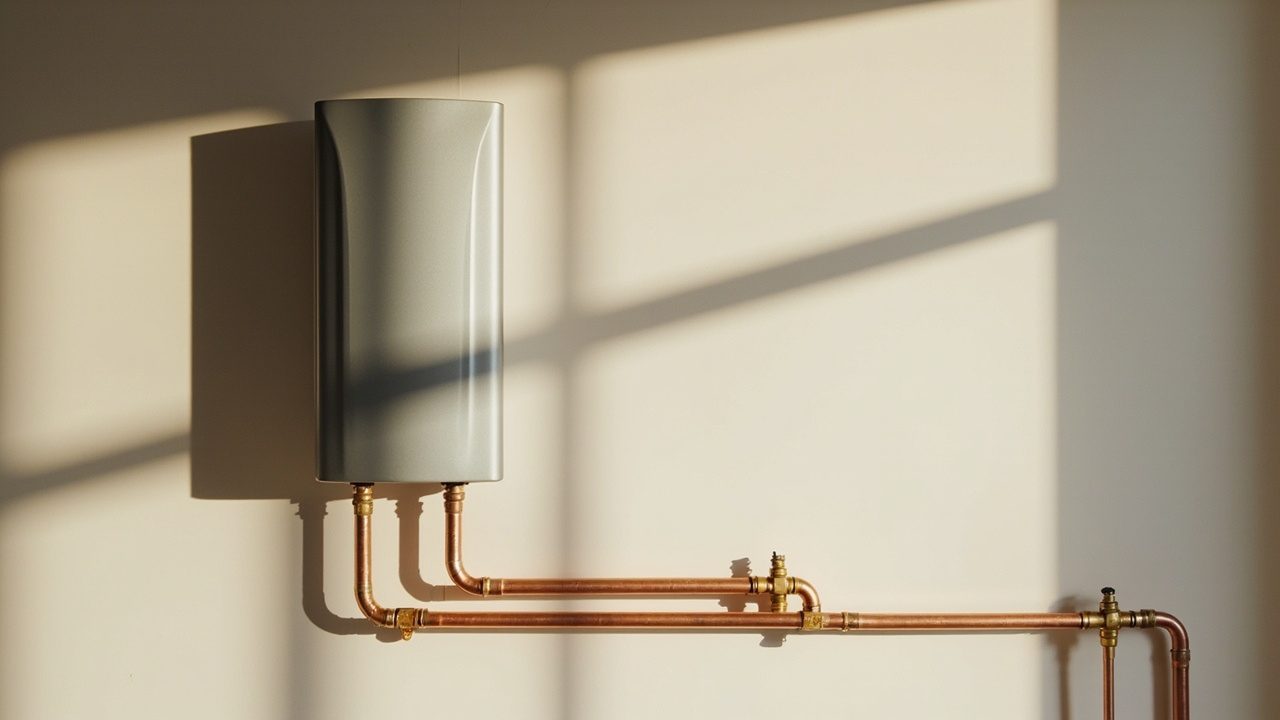
How the hardness reading decides the scope before we quote
The hardness test comes first, before anyone quotes a unit or a repair. A test kit on a tap fed by the incoming line reads the water in grains per gallon, and that one number tells us whether scale explains the symptom, how fast it forms and how often the exchanger will need a flush. Next the hot flow is measured at the farthest tap with a second tap open, which shows whether the loss follows demand. Then the cold inlet closes and the gas control goes off, isolating the heater before anything is opened. Only after those readings does anyone say tankless heater repair, flush or replacement, and the written scope names the reading that put each line in it.
The reading forks the job. A result under about seven grains per gallon says scale is not the cause, and the search moves to the gas supply, the venting or a failed part. A result around ten grains or more, which is common here, says the exchanger will scale on a steady schedule, so a flush interval goes into the scope and water treatment goes in as an option. The jump from moderately hard to hard is where scale starts showing up on service calls. An ion exchange softener removes hardness minerals and needs salt and a drain, while a template assisted crystallization conditioner changes how minerals behave and needs neither, so the test result and the available drain decide between them. A hardness kit measures minerals only, so anyone worried about drinking water should read the utility water report and send a sample from their own tap to a laboratory. Pressure gets read last at a hose bib with the house off. Above 80 psi puts a pressure reducing valve into the job, and a closed system adds a thermal expansion tank.
The local condition that decides between a tank and an on demand water heater is that same hardness number. Around ten grains per gallon or more, a tankless installation suits a household that will flush on schedule or treat the water, because the exchanger has thin passages and nowhere to hold scale. A tank tolerates neglect longer, and its anode rod can be pulled to see what is left of the sacrificial metal. Where hard water has already crusted aerators and shortened element life in the house, treating the water comes before buying another heater, tank or tankless. Room decides the rest. Slab homes from the 1970s through the 1990s often keep the heater in a garage or closet, so clearance for venting and a condensate line gets measured before anyone promises that tankless water heater installation fits in one visit.
If this sounds close but not quite your situation, emergency water heater repair may be the better starting point.
Narrow this to two options before calling, then ask which one suits the house.
| Option | The numbers a buyer weighs | Best suited to |
|---|---|---|
| Tank water heater against tankless | A tank is judged on capacity in gallons and its first hour rating | Households with long back to back hot water use |
| Cast iron drain against PVC or ABS | Cast iron is heavy and quiet and corrodes from the inside over decades | Drain replacement under a finished house |
| Sump pump selection | Sized by horsepower against the vertical lift plus pipe run it has to push through | Basements with a real lift to the discharge |
| Type L copper against PEX | Copper is rigid, tolerates heat directly | Repipes where the existing layout sets the method |
How a tankless call runs
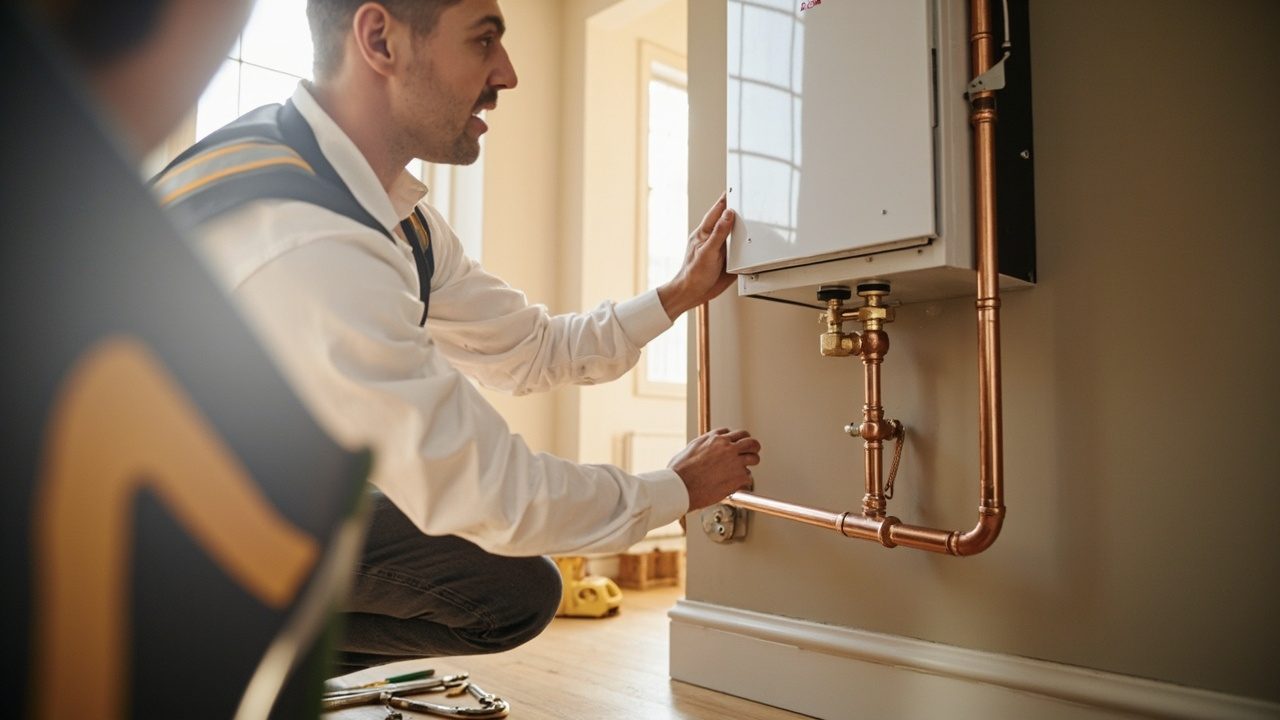
First call and hardness test
The call starts with three questions. What does the hot flow do when a second tap opens, how old is the unit, and where do the cold inlet and gas control sit? On site, the hardness kit attaches to the supply line first, and the grains per gallon reading is written down. The inlet valve closes and the gas control shuts down, so the heater is isolated before anything is opened. Hot flow is measured at the farthest fixture with a second tap running, and pressure is read downstream at the house shutoff. Only then does anyone name a repair, a flush or a replacement.
Approved scope and isolation
Once you approve the scope, the cold inlet closes, the gas control goes off, and a hot tap opens on a lower floor so the heater is not under vacuum. On a service job the exchanger is flushed and descaled with the discharge routed to a drain. On a new on demand water heater, the old tank drains out, a dielectric union joins dissimilar metals, the larger gas line and venting go in, and the condensate path runs to a drain. A thermal expansion tank goes on if the system is closed. If a corroded angle stop or galvanized fitting turns up behind the unit, we stop and show you before going further.
Tested before we leave
Before we leave, the combustible gas detector goes over every gas fitting and bubble solution goes on each joint, and both have to show no alarm and no growing bubble. Hot flow is measured again at the farthest tap while a second tap runs, and the pressure reading is compared with the one taken on arrival. The hardness number from the first visit is written on your handover next to the flush interval it set. You keep that page, and we walk you through where the cold inlet, the gas control and the relief valve discharge sit.
Why local water and gas details trip up unfamiliar crews
Gas work and a change to the venting on an on demand water heater usually need a permit and inspection at stages, while a like for like fixture swap usually does not. The local plumbing authority makes the final call. Work inside city limits and work outside them answer to different offices, so the first question on any call is which side of that line your house sits on. The permit gets pulled before the work starts, so an inspection never holds up getting your hot water back.
A crew that has not worked this water makes predictable mistakes. It sizes the unit on rated flow, the exchanger scales, flow falls below what the household needs, and the first service call is on a unit that looked correct on paper. It reuses the tank's gas line, although a tankless swap usually means a larger gas line, and the old line cannot feed the burner at full demand. It leaves exposed plastic lines where intense sun and heat degrade them, or leaves a cold inlet on an outside wall bare for the brief hard freeze that follows an arctic front. It also skips the pressure reading, and above 80 psi water heaters start failing early and a pressure reducing valve normally goes in.
Response covers the whole county and the greater metro, so the phone answers do the planning before anyone drives out. Unit age, where the heater sits and whether cold water holds full strength tell us what to bring. Crews carry a hardness kit, a screw on gauge, a combustible gas detector and bubble solution, which means a same day visit can finish the diagnosis rather than only start it. A crew without a hardness kit quotes from the rated flow on the box, and rated flow assumes water that does not scale. The pressure gauge also matters because high pressure stresses tank components, shortens tank life, and forces the pressure reducing valve into service earlier than expected. Water that tests hard requires a softening approach, and soft water with no mineral content can corrode the exchanger faster than design life predicts.
More detail on water heater repair & installation is on its own page.
Permit and inspection questions? Planning & Inspections is the office we coordinate with on every permitted El Paso job.
Working with Bedrock Plumbing El Paso on a tankless job
When someone arrives
You call, and the person who answers asks what you see at the taps, whether cold water still runs at full strength, and how old the unit is. Those answers separate a tankless heater repair that needs someone today from a flush or installation that can be scheduled. The arrival window is stated before the call ends. If the job ahead of yours runs long, the window moves and you hear about it before the technician reaches your door.
What gets protected
Before anything comes apart, floor coverings go down from the door to the heater, and water and gas stay off only as long as the work needs. A flush discharges through a hose to a drain or outside, so scale and water stay off your floor. The removed unit, old fittings and packaging leave with the crew. The last step is wiping down the heater area and running the hot tap until the discharge runs clear.
What moves the scope
Access moves the scope furthest. A heater on an open garage wall is a smaller job than one in a closet or behind a finished wall, because opening the surface and restoring it is often the larger half. Gas line size, venting and the condensate path come next, then whether new pipe joins old material. The grade of heater you choose raises or lowers the material side, and after hours dispatch adds to any of it. You approve a written scope before work starts, and it states what happens if an opening finds more.
How technicians earn sign off
A new technician rides with a lead before working alone, and the lead signs off on specific tasks. Reading a hardness kit and setting a flush interval from the result is one. Bubble testing a gas fitting with a combustible gas detector is another, and setting a pressure reducing valve is a third. Code updates get studied as a team. On an unusual job, such as a heater behind a finished wall, a second technician looks at it before a scope is written.
You Have Questions,
We Have Answers
Yes, tankless water heaters need periodic servicing, mostly to remove mineral scale from the heat exchanger. Scale narrows the water passages and forces the burner to run longer for the same output. A service visit also checks the intake screen for debris, the vent connections for tight seals, and the error code history stored in the controller. Units that skip servicing tend to show rising exhaust temperatures and short bursts of lukewarm water before any leak or shutdown appears.
Most manufacturers call for a flush about once a year, and harder water shortens that interval. Homes with heavy scale often need service closer to every six months. A useful check is the temperature rise at a fixed flow. If outlet temperature slips a few degrees compared with the last visit, deposits are building. Units with a recirculation loop or a water conditioner upstream can stretch the schedule, though the inlet filter still needs cleaning at each visit.
Flush pricing depends on labor time, unit access and whether descaling goes beyond a basic flush. Isolation valves make the job shorter, because hoses connect in minutes. Without them, the plumber must cut in a service valve kit first, which adds parts and time. Heavy scale can also mean a second cycle of circulating descaling solution. The scope is confirmed by phone questions before anyone arrives, so the answers you give about the unit shape the final number.
No single brand is reliably best, because installation quality and water treatment shape longevity more than the nameplate. Condensing models extract extra heat and run cooler exhaust, but their heat exchangers and condensate drains need attention. Non-condensing units are simpler and often easier to repair. Look for parts availability locally, a serviceable exchanger, built-in isolation valves and clear error code documentation. A well-flushed midrange unit frequently outlasts a neglected premium one.
Plumbers dislike callbacks caused by installation shortcuts and unmet expectations, not the concept itself. Common friction points include undersized gas lines, vent runs that exceed the maker's limits, and minimum flow rates that leave a trickle of hot water lukewarm. Scale makes it worse, since the narrow passages clog sooner than a tank bottom does. Repairs also need specific parts and diagnostic codes, so a unit installed without service valves turns each maintenance visit into extra labor.
Installed cost swings with gas line upsizing, venting type, unit grade and access. Swapping a tank for a tankless often needs a larger gas line, a new stainless or PVC vent, a condensate drain and sometimes an electrical outlet. Replacing a same-location tank costs less labor than relocating to a new wall. Adding a softener or an expansion tank raises the material side further, so no honest number exists without seeing the setup.
A local flush price depends on access and scale load, and it is quoted after a few phone questions. Units with existing service valves are the quicker case. Units without valves need them added first. Local groundwater and river blends leave a hard, chalky scale, so a flush often runs longer than the standard forty-five minutes some manufacturers list. Vinegar or a food-grade descaler circulates through the exchanger by pump until the discharge runs clear.
A well-maintained tankless water heater typically lasts 15 to 20 years, roughly double a tank unit. The heat exchanger is the limiting part, and scale, corrosion from very soft water, and repeated overheating cut that number. Replaceable parts such as flow sensors, igniters, thermistors and fans wear out sooner and are usually serviceable. Units serviced annually with a filter clean commonly reach the upper end of the range.
Expect about 20 years from a tankless hot water heater flushed on schedule and installed with correct venting. Neglected units in hard water areas often fail closer to 10 years, because scale overheats the exchanger walls and causes pinhole leaks. Condensing models add acidic condensate that can corrode components if the drain backs up. Checking the burner flame and the exhaust temperature yearly catches wear early.
Why moderately hard to hard water changes tankless work in El Paso
El Paso Water describes its supply as moderately hard to hard, blends river surface water with groundwater from two aquifers, and disinfects with chlorine. Commonly that means around ten grains per gallon or more, well past the point where scale forms steadily in an on demand water heater. The same scale hits evaporative cooler float valves when coolers start up in spring, so a house with scaled valves outside is usually scaling inside. Older central homes still carry galvanized supply that corrodes from the inside and discolors the water, so a new exchanger there sits downstream of a supply that keeps deteriorating. Newer subdivisions with PEX and manifold distribution are easier to isolate branch by branch. Where a larger gas line has to cross a yard, caliche hardpan slows the trench, and that time belongs in the scope. Summer heat also stresses any heater and its outdoor lines.
Work like this is inspected at stages, and a gas line change or a new vent is the kind of job that draws an inspector while the fittings are still visible. The local plumbing authority decides whether your address needs a permit at all, and a like for like swap on an existing heater often does not. Inside city limits and outside them, different offices answer, and the county or the neighboring town covers the rest. Inspectors typically look at gas joints, vent termination, the condensate route and the relief valve discharge. Knowing that up front changes the sequence, because gas joints get bubble tested before any wall is closed and the permit is pulled before the old heater comes out. That order keeps an inspection from stalling the day your hot water is meant to return.
Plumbing Services in The El Paso Area
Explore our service area and locate Bedrock Plumbing El Paso with ease. We're proudly local and serve the surrounding neighborhoods with fast response and honest pricing. Use the map to check our coverage area, or call us and we'll confirm in seconds.
Address:
Bedrock Plumbing El Paso, 221 North Kansas St, Suite 700, El Paso, TX, 79901
Additional Services We Offer
- Backflow Prevention & Testing
- Drain Cleaning & Rooter Service
- Faucet & Sink Repair
- Garbage Disposal Services
- Gas Line Repair & Installation
- Plumbing Services
- Sewer Line Repair & Replacement
- Shower & Bathtub Plumbing
- Slab Leak Detection & Repair
- Sump Pump Services
- Toilet Repair & Installation
- Water Heater Repair & Installation
Cleaning a crusted aerator, swapping a braided supply hose and finding the main shutoff are homeowner jobs, and you do not need us for them. DIY stops at anything soldered, anything on the gas line and anything behind a finished wall, because a gas joint or a hidden solder joint cannot be judged by eye. We do not test drinking water for contaminants. If the first visit turns up work outside our scope, we say so then and tell you who handles it.
Before you call, know when the hot flow began thinning and whether the cold supply maintains normal pressure. Note the unit's age if you know it, and whether anyone has ever flushed it. If you own a hardness kit, read a tap first. Find the cold inlet and the gas control on the heater, and know whether anyone will be home when the technician arrives.
Last reviewed September 2026 by Dave Parker, Owner.