





What a brown ring on the ceiling below a bathroom means in El Paso
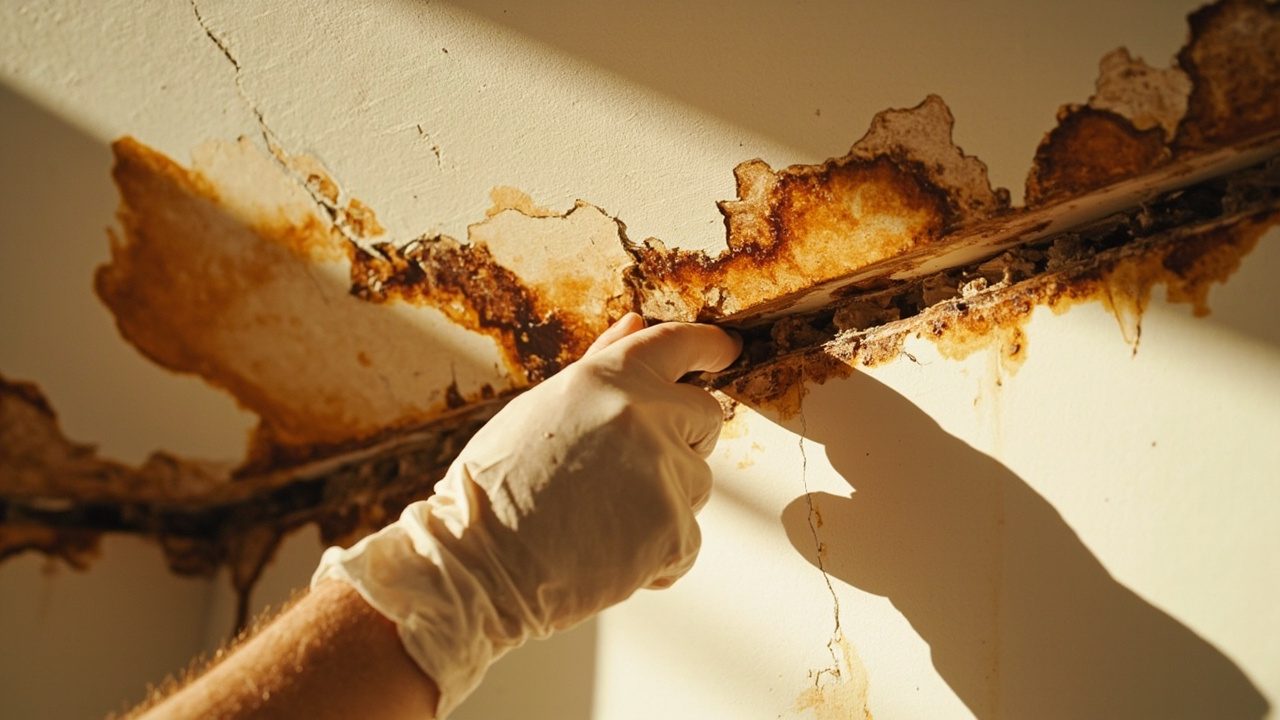
A brown-edged patch on the ceiling under a bathroom, with paint that feels soft under a finger or has started to bubble, means water is reaching that spot from above. The first job is sorting supply water from drain water, because they behave differently. Pressurized supply water escapes all night whether anyone is home or not. A drain only leaks while something upstream runs. So a water stain on ceiling drywall that widens in an empty house points at a supply line, and one that grows after a shower or a flush points at the drain, the tub overflow or the seal at the closet flange.
Local housing decides what is up there. The oldest houses, from the late 1800s through the 1930s, carry galvanized steel supply and cast iron drains and vent stacks, and postwar homes often kept the cast iron drains. Cast iron corrodes from the inside out, and galvanized closes up from the inside as rust builds. That iron is one reason brown spots on a ceiling are common in older stock. Homes from the 1970s through the 1990s mostly have copper supply and ABS or PVC drains, where the leak more often starts at a fitting or a fixture valve.
The stain marks where water leaves the framing, and that is rarely where it started. Water follows a joist, a top plate or the back of a pipe run until it finds a gap, then soaks the drywall below. A ceiling under a bathroom has plenty of candidates right above it, including the shower valve and its drain, the supply stops, the toilet connection and the stack passing through the floor. A leak behind wall tile or drywall can sit a full stud bay from the mark, and a wall that feels warm to your hand at one spot puts the leak on the hot line. If you already painted over the ring with a stain-blocking primer and it came back through, water is still arriving.
Call today when the stain keeps widening while nobody uses water. A hairline supply leak behind tile leaves the framing damp, and nothing dries inside a wall, so the pipe repair turns into a wall rebuild. Drywall that gives under a thumb and a musty smell in the room mean the wetting has run a while. Until someone arrives, closing the main stops a supply leak, and the meter and that shutoff are the only plumbing you need to touch.
More detail on high water bills is on its own page.
How we find the source before anyone opens a ceiling
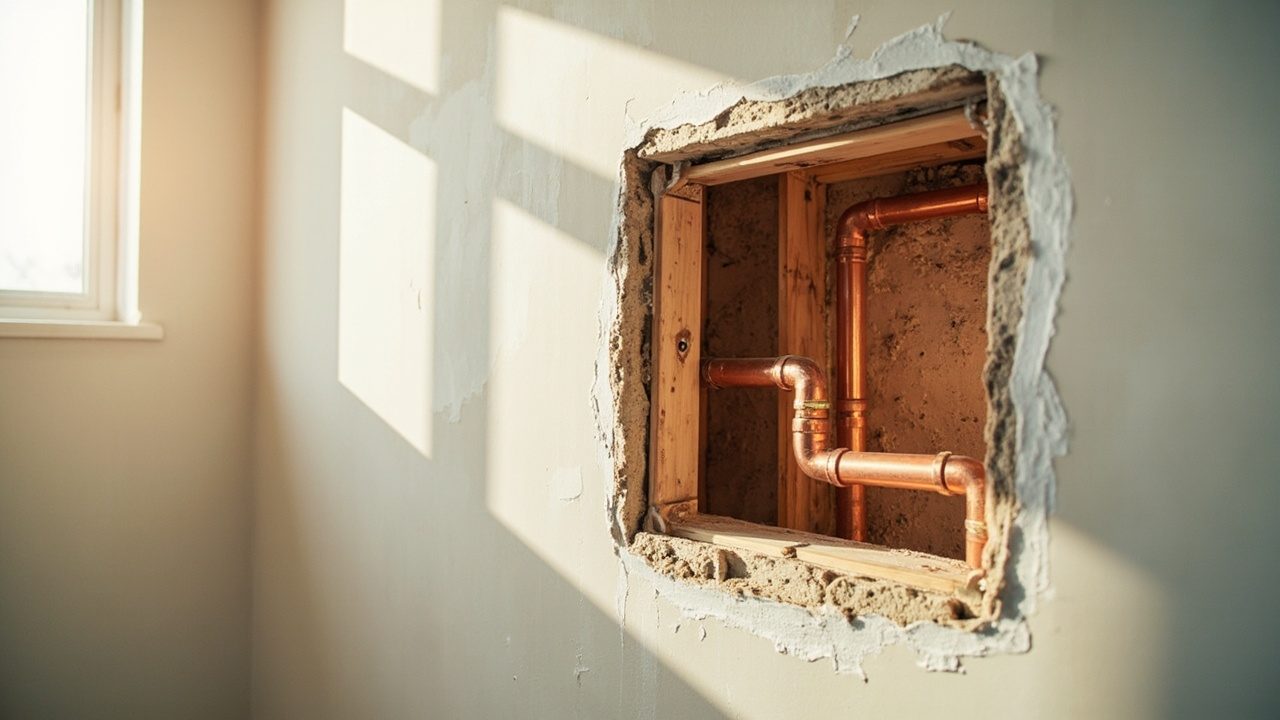
The sequence follows where the water is going. With every fixture closed, the washer and dishwasher idle and any evaporative cooler supply shut, we read the meter leak indicator for fifteen minutes. Then the main closes and the meter gets read again. Next, branches and fixture stops close one at a time, starting with the bathroom above the stain, until the loss stops. A surface only gets opened after that, and it gets opened at one point. The meter leads because it separates supply from drain without touching drywall, and a stain on a ceiling below a bathroom can come from either.
Any movement at the dial with every fixture closed means water is leaving the system under pressure. That puts the stain on the supply side and makes the job a same day question. Closing the main then decides the next fork. A dial that stops means the loss sits inside the house, and we narrow it by branch. A dial that keeps turning with the main closed puts the loss on the street side, which moves the job out to the service line. A dial that holds still for the full fifteen minutes while the stain grows points at the drain side. Then we run the bathroom fixtures one at a time and watch the ceiling, since a shower drain, a tub overflow, a flush and the stack itself each load a different part of the drain.
If the drain stack is the source, the fork is cast iron against PVC or ABS. Cast iron is heavy and quiet and corrodes from the inside over decades, so one leaking hub raises the question of the pipe on either side of it. PVC and ABS are lighter, faster to install and carry more noise through a wall, which matters when the stack runs beside a bedroom. A partial replacement joins new plastic to old iron with a no hub band and a proper transition rather than glue, and that detail decides whether the joint holds. Sound iron above and below one bad hub is a repair at that hub. Pitted pipe along the run points at replacing the segment. On the supply side the same logic applies, since a second pinhole in one length of type L copper means replacing that length, and PEX with fewer joints inside the wall makes the next repair a smaller opening. Where cast iron sits inside a finished wall, reaching the stack often settles the scope before the material does.
If this sounds close but not quite your situation, cold water sandwich effect may be the better starting point.
Your local utility, El Paso Water, publishes service and water-quality information every El Paso homeowner should know.
Ask which of these readings was taken before any part is replaced.
| Instrument | Good reading | Bad reading | What it changes |
|---|---|---|---|
| Water meter leak indicator with every fixture closed | The dial or the small leak wheel does not move over fifteen minutes | Any movement at all with the whole house off | Water is leaving the system somewhere you cannot see |
| Combustible gas detector and bubble solution on gas fittings | No alarm at the fittings and no bubble growing on the joint | Any bubble that keeps growing or any sustained alarm | The appliance valve gets closed before anything else happens |
| Screw on pressure gauge at a hose bib | Static pressure sitting in the 45 to 70 psi range with nothing running | Above 80 psi | Fixtures, supply hoses and water heaters start failing early |
| Anode rod pull on a tank water heater | The rod still has sacrificial metal along the core wire | A bare core wire with the metal gone | The tank itself is now the part being eaten |
| Overnight pressure hold with the gauge left | The morning reading is close to the reading taken the night before | A reading far above the night figure | The heater is expanding water into a closed system with nowhere to put it |
How a ceiling stain visit runs

Phone questions and meter test
On the phone we ask where the stain sits, what room is above it and whether it has grown since you first saw it. On site, you show us the meter and the main shutoff, and every fixture in the house goes quiet. We read the leak indicator for fifteen minutes, close the main, and read again. If the dial moves, fixture stops and branches close one at a time until the loss stops. If it holds still, we activate each bathroom fixture while someone watches the ceiling. Only then does a surface get opened, at one point. Nothing gets cut before you have seen the reading.
Scope approval and repair
Once you approve the written scope, water gets isolated first, at the fixture stop, the branch or the main, depending on where the fault sits. The opening is cut, the failed length or joint is exposed, and the repair follows the material. Cast iron to plastic gets a no hub band and a transition. Copper to galvanized gets a dielectric union. A soldered joint on type L copper gets cut back to sound pipe. If the opening shows more damage than the isolation suggested, we stop and show you before going further, and the change is agreed in writing before work resumes. The rest of the house keeps water whenever the layout allows.
Verification and handover
Before we leave, the meter leak indicator goes back on under the same conditions as the first reading, every fixture closed for fifteen minutes, and the dial has to hold still. Then the bathroom fixtures run one at a time while the repaired area is watched, including a flush and the tub overflow if either was suspect. You walk the opening with us and see the pipe or joint that failed. You keep the written scope along with a note of what the opening found, and the surface goes back as the approved scope states.
Why local pipe eras change how a ceiling leak gets repaired
Anyone can cut a ceiling open, and knowing what sits behind it takes the local housing record. Cast iron drains are common here in houses built before the 1970s, plastic drains take over after that, and newer homes carry PEX supply from a manifold that needs different fittings than copper. A crew that expects PVC behind every bathroom wall reaches for a glue fit coupling on a cast iron hub, and that joint will not hold. Cast iron to plastic takes a no hub band and a transition sized to the pipe.
Mixed materials are the next trap. Where a house has had partial repipes, one wall can hold copper, galvanized and plastic together. Joining copper to galvanized without a dielectric union starts corrosion at that junction, and the new repair becomes the next leak inside the same wall.
The local water is moderately hard to hard. A crew that swaps a shower cartridge or a toilet fill valve without testing at the tap installs a part that scales the same way, so we test the water and plan for flushing, descaling or treatment when the reading is high.
Brief hard freezes during arctic cold fronts split exposed lines, and a ceiling stain can appear hours after temperatures recover, once the pipe is under pressure again. Work that replaces a stack segment or a supply run usually needs a permit, while a like for like fixture valve swap usually does not. The authority that issues plumbing permits makes the final call, and which office that is depends on whether the house sits inside city limits or out in the county.
Calls arrive from across the county, so the first phone questions sort the visit. Water at a ceiling light fixture or an outlet goes first, and the caller is told to kill that circuit before anyone steps into the room. A stain that has held its shape for weeks goes to a scheduled visit that starts with the meter test.
See discolored or rusty water for how the related work is scoped and priced.
The U.S. Department of Energy's water heating guide is a solid primer on operating costs if you want to dig into the numbers yourself.
What the visit looks like from your side
How a call becomes a visit
We ask where the stain sits, whether it is still growing, whether the meter dial moves with everything off, and whether water has reached a light fixture or outlet. Those four answers sort a same day visit from a scheduled one. The arrival window is confirmed with you by phone before anyone heads to your door. If the job ahead of yours runs long, the window moves and you are told by phone. A stain that stopped spreading weeks ago typically takes a scheduled slot.
Protecting floors and rooms
Before anything comes apart, drop cloths go down from the door to the bathroom, and furniture under the stain is moved or covered. A ceiling or wall opening is cut small, at the point the meter test and the isolation marked, with a vacuum held at the blade so drywall dust stays out of the room. A bucket and wet vac stand ready under the cut. Wet drywall and insulation are bagged and leave with us, and the last thing we do is sweep and vacuum the floor.
What moves the scope
Reaching the pipe moves the number most. A tiled shower wall, a finished ceiling below or a slab costs more to open and restore than the pipe costs to fix. Next comes one joint against a whole run, which depends on the condition of the rest of that run, then matching old pipe to new, then fixture grade and after hours calls. You control fixture grade, clearing access and whether adjacent work shares the opening. The written scope comes after the meter test, states what happens if the opening finds more, and you approve it before any work starts.
How technicians are checked
A new technician rides along with a lead before working alone, and the lead signs off on specific tasks. One is reading the meter leak indicator and closing the main to place a loss on the house side or the street side. Another is making a no hub transition between cast iron and plastic that holds. On anything unusual, such as a growing stain over a dial that reads still with no visible source, a second technician looks at it before a scope is written.
You Have Questions,
We Have Answers
Water stains form when moisture soaks into drywall paper and carries dissolved minerals and dust to the surface. As the water evaporates, those deposits collect at the wet edge and leave a tan or brown ring. Sources include a leaking supply line, a drain joint, a failed shower pan, a condensate line from an air handler in the attic, or a roof leak. Each layer of ring usually marks one wetting cycle, so a target-shaped stain means the leak has come and gone repeatedly.
Call a plumber first when the stain sits under a bathroom, kitchen, laundry or water heater. Call a roofer first when it appears only after rain. Water near a light fixture calls for switching off that circuit at the panel before anything else. An HVAC technician fits stains under an attic air handler, because a clogged condensate drain pan overflows onto the ceiling below. Phone details such as the room above and whether the stain grows sort the right trade quickly.
A new stain is damp, soft and often still spreading, while an old one is dry and firm. Press gently with a fingertip. Fresh drywall feels cool and gives, and old drywall feels stiff and chalky. Multiple concentric rings show repeated wetting over time. A stain with a yellow halo that darkens after showers or rain is still active. Photograph the edge with a pencil line drawn around it, then check again in two days to see whether it has crossed the line.
Marks that appear seemingly at random usually come from condensation, not a pipe failure. Cold supply lines or uninsulated ducts in an attic sweat when warm humid air touches them, and the drips soak the drywall below. A clogged air conditioner condensate line, a bath fan duct that vents into the attic, and a loose roof flashing can each wet a ceiling on an irregular schedule. Ice or heavy dew on roof decking that thaws by mid morning also produces stains that show up without any obvious water use.
Cost depends on how much of the ceiling must be opened and what failed above it. Drivers include access, since a tiled shower or finished ceiling adds restoration labor, the pipe material, the length of the damaged run and whether the leak is a single joint. Paint and texture matching add further work after the pipe is fixed. Repairs behind hard to reach framing move the number up, and a simple fixture stop replacement in an open space moves it down. A written scope states the figure before work begins.
Homeowners policies commonly cover sudden and accidental water damage, such as a burst pipe. Slow leaks and gradual seepage over time are commonly excluded. Carriers also tend to exclude the cost of repairing the failed pipe itself while covering the resulting drywall, paint and flooring. Report the damage promptly, photograph the stain and any wet materials before repairs, and keep the plumber's written findings, since adjusters ask when the leak began. Your policy language and adjuster make the final coverage decision.
Why iron pipe and hard water change ceiling stain repair in El Paso
El Paso Water supplies a blend of surface water and groundwater that it describes as moderately hard to hard, and hardness commonly runs around ten grains per gallon or more. Above about seven grains, scale forms steadily in valves, cartridges and water heaters, so a leaking shower valve or toilet fill valve gets replaced with scale in mind and the water is tested at the tap first. The utility also names rusting galvanized pipe inside homes as the typical cause of discolored water, which is why a galvanized run in a leaking wall gets replaced past the failed fitting. Galvanized closes up from the inside, so the pipe beside a failed fitting has usually corroded on the same schedule. Heat matters too. Intense sun degrades exposed plastic lines, and in spring the supply line and float valve on an evaporative cooler go back into service, where scale can hold the float valve open and wet the ceiling around it.
Start with the street side. When the main valve stays closed but the dial continues advancing, the loss originates on the street side, and the water utility and the permit authority determine where responsibility lies, so we hand you the reading and they take it from there. Inside the house, any stack or supply segment replaced under a permit stays visible until the inspection stage the authority requires, which is why we leave that opening uncovered and schedule the drywall after. The desert climate adds its own confusion. Dry air dries a wet stain quickly and leaves a ring at its edge, and a monsoon storm that soaks the roof can leave the same ring on a ceiling while the meter dial holds still. Reading the dial first keeps a roof stain from turning into a pipe replacement.
Plumbing Services in The El Paso Area
Explore our service area and locate Bedrock Plumbing El Paso with ease. We're proudly local and serve the surrounding neighborhoods with fast response and honest pricing. Use the map to check our coverage area, or call us and we'll confirm in seconds.
Address:
Bedrock Plumbing El Paso, 221 North Kansas St, Suite 700, El Paso, TX, 79901
Additional Services We Offer
A water stain that shows up only after a storm, with the meter holding still, is a roof question, and roof repair is outside plumbing. Closing the main, reading the meter and swapping a braided supply hose are homeowner jobs. DIY stops at anything soldered, anything on the gas line and anything behind a finished wall. If the first visit shows the source is outside plumbing, we say so then and tell you who handles it.
Before you call, note where the stain sits, what room is directly above it and if it is spreading. If you can, know when it began and what changed just before. Find the water meter and the main shutoff so you can read the dial with everything off. Know whether water has reached a light fixture, and the age of the pipes if you have it.
Last reviewed September 2026 by Dave Parker, Owner.