





What a slow kitchen drain and a lukewarm sink mean in El Paso
The floor drain nearest the dish station gurgles when the dish machine empties, and the prep sink beside it takes longer to clear each day. One slow fixture puts the fault on its own branch or its p trap. Every fixture slow, with the lowest drain in the kitchen rising first, puts it on the main. A smell with nothing wet points elsewhere, to a dry trap, a vent or the seal at a closet flange. Placing the fault decides how much service you lose, because a branch takes one station offline and a main takes the building.
Supply water behaves differently, because pressurised water escapes whether the kitchen is open or closed and a drain escapes only while something upstream runs. A ceiling stain that spreads overnight is a supply problem. A wet floor that appears when the dish machine empties is a drain problem. Hot water adds its own clue. A dish machine that will not hold its rinse temperature, or a far tap that runs lukewarm, sends the diagnosis to the heater and the pipe run. Water in El Paso tests moderately hard to hard, commonly around ten grains per gallon or more, and above about seven grains per gallon scale forms steadily in tank heaters, valves and faucet cartridges. A kitchen that draws hot water all day builds that scale fast, so a second heater failing within a few years points to the water as the cause.
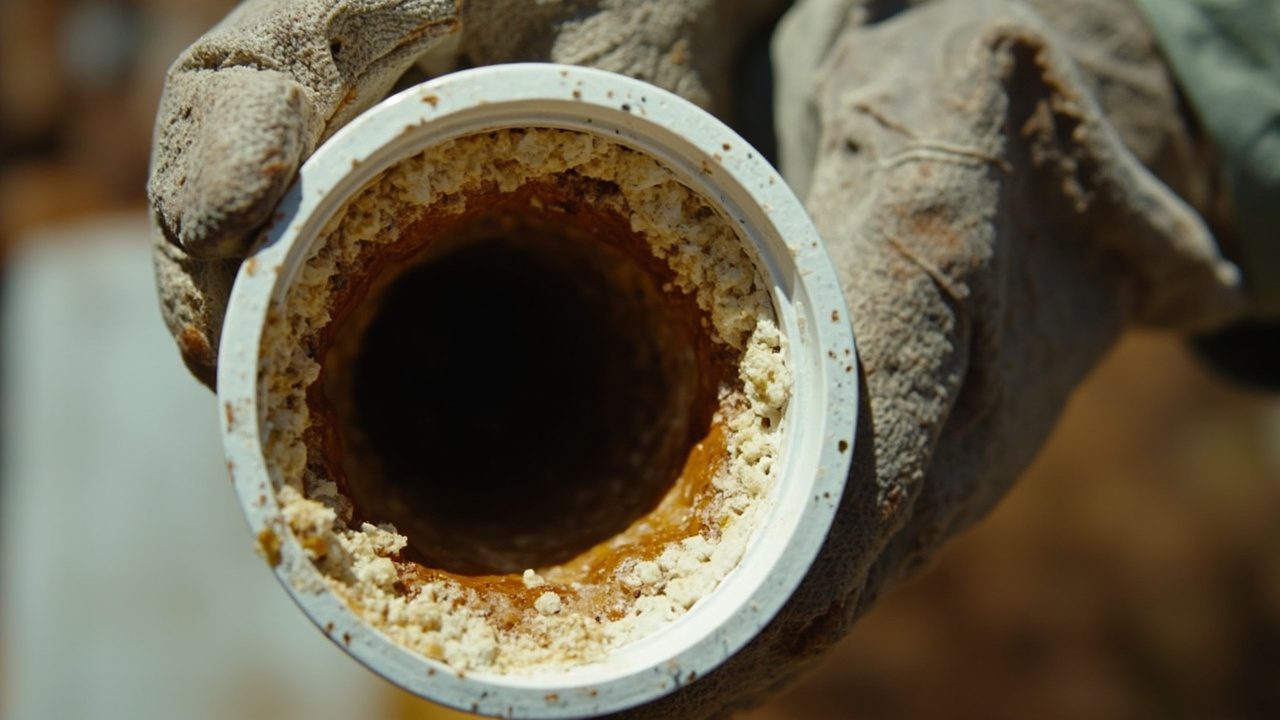
The age of the building sets the rest of the mechanism. Older commercial buildings here often have cast iron drain stacks and long horizontal runs, and cast iron corrodes from the inside out until the wall of the pipe is rough. Hot wash water carries grease in suspension, and the fat cools and sets at the first rough spot, whether that is a hub, an offset or a joint. Clay laterals were jointed in short sections, and every joint gives roots an opening. Buildings from the 1970s through the 1990s have ABS or PVC drains, where grease collects at fittings instead. Restaurant plumbing services that stop at clearing the line leave that spot intact, and commercial kitchen drain cleaning holds longer once a camera has shown where the fat lands.
Call the same day when a line that was cleared slows again. Roots at one clay joint come first, then paper and grease catch at that spot every day, and then the main backs up into the lowest fixture in the building with no warning. A line that slows again after clearing is a location question, because something at one spot is holding the fat.
See commercial backflow prevention & testing for how the related work is scoped and priced.
How the cause is found before any kitchen scope is written
The visit separates supply from drain before any surface opens. Pressurised water escapes whether the kitchen is open or closed, and a drain escapes only while something upstream runs, so the first question is which system is misbehaving. On the supply side the technician closes stops and branch valves one at a time until the symptom stops, which shrinks the problem to one segment. The thermometer then goes on the farthest hot tap, the one at the far end of the pipe run from the heater. The tap runs a full minute first, because the first slug of water is whatever sat in the pipe. Around 120 degrees is the usual balance between scald risk and a tank that stays clean. A booster ahead of a dish machine changes the number at that machine, so the far tap records what survives the trip through the piping.
A far tap reading well below what the heater delivers puts the loss in the pipe run or in a heater scaled over. A tap hot enough to scald a child in seconds points at the control. One so cool that the tank sits where bacteria are comfortable points at an element, a gas control or a thermocouple, all of which are repairs. A hardness test at the same tap settles what comes next. Above about seven grains per gallon the plan includes flushing, descaling or treatment, and a heater replaced into unchanged water scales again. On the drain side the line is cleared first and the camera goes in second from a cleanout, since a full line shows nothing but water. Standing water part way along a level run is a belly. Roots at a joint mean the repair belongs at that joint. Continuous fall with clean joints and visible pipe walls means grease at a branch, which calls for a hydro jetting schedule and no excavation.
Cast iron against PVC or ABS is the comparison that decides most kitchen drain jobs, and El Paso conditions choose the row. The first condition is building age. In a postwar slab building the cast iron under the floor is corroding from the inside, and the camera shows whether one section has failed or the whole run has scaled over. The second is the joint. A partial replacement ties plastic to iron with a no hub band transition, and the transition detail decides whether the joint holds. Check the pipe maker's temperature rating against the water the dish machine discharges before choosing plastic at that station. Under a slab, caliche hardpan slows any dig to a lateral, so lining suits a host pipe that is still round and open cut suits a run whose slope has to be corrected.
Our page on commercial plumbing contractors covers that side of the work in more depth.
Your local utility, El Paso Water, publishes service and water-quality information every El Paso homeowner should know.
Narrow this to two options before calling, then ask which one suits the house.
| Option | The numbers a buyer weighs | Best suited to |
|---|---|---|
| Cast iron drain against PVC or ABS | Cast iron is heavy and quiet and corrodes from the inside over decades | Drain replacement under a finished house |
| Type L copper against PEX | Copper is rigid, tolerates heat directly | Repipes where the existing layout sets the method |
| Tank water heater against tankless | A tank is judged on capacity in gallons and its first hour rating | Households with long back to back hot water use |
| Salt softener against a salt free conditioner | An ion exchange softener removes hardness minerals and needs salt and a drain | Hard water houses weighing salt against upkeep |
| Sump pump selection | Sized by horsepower against the vertical lift plus pipe run it has to push through | Basements with a real lift to the discharge |
How a kitchen plumbing call runs
Call and isolation
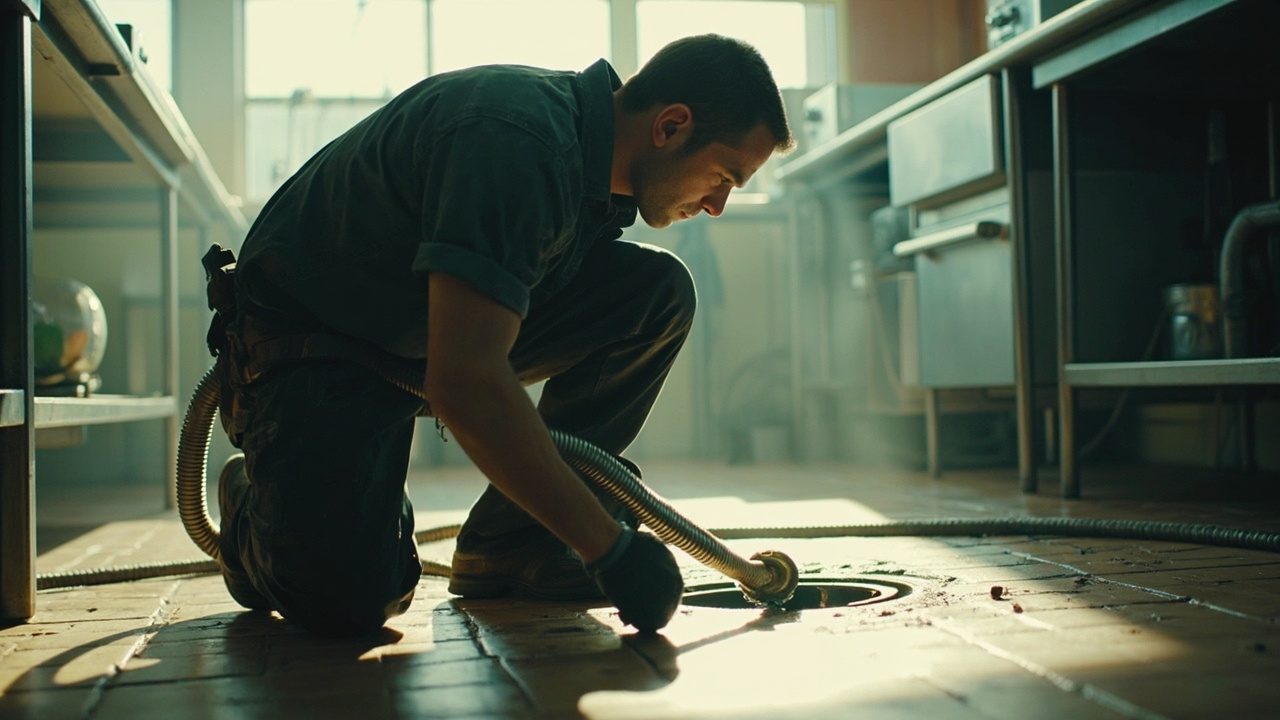
On the phone we ask what you see, when it began, what changed just before it, and whether the kitchen is open. On site the technician isolates first: supply from drain, then the stops and branches to identify where the symptom originates. The thermometer goes on the farthest hot tap after a full minute of running water. On a drain, the line is cleared before the camera goes in from a cleanout, because obstructed lines block visibility. You watch the reading and the picture, and the diagnosis is finished when the fault has a segment and a depth.
Approval and the work
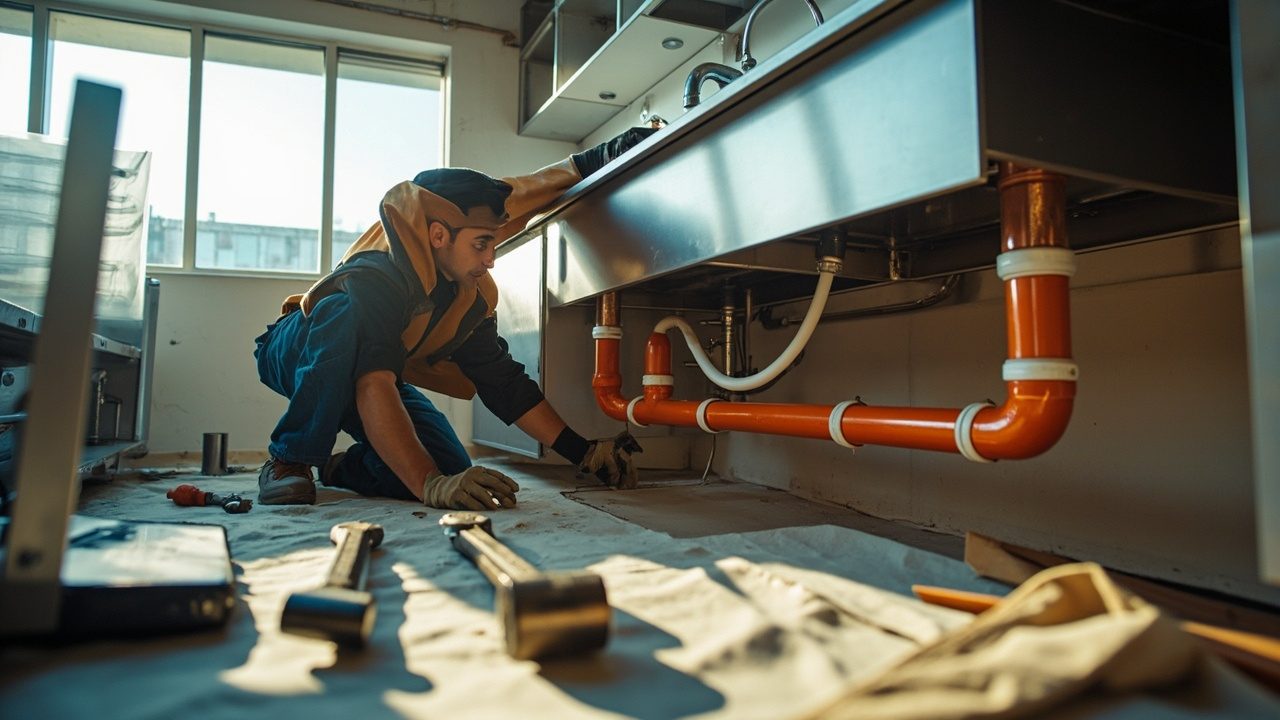
Once the scope is approved, the affected branch is isolated at its stop or valve and surface protection goes down. The main operation follows in trade terms: hydro jetting on a grease line, a cut and a no hub band transition on cast iron, soldered type L copper or PEX on a supply segment, or a commercial sink installation with the angle stops and p trap set before the fixture is loaded. If a second pinhole, a belly in the line or a corroded hub turns up behind the opening, work stops and you see it before we go further.
Testing and handover
Before we leave, the thermometer goes back on the farthest hot tap and has to read the number the scope set, around 120 degrees at a hand tap unless your equipment calls for a different setting. Water then runs through every fixture on the repaired branch while the floor drain is watched for standing water and the line is checked for continuous fall. Gas fittings get the detector and bubble solution. We walk you through each reading, and you keep a written record of the findings and readings that a landlord or a lender can read.
What a crew new to El Paso kitchens gets wrong
Plumbing permits inside city limits come from the city, and work outside city limits falls under the county or the neighboring town, so the first question on any job is which side of that line the building sits on. A full grease line replacement, a main line repair or a change on the gas line usually needs a permit and gets inspected at stages. A like for like faucet or fixture swap usually does not. The authority makes the final call, and the written scope for your job says which applies before work starts.
A crew that does not work this metro tends to make three mistakes. It replaces a scaled heater element without testing hardness at the tap, and the new part scales at the same rate because the water still tests moderately hard to hard. It ties plastic into an old cast iron stack with glue or a plain coupling, and the transition band that should carry the joint is missing. It prices a lateral dig as if the ground were soft, then meets caliche hardpan on the mesas, which slows trenching and stretches the hours a kitchen has no drain.
Weather adds a fourth. Freezing nights happen every winter and most sit just below freezing, so exposed pipe survives until an arctic front drops the temperature well into the teens. That is when exposed hose bibs, backflow assemblies and outdoor lines split, and a crew used to milder or colder climates leaves a new outdoor line unprotected because the average night looks safe.
El Paso County spans river valley soils that hold water and mesa soils over caliche, so the tools and the time a lateral needs depend on where the building sits. Food service plumbing also runs on the kitchen's hours, and a kitchen that cannot close for a repair is served by isolating one branch and keeping the rest working while the fault is corrected. Older buildings in the county may carry several pipe materials in one kitchen, original galvanized and cast iron beside later partial repipes, so the first walk through maps the materials before anything is priced.
If this sounds close but not quite your situation, apartment complex plumbing may be the better starting point.
Permit and inspection questions? Planning & Inspections is the office we coordinate with on every permitted El Paso job.
Working with Bedrock Plumbing El Paso on a kitchen job
How the visit gets scheduled
You call and answer three questions: whether water is escaping under pressure, whether one drain or every drain is slow, and whether the kitchen can run tonight. Those answers sort the call into a same day visit or a scheduled one. The arrival window is set during that call, and a person confirms it by phone ahead of arrival. If the job ahead of yours runs long, the window is reset with you on the phone instead of left to slide.
Protecting your kitchen space
Before anything comes apart, floors and equipment near the work get covered, and the stop or branch valve for that line is closed so the rest of the kitchen stays usable. A full line is opened only from the lowest safe cleanout, with staff kept clear, because a cleanout under head pressure empties onto whoever stands there. Cut pipe, packaging and rinse water leave with the crew. The last step is a run of every fixture on the branch while the nearest floor drain is watched.
What moves the scope
Access moves the scope furthest, meaning a finished wall, tile, a ceiling below or a slab plus restoring the surface. Depth and length of any dig come next, then one joint against the whole run, which turns on the condition of the rest of that pipe. Matching old material to new and fixture grade follow. After hours, weekend and holiday dispatch raises the visit itself. The written scope follows diagnosis, and you approve it, including what happens if an opening finds more, before work starts.
How technicians earn sign off
A new technician rides with a lead and does not work alone until the lead has watched these tasks: a static pressure reading at a hose bib, a drain camera run from a cleanout, and a gas joint proved with detector and bubble solution. The lead signs off on each one. The adopted plumbing code and its updates are reviewed with the crew as they change. On an unusual job, such as cast iron meeting plastic in an old stack, a second technician looks at it before a scope is written.
You Have Questions,
We Have Answers
Most codes require a floor drain in public restrooms with several fixtures, though local amendments decide each building. A drain in a room nobody washes down still needs a trap primer, because an unused trap seal evaporates within weeks and lets sewer gas into the room. The floor should slope toward the drain, and the drain body has to sit at the lowest point. Single-user restrooms are often exempt. Confirm with the permitting authority before cutting a slab, since adding a drain means trenching and a new trap arm.
A commercial kitchen sink drains through a trap and a vented branch, and food-contact sinks usually drain indirectly. Indirect waste means the sink pipe ends above a floor sink or standpipe with an air gap, so a backup below cannot rise into a basin holding food. Pot and pan sinks often route through a grease interceptor first. Each compartment of a multi-bay sink needs its own trap or a shared trap sized for the combined flow. Drain size steps up from the two inch typical of a lavatory to larger pipe where several bays discharge together.
A commercial kitchen needs hot and cold water, sanitary drainage, grease control, backflow protection and separate hand washing fixtures. Typical items are a dedicated hand sink, a three-compartment sink, a mop sink, floor drains and a grease interceptor sized to the fixtures upstream. Dish machines and carbonated beverage lines need backflow preventers on the supply. Gas appliances need properly sized piping with a pressure test. Health and building authorities each review different parts, so the equipment layout should be settled before rough-in begins.
The 135 degree rule limits how sharply drain pipe may turn, so direction changes are built from gentle bends. A 45 degree fitting leaves a 135 degree interior angle, which lets solids keep moving. A 90 degree turn in a horizontal drain is normally made with two 45 fittings or a long sweep elbow, not a sharp short-radius one. Sharp turns catch paper and grease at the inside corner. Vertical-to-horizontal transitions get the same treatment, and a cleanout is usually placed near any significant change of direction.
Yes, a shower and toilet can share one drain branch when the pipe is sized and vented for both. The toilet needs a three inch drain, and the shower trap is usually two inches, so the shower ties in to that larger line downstream of the toilet or through an approved wet vent arrangement. Each trap still needs air behind it, or one fixture will siphon the other dry when it discharges. A shower flowing while the toilet flushes is the test that shows a venting shortfall by gurgling.
The trap sits directly below the sink outlet, and the trap arm then runs to the wall at a steady slope. A common working slope is about a quarter inch per foot, since steeper pitch can pull water out of the trap while flatter pitch leaves solids behind. The vertical drop from tailpiece to trap weir should stay short, and the wall stub-out is set so the trap arm meets its length limit before reaching the vent. Deep sinks or tall cabinet bases can force the trap arm lower, so measure both before roughing in.
Yes, a 45 degree fitting is acceptable in a sewer line and is preferred over a sharp 90. Two 45 bends separated by a short straight piece make a smooth offset that keeps flow moving and lets a drain camera or jetting nozzle pass through. Sewer pipe should hold its slope through the bends, so check fall after setting them. A long run with several bends deserves a cleanout at the upstream side. Solvent-welded plastic and no-hub cast iron both accept 45 fittings, but each needs its own joint method.
Most commercial kitchens need at least one floor drain, and health authorities often require several near wet equipment. Floor drains carry wash-down water, dish machine overflow and condensate from walk-in coolers. The slab has to slope toward each one, or water pools around the mats. Floor drains in rarely used corners dry out, so kitchens often add a trap primer or pour water in weekly. Grease-bearing floor drains commonly connect to the interceptor line, while clean-water drains may bypass it, depending on the plan review.
Commercial plumbing uses larger pipe, higher flow rates and more code-driven safeguards than a house system. Supply lines often feed flush valve toilets, which need high flow and pressure rather than a tank refill. Drains are sized by fixture units across many fixtures at once, so mains run bigger and stack risers multiply. Backflow preventers, grease interceptors, sand traps and water heaters with recirculation loops are routine. Materials tend toward type L copper, cast iron and schedule 40 plastic, chosen by temperature, fire rating and building type.
A kitchen needs hot and cold supply, a trapped and vented drain, shutoff valves and gas piping for gas appliances. Each sink gets angle stops on both supplies, so a single fixture can be shut off without closing the building. The dishwasher takes a supply stop and a drain connection, usually run through a high loop or air gap to stop dirty water reversing. A gas range needs its own shutoff and a flexible connector rated for the appliance. A disposal adds an electrical outlet and a larger trap arm.
Why hard water changes commercial kitchen plumbing in El Paso
Three conditions decide most kitchen jobs here. The water comes from El Paso Water as a blend of surface water and groundwater, tests moderately hard to hard, and is disinfected with chlorine. On the visit that shows up as the far tap reading low while the heater outlet reads fine, because scale on the element and the dip tube slows recovery. Treatment follows the hardness test. An ion exchange softener removes hardness minerals and needs salt and a drain, while a template assisted crystallization conditioner needs neither, so drain availability often decides the choice. Anyone with a question about drinking water should read the utility report and send a tap sample to a laboratory. The second condition is building age. Postwar slab buildings carry cast iron under the floor, later units carry ABS or PVC, and the newest carry PEX manifolds. The third is ground. Caliche hardpan on the mesas slows every trench, and finer valley soils hold more water around the pipe.
Work is inspected at stages during construction, and the stage that matters on a kitchen job is the last one before the surface closes. The adopted plumbing code carries local amendments, so a rule remembered from another jurisdiction can be wrong here. On gas work and main line work the permit is pulled before the first cut, and the inspection is booked around the days the kitchen is closed, because an open trench or an open wall has to be closed on a schedule. What the inspector looks at depends on the work, and the final call is theirs. The joint between old and new pipe, the fall of the new run and the test on the gas fittings are usual places for attention. Familiarity shortens the job because the sequence runs backward from the inspection: isolate the branch, cut, set the transition band, test, then close the surface. A kitchen that closes for one day loses less than one that closes twice.
Plumbing Services in The El Paso Area
Explore our service area and locate Bedrock Plumbing El Paso with ease. We're proudly local and serve the surrounding neighborhoods with fast response and honest pricing. Use the map to check our coverage area, or call us and we'll confirm in seconds.
Address:
Bedrock Plumbing El Paso, 221 North Kansas St, Suite 700, El Paso, TX, 79901
Additional Services We Offer
- Apartment Complex Plumbing
- Commercial Backflow Prevention & Testing
- Commercial Plumbing Contractors
- Commercial Repiping Services
- Commercial Sewer Line Repair
- Commercial Toilet & Urinal Repair
- Commercial Water Heater Systems
- Grease Trap Cleaning & Pumping
- Hydro Jetting Services
- Industrial Pipe Repair
- Medical & Dental Gas Plumbing
- Preventative Commercial Maintenance
Cleaning an aerator, swapping a braided supply hose and closing the main shutoff are homeowner or staff jobs. DIY stops at anything soldered, anything on the gas line, anything behind a finished wall or under a slab, and any drain already backed up past a cleanout. Repairs inside the dish machine or the fryer belong to that equipment's service provider. If the first visit turns up work outside plumbing, we say so then and tell you who handles it.
Know when the slowdown started and what changed just before it, such as a new dish machine. Note which fixtures are affected and the temperature at the far hot tap. Find the main shutoff and any cleanouts if you can, and have the age of the building and the heater to hand. Say whether staff are on site.
Last reviewed September 2026 by Dave Parker, Owner.