





What a musty smell under the sink usually means in El Paso homes
You open the vanity door and the smell arrives first, a damp, earthy odor that stays after the door closes. Then you see black or dark green spotting on the cabinet floor and a base panel that has swelled or gone soft under the trap. That is mold under the sink, and it tells you the wood has been wet for days. A vanity base is glued particleboard or plywood inside a closed box with a tight door. Once water reaches the fibers, almost no air moves through that box to dry them, and the panel keeps feeding whatever is growing on it. The board also swells at its edges, and a swollen edge does not shrink back when it dries.
Placing the water comes before anything else, because the source decides everything. Supply water sits under pressure, so a weeping angle stop or a braided supply hose leaks all night whether anyone is home or not, and the damp shows along the back panel where the lines rise into the wall. A drain leak behaves differently. The slip joint on the p trap drips only while the basin empties, so the stain forms as a ring directly under that joint, wet in bursts and dry in between. Both produce the same black mold in the bathroom vanity. Only the first one is running while you sleep.
The dry desert climate changes what that growth means. Outside air here is dry, so a vanity that stays wet is being fed by a plumbing joint. When you find cabinet water damage mold in a house here, a stop, a hose or a slip joint is almost always wetting the wood directly. Where the supply lines enter the wall behind the cabinet, a pinhole wets the back panel from the far side, and the cabinet floor can look nearly dry while the back panel stays dark and soft.
Where the growth sits tells you which case you have. Spotting confined to the floor under the trap points at a drain joint, and it stays put after the cabinet is dried. Growth that returns within days, or that climbs the back panel, means a supply line is still wet behind it. Closing the angle stop under the sink takes seconds, and if the dampness at that stop dries over the next day, you have found your source. If a hairline supply leak behind tile keeps the wall framing damp, nothing dries inside that wall, and the pipe repair turns into a wall rebuild. Growth on the back panel with a soft wall face is the condition where calling today beats waiting.
More detail on dripping faucets & leaks is on its own page.
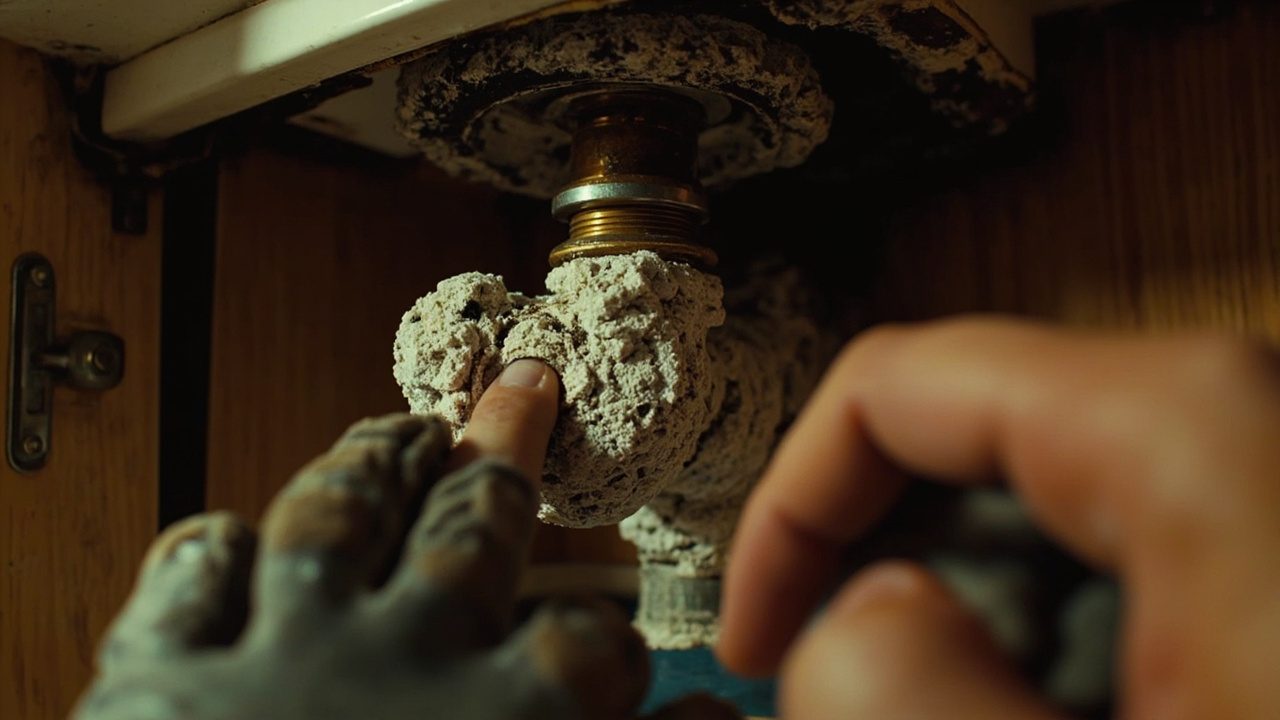
Find the sign you have, then read across to see whether it can wait.
| Symptom or first sign | What is already happening | What it becomes if ignored | When to call |
|---|---|---|---|
| A hairline supply leak behind tile | The framing stays damp | The pipe repair turns into a wall rebuild | This week, while it is still one part |
| An anode rod eaten away | The steel tank becomes the sacrificial metal | Rusty hot water arrives first and a split tank arrives after | This week, while it is still one part |
| A toilet that runs after flushing | The flapper lets the tank refill all night and the fill valve cycles constantly | The valve wears and sticks open with the overflow carrying it away unnoticed | This week, while it is still one part |
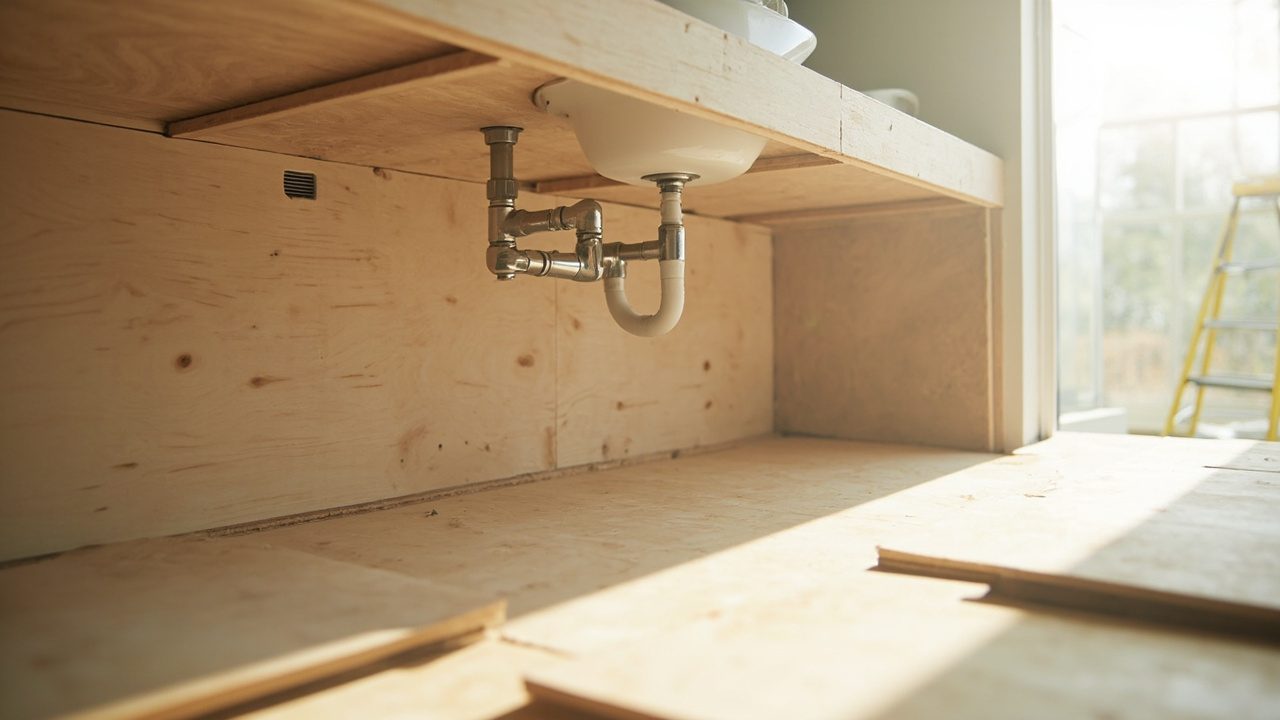
How we find the source before the vanity comes apart
The visit starts at the meter. With every fixture in the house closed, the leak indicator gets watched for fifteen minutes, and that one reading is what this job turns on. Any movement means pressurized water is leaving the system somewhere. A dial that holds still puts the source on the drain side, or on a supply weep too small for the dial to register. Closing the main and reading again splits the house side from the street side, since a dial still turning with the main closed puts the loss outside the building. When the dial moves only with the main open, the angle stops under the sink get closed one at a time until the movement ends, and that names the branch. Only then does anyone pull a panel or open a wall. For a suspected trap joint, the basin gets filled and released over a dry surface, and the slip joint gets watched as the water passes.
What the meter says sets the scope before a quote exists. A still dial with a ring under the trap means a slip joint nut or a cracked trap arm, and the job is a new p trap assembly. A dial that moves and stops when the sink stop closes points at the stop or the braided supply hose, and a corroded compression nut that cannot be snugged means the stop gets replaced with the hose. Movement that continues with the sink stops closed sends the search to the next branch or into the wall behind the vanity, and the job becomes one of access. The cabinet itself is judged after the source is fixed. A base panel that has swelled at the edges or crumbles at the screw holes gets replaced, since wet fibers keep the growth fed.
When the source is a supply segment, the material decides what the next repair costs in drywall. Type L copper is rigid, takes heat directly and costs more in material and labor. PEX with expansion fittings or crimp rings is flexible, so a home run layout to a manifold puts fewer joints inside the wall and gives each fixture its own shutoff. In a house with galvanized supply, the new line joins the old steel through a dielectric union, since bare copper against steel corrodes at the joint. On the drain side, cast iron is heavy, quiet and corrodes from the inside over decades, while PVC or ABS is lighter and carries more noise through a wall. A partial swap needs a no hub band as the transition. Older houses here carry galvanized supply and cast iron drains, so expect to meet that transition, while newer slab homes with PEX and PVC take a single stop swap without one.
If this sounds close but not quite your situation, cold water sandwich effect may be the better starting point.
Permit and inspection questions? Planning & Inspections is the office we coordinate with on every permitted El Paso job.
Ask which of these readings was taken before any part is replaced.
| Instrument | Good reading | Bad reading | What it changes |
|---|---|---|---|
| Water meter leak indicator with every fixture closed | The dial or the small leak wheel does not move over fifteen minutes | Any movement at all with the whole house off | Water is leaving the system somewhere you cannot see |
| Drain camera with a locator | Continuous fall to the main, clean joints | Standing water part way along a level run means a belly | Roots at a joint mean the repair belongs at that joint rather than the whole line |
| Anode rod pull on a tank water heater | The rod still has sacrificial metal along the core wire | A bare core wire with the metal gone | The tank itself is now the part being eaten |
How a moldy vanity call runs
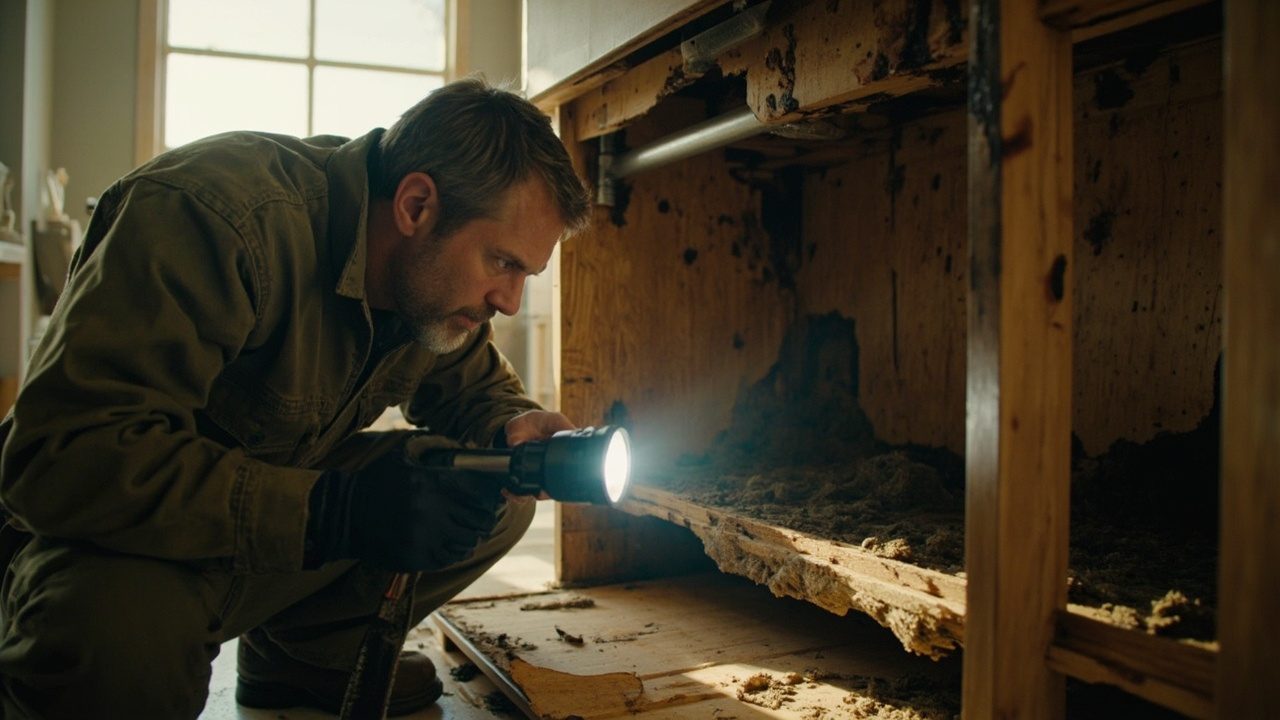
First call and meter read
On the phone we ask where the growth sits, when the smell started, and where your main shutoff is. When the technician arrives, the first stop is the meter, so the household holds off on water for fifteen minutes, including the washer, the dishwasher and the ice maker. The technician reads the leak indicator, closes the main and reads again, then closes the angle stops under the sink one at a time. You watch each reading and hear what it decided. Only after that is the vanity emptied and the back panel checked, and the scope is put on paper from what the water did.
Approved scope and repair
Once you approve the scope, isolation comes first. That means the angle stop for the fixture, the manifold valve on a PEX house, or the main when the work reaches into the wall. We place a bucket underneath before touching any slip nuts. A trap joint gets the trap and its washers replaced as an assembly. On a stop, the corroded compression fitting comes off and a new angle stop and braided supply hose go on. If a corroded galvanized nipple or a soft back panel turns up, we stop and show you before going further, and any change to the scope is written and approved again.
Test and handover
Before we leave, the sink is filled and released over a dry towel, and the new slip joint has to stay dry. The angle stop is opened and the joint and hose watched, and the meter leak indicator goes back on with every fixture closed and has to hold still for fifteen minutes. The old stop or hose is set aside so you can see the crusted fitting. You get walked through the failed part, the reading and the state of the back panel, and you keep the written scope with what was found and done, which gives you the record of cause and extent.
Why a moldy vanity job here needs local plumbing knowledge
Permitting here depends on where the house sits. The city adopts its plumbing code with local amendments, and work outside city limits falls under the county or the neighboring town. A like for like swap of a stop, a supply hose or a trap under a vanity usually needs no permit. A repipe of the branch that feeds the bathroom, or any gas work done in the same visit, usually does, and the final call belongs to the authority for that address.
A crew that does not work these houses tends to treat the cabinet as the job. It pulls the stained base, sets a new vanity, reconnects the old stop, and the growth returns on new wood because the weep never stopped. The second mistake sits in the wall. Older houses here carry galvanized supply, and galvanized corrodes closed from the inside. A new angle stop threaded onto a corroded galvanized nipple can twist the nipple off in the wall, and the bathroom then takes full supply pressure. A crew that has opened these walls closes the main first and supports the nipple with a wrench while the stop comes off.
Postwar slab houses add a third condition. Their copper or galvanized supply and cast iron drains can run under the floor, so a warm spot on the bathroom floor points to a hot line under the slab and turns a vanity repair into a slab leak job. Cast iron trap stubs need a check too, since one that has corroded from the inside can crack at the wall when a new p trap is torqued onto it.
Once the source is stopped, document the damp base and the failed joint before anything goes in the trash. Photographs should show the failed part, the wet wood and the surrounding wall. If you file a claim, you file it and your carrier decides what is covered.
Calls reach us from across the county, from dense older housing to newer subdivisions on the east and west sides, and the phone questions sort them by one thing, which is whether water is escaping under pressure right now. Older housing brings galvanized and cast iron, newer housing brings PEX and PVC, and the material is worth knowing before the visit begins.
See discolored or rusty water for how the related work is scoped and priced.
What a moldy vanity job looks like day to day
How a call becomes a visit
You call, and we ask where the growth sits, whether the meter dial moves with everything off, and whether you can reach the stop under the sink. Those answers sort a supply leak that runs all night from a trap joint that drips only when the basin empties, and the supply leak goes first. The arrival window is given to you during that call. If a burst line ahead of yours is running under pressure, your window can shift, so keep the phone within reach.
Protection and cleanup
A drop cloth goes down from the bathroom door to the vanity before the doors are opened, and everything stored under the sink comes out onto a protected surface. Before a slip nut is loosened, a bucket goes under the p trap, because the trap holds standing water. Tools stage on a mat beside the vanity. Cabinet parts that come out are bagged inside the room, and the last thing done is wiping the floor and lifting the drop cloth with the debris inside it.
What moves the cost
Access moves the number furthest. A stop or trap under an open vanity is a short job, while a pinhole behind tile or inside a wall adds the opening and the surface put back afterward, usually the larger half of the work. Next comes one joint against a whole run, decided by the condition of the rest of that pipe. Fixture grade and after hours calls follow, and you control the grade and any adjacent work in the same opening. The written scope follows diagnosis, and you approve it before work starts.
How technicians get checked
A new technician rides with a lead before working alone, and the lead signs off on specific tasks. Those include reading the meter with every fixture closed, closing stops in sequence until the movement ends, making up a slip joint that stays dry under a full basin, and joining copper to galvanized with a dielectric union. On anything unusual, such as a meter that keeps moving with every stop closed, a second technician looks at it before a scope is written. The owner keeps up with updated state codes and newer fixtures.
You Have Questions,
We Have Answers
Yes, mold exposure can cause respiratory and skin irritation, especially in people with asthma, allergies or weakened immune systems. Typical symptoms include sneezing, a stuffy nose, itchy eyes, coughing and wheezing that ease when you leave the room. Spores concentrate in a closed vanity and spread each time the doors open, so the reaction is often worst right after cleaning under the sink. Anyone with persistent symptoms should ask a physician, because plumbing work cannot diagnose a health condition.
No agreed list of ten signs exists, and the symptoms attributed to mold overlap with many other conditions. Commonly reported ones are congestion, cough, wheeze, eye irritation, skin rash and headache. Treatment is a medical matter, so a physician should evaluate anything persistent. The practical step on our side is removing the moisture source, since growth continues while wood stays wet. A plumber can stop the leak but cannot test for mold or treat exposure.
Most people recover once the exposure ends, and irritation symptoms often fade within days to weeks. Recovery depends on the person and on how long spores were breathed. Fixing the water source matters most, because a vanity that keeps getting wet keeps releasing spores. Someone with lingering breathing trouble should see a physician, since that judgment falls outside plumbing.
A plumbing joint or supply line is wetting the wood, and the closed box cannot dry it. Two signs point to the cause. A slow drip from a compression fitting leaves a green or white crust on brass, and a weeping trap nut leaves a rust or mineral ring. Steamy showers add humidity, but constant growth usually means a live leak.
Cabinets can be saved when the wood is solid and the growth sits on the surface. Solid wood doors and face frames often clean up after drying. Particleboard that has swelled, crumbles at screw holes or feels soft cannot be restored, because the fibers hold moisture and feed growth. Press a screwdriver tip into the base panel. If it sinks in, the panel is finished. Fix the leak before any cleaning, or growth returns.
Texas runs a state mold program that regulates mold assessors and remediators, and it covers mold work, not plumbing. Its rules generally require the assessor and the remediator to be separate parties on a job. Small areas of contamination are treated differently from large ones, and the state agency that administers the program publishes the current thresholds. Check those rules before hiring anyone for mold removal. A plumber's role is stopping the leak.
Late summer is usually worst here, when monsoon storms raise outdoor humidity for a few weeks. Indoors, though, cabinet mold follows leaks more than seasons. Cold nights can also make supply lines sweat, wetting a vanity base that stays dry the rest of the year. Steady growth in any month means a fitting is leaking. Checking under the sink each time the weather turns catches a weeping stop early, before wood absorbs much.
Yes, bathroom mold can harm people who are sensitive to it and it damages the cabinet itself. The most common effects are irritation of the nose, throat and eyes, and worsening asthma. The wood suffers too, because growth on a damp panel goes along with fibers that weaken and swell. Black growth clustered around a trap joint or along the back panel signals a continuing leak. Stopping that water is the first repair.
Nothing kills mold instantly, and wiping alone leaves the damp wood that regrows it. Household products can clean surface growth on hard, nonporous surfaces, but they will not reach into porous particleboard. Never mix bleach with ammonia or acidic cleaners, because the fumes are dangerous in a small enclosed bathroom. Ventilate, dry the cabinet fully and find the leak, since a plumber's job is tracing the water source behind the growth.
Most bathroom mold is not the toxin-producing kind people fear, but color cannot identify a species. Black growth is not proof of a dangerous type, and only laboratory testing can identify it. Treat every colony as a possible irritant and keep children, pets and sensitive people away during cleanup. Wear an N95 respirator and gloves when handling it. The dependable fix is eliminating the moisture that supports growth.
Why hard water changes mold in bathroom cabinets in El Paso
El Paso Water describes the supply as moderately hard to hard, and a test kit at the tap commonly reads around ten grains per gallon or more. Above about seven grains, scale forms steadily on valves and fixtures, so the crust on a compression nut under a vanity is a visible sign that a stop has been weeping long enough to wet a cabinet base. Age of the house then decides what sits behind that stop. Older homes carry galvanized supply that corrodes from the inside, and the same utility names rusting galvanized pipe as the typical cause of discolored water in a home. Homes from the 1970s through the 1990s commonly have copper supply run under or through the slab, and homes from the 2000s onward commonly have PEX on a manifold. Each material fails at a different point, so the same black growth under a sink can trace to a nut, a fitting or a pipe wall.
Where a permit applies, work is inspected at stages during construction, and the inspector needs to see the pipe before drywall covers it. That fact sets the order of a bathroom job. The new supply branch, its stops and any drain transition stay exposed until the inspection, and the studs and bottom plate dry in the open room air at the same time. Wood that stayed wet behind a vanity should show no dark staining and carry no musty smell before it is closed in, so an open wall serves the inspection and the drying together. Whether a given job needs a permit is the authority's decision, and a call to them before the wall is closed settles it. If the meter dial keeps turning with the main closed, the water utility and the authority settle whose side of the line the pipe sits on.
Plumbing Services in The El Paso Area
Explore our service area and locate Bedrock Plumbing El Paso with ease. We're proudly local and serve the surrounding neighborhoods with fast response and honest pricing. Use the map to check our coverage area, or call us and we'll confirm in seconds.
Address:
Bedrock Plumbing El Paso, 221 North Kansas St, Suite 700, El Paso, TX, 79901
Additional Services We Offer
Swapping a braided supply hose and closing the angle stop are homeowner jobs, and you do not need us for them. DIY stops at anything soldered, anything on the gas line, anything behind a finished wall or under a slab, and any drain already backed up past a cleanout. Testing for mold and removing widespread growth fall outside plumbing work. If the first visit finds that scope, we say so then and name who handles it.
Before you call, know where the dark growth sits, under the trap or on the back panel, and when the smell first showed up. Find your main shutoff and the angle stop under the sink, and note if water is flowing when all fixtures are closed. Any age you have for the vanity or the pipes helps, and so does what changed just before you noticed it.
Last reviewed September 2026 by Dave Parker, Owner.