





What a turning meter dial and a warm floor spot mean in El Paso homes
Start with these steps, in this order, while the leak is active. Shut the water off. Use the stop at the fixture if there is one. If there is not, close the main where the line comes into the house or at the meter. If water has reached an outlet, a panel or a ceiling fixture, kill that circuit before anyone steps into the water. If the leak is at the water heater, close the cold inlet on top of the tank and turn the gas control or the breaker off. Then open a hot tap on a lower floor so the tank is not under vacuum. If you smell gas or rotten eggs, touch no switch and no phone charger. Get everyone outside, leave the door open behind you, and call Texas Gas Service from outside.
A stain is spreading on a ceiling, one spot on the floor feels warm, or your water bill jumped while nothing looks wet. All three put the leak on the supply side. Pressurized water leaves the pipe all night whether anyone is home or not. A drain only leaks while something upstream runs, so a wet spot that appears only during the wash cycle is a different job. A warm patch on a slab floor is a hot line under the floor. A ceiling stain that grows by the hour is a pinhole or a fitting inside a wall, and the framing stays damp because nothing dries inside it. A bill that jumped points to the meter, which is where the search starts.
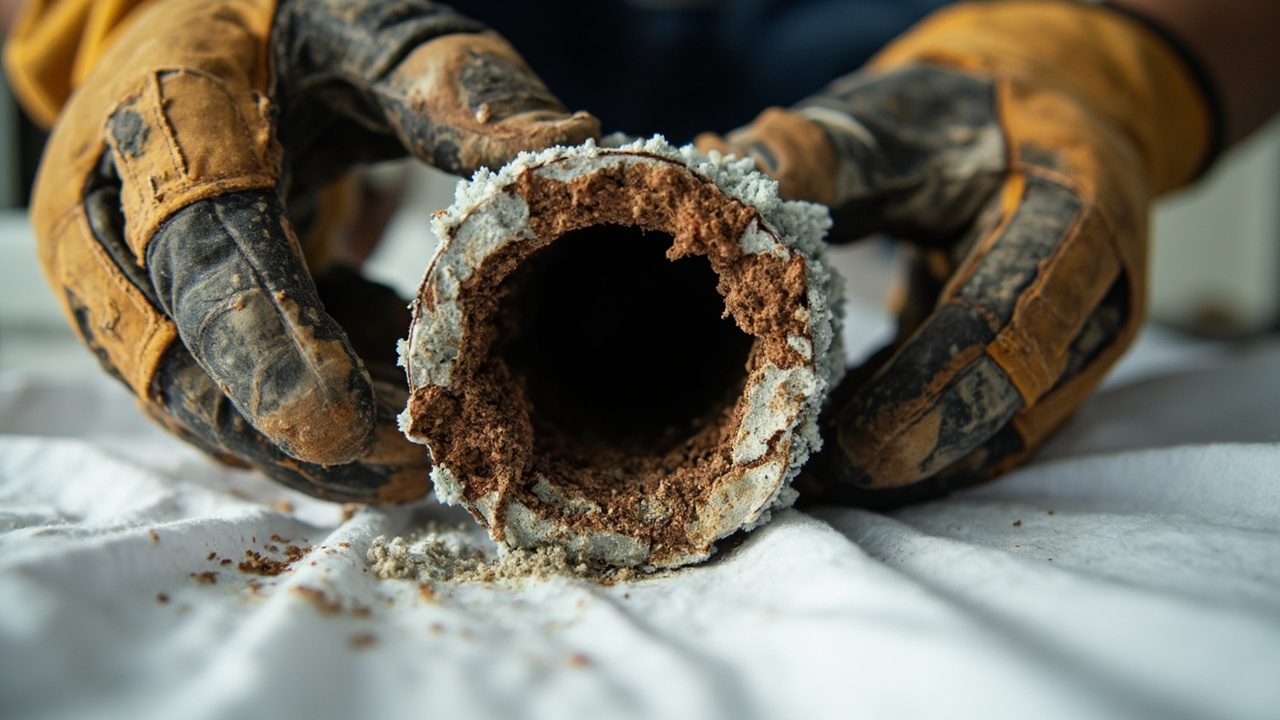
The local utility describes the water as moderately hard to hard, and scale crusts the compression nut and stem on angle stops and fixture valves. Houses from the 1940s through the 1960s often carry galvanized or early copper supply, and galvanized closes up from the inside. Slab homes from the 1970s through the 1990s run copper through or under the slab. Newer subdivisions use PEX on manifolds, and PEX left in sun degrades. Spring brings evaporative coolers back into service, and scale on a float valve keeps the fill open. Brief hard freezes after mild days split exposed hose bibs and outdoor lines at the coldest point. Nothing shows until the ice clears and the pipe is under pressure again.
A weeping angle stop under a sink looks minor, and calling today beats waiting because scale corrodes the compression nut until it cannot be snugged. Then the stop snaps off in someone's hand during a faucet change and the room takes the full supply. A meter dial that turns with every fixture off is the same call. At the weep stage the fix is a valve swap. After the snap it is a flooded room and an urgent pipe leak repair behind a wet wall.
Our page on 24/7 emergency plumbing services covers that side of the work in more depth.
How the meter locates a leak before anyone opens a wall
The sequence follows where the water goes. With every fixture, the washer and the ice maker off, the technician watches the meter leak indicator for fifteen minutes. A dial or leak wheel that sits still means water escapes only while something runs, and the search moves to a fixture, a supply hose or a drain. Any movement at all means water is leaving the system somewhere you cannot see. Next the main gets closed and the dial gets watched again. A dial still turning with the main closed puts the leak on the street side of your shutoff, and the job moves out to the service line. A dial that stops puts the leak inside the house. Then stops and branches close one at a time until the loss stops. Only after that does a cabinet or a wall get opened, and only the one that holds the segment.
The meter reading with everything off is the one this page turns on, because it splits the house into halves before a tool touches a surface. That split decides the first cut. Above the slab, closing branches and listening at the pipe narrows the leak to a run. Below the slab the work needs listening gear, tracer gas or thermal on a hot line, plus a locator. The choice there is breaking the slab at one point or rerouting the line overhead. Pressure and hardness readings taken on the same visit can widen the job to a pressure reducing valve, an expansion tank or heater work, and any widening goes into the written scope before you approve anything.
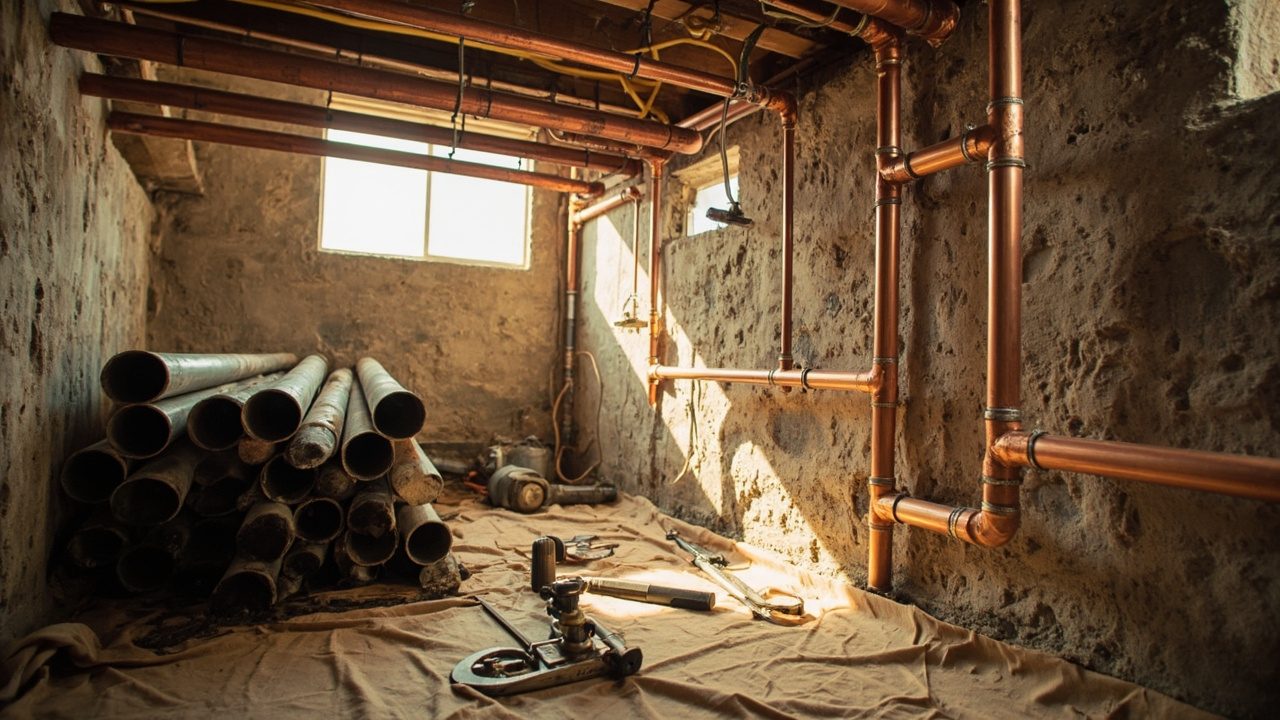
When a segment has to be replaced, the choice is type L copper or PEX, and access decides which one is easier. Copper is rigid, takes heat directly and costs more in material and labor. PEX is flexible, so a home run layout from a PEX manifold puts fewer joints inside your walls. PEX A takes expansion fittings and PEX B takes crimp rings, and both have to stay out of sunlight and be protected where they pass through framing. Fewer joints in the wall also means fewer places to open drywall on a later repair. Local water adds a second decision. Water that tests moderately hard to hard scales the stops and valves that feed a fixture, so a new pipe run does not cure a scaling stop. Freeze exposure decides routing, since brief hard freezes split lines at the coldest exposed spot. Where the same old pipe has pinholed twice in one segment, the segment gets replaced. Where one fitting failed and the rest of the run looks clean, the spot gets repaired.
See gas leak detection & repair for how the related work is scoped and priced.
Your local utility, El Paso Water, publishes service and water-quality information every El Paso homeowner should know.
Ask which of these readings was taken before any part is replaced.
| Instrument | Good reading | Bad reading | What it changes |
|---|---|---|---|
| Water meter leak indicator with every fixture closed | The dial or the small leak wheel does not move over fifteen minutes | Any movement at all with the whole house off | Water is leaving the system somewhere you cannot see |
| Thermometer at the farthest hot tap | Hot water arriving around 120 degrees | Hot enough at the tap to scald a child in seconds | The first slug of water is whatever was sitting in the pipe |
| Drain camera with a locator | Continuous fall to the main, clean joints | Standing water part way along a level run means a belly | Roots at a joint mean the repair belongs at that joint rather than the whole line |
| Overnight pressure hold with the gauge left | The morning reading is close to the reading taken the night before | A reading far above the night figure | The heater is expanding water into a closed system with nowhere to put it |
How a leak repair call runs
The call and the meter
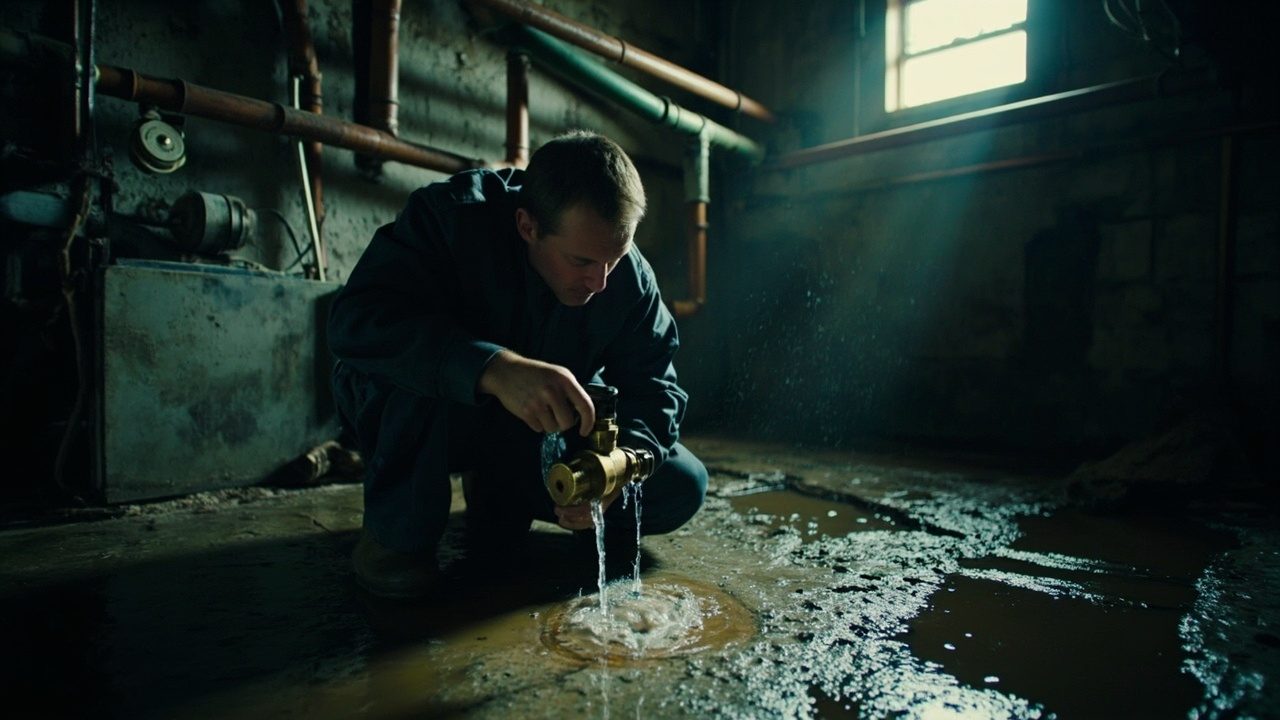
On the phone we ask where you see water, when it started, whether anyone is in the house and where your main shutoff is. On site, the technician closes every fixture and observes the meter for fifteen minutes while you stand by if you like. Then the main closes and the dial gets read again. Individual stops and branches isolate one at a time until flow ceases, which names the segment. Listening at the pipe confirms the location before any cutting begins. A cabinet or one section of wall opens only after that, and the scope gets written from what is found.
Approval, then the repair
Once you approve the scope, isolation comes first. The branch closes and drains, and the failed section is cut out square. A new angle stop or valve goes in, or a section of type L copper is soldered in, or PEX goes in with an expansion fitting or a crimp ring. A dielectric union joins copper to galvanized. Old and new pipe get matched on material and size at every joint. If more pipe of the same age turns up behind the opening, we stop and show you before going further, and the scope changes only with your yes.
Testing before we leave
Before we leave, the meter leak indicator goes back on with every fixture closed, and the dial has to sit still for fifteen minutes, the same test that found the leak. A screw on gauge at a hose bib then reads static pressure with everything off, and good static pressure sits between 45 and 70 psi. A reading above 80 psi gets written into a recommendation for a pressure reducing valve, and you decide on it. We walk you through the repaired joint and the removed part. You keep the written scope and the readings taken.
Why desert water and mixed pipe eras change a leak repair
Permits follow the work, and the answer changes by address. Gas line work and main line work usually need a permit, and a like for like swap of a faucet, an angle stop or a supply hose usually does not. Inside city limits one office issues plumbing permits, and outside them the county or the neighboring town does, so the first question is which office covers your house. That office makes the final call, and the written scope reflects its answer. We ask that question on the call so the plan is settled before a wall is opened.
Crews from outside the area tend to treat every house in the county as one pipe material, and a house with a partial repipe holds several. Tie new copper straight to old galvanized without a dielectric union, and the joint corrodes where the two metals meet. A cast iron stack glued to plastic leaks at the joint, where a no hub band transition holds. Scale crusts a new angle stop's stem when the crew ignores water that tests moderately hard to hard. Caliche hardpan under the sand turns a yard line dig into a different job halfway through, for a crew that scoped it as soft soil. After a freeze, the visible split on a hose bib gets repaired and the rest of the exposed run gets skipped, so a second split stays hidden until the line is under pressure again. PEX routed through an exposed garage wall sits in sun and freeze range, so routing is decided before pipe is cut.
Response across the county depends on where you are and what is ahead of yours, so the person who answers gives you the window on the call. Calls bunch up during arctic cold fronts, when exposed lines split, and again in spring when evaporative coolers start up and scaled float valves stick open. The fork most callers face is tonight or tomorrow morning. Water escaping under pressure runs all night, so that is tonight. A weeping stop you have closed at the fixture can wait for a scheduled visit, and emergency leak repair service after hours covers the first kind.
More detail on slab leak detection & repair is on its own page.
Permit and inspection questions? Planning & Inspections is the office we coordinate with on every permitted El Paso job.
Working with Bedrock Plumbing El Paso on a leak, day to day
When someone arrives
You call and describe the leak, and we ask whether water is leaving under pressure, whether it has reached a ceiling or a circuit, and what the meter dial does with everything off. Those answers separate a same day leak repair service visit from a scheduled one. The person on the phone gives you an arrival window during that call and confirms it with you as the visit gets close. If the job ahead of yours runs long, the window moves and you are told before it passes.
Protecting floors and walls
Before anything comes apart, the water goes off at the stop or the main and the floor under the work gets covered. The opening is sized from what the meter check and listening found, so only the wall section or cabinet that holds the pipe gets cut. Plastic sheeting at the opening keeps drywall dust out of the room, and a wet vacuum takes standing water. Cut drywall and old pipe leave with us. The last thing done is turning the water back on and wiping the repaired joint dry to watch it.
What moves the scope
Access moves the job furthest. A finished wall, a tiled surface, a ceiling below, a slab or a crawlspace each add work to reach the pipe and to put the surface back. Depth and length of any dig come next, then one joint against the whole run, which the condition of the rest of that pipe decides. Matching old pipe to new, the fixture grade you choose and an after hours call move it too. You see the written scope after the meter check and approve it before work starts, stating what happens if the opening finds more.
How technicians earn sign off
A new technician rides along with a lead before working alone, and the lead signs off on specific tasks. Those include reading a meter leak indicator, closing a main, making a no hub band transition and joining PEX with crimp rings and expansion fittings. Dave Parker keeps the team current on updated state codes and newer fixtures. On an unusual job, such as a leak under a slab, a second technician looks at it before a scope is written.
You Have Questions,
We Have Answers
A rubber leak repair clamp or a self-fusing silicone tape stops most pipe leaks fast. Silicone tape stretches to about twice its length and bonds only to itself, so wrap it tightly with each turn overlapping the last by half. Dry the pipe first, because a wet surface prevents a seal. Either product buys hours on a pinhole or a split, not a permanent fix. Keep the water off at the stop while the wrap cures, then plan a proper repair of that section.
Report a street-side leak to the water utility and a house-side leak to a plumber. The meter box lid usually marks the boundary at the shutoff valve. Before calling the utility, note the meter number, where water surfaces, and whether it is clear or muddy. Muddy water bubbling from soil often means a broken service line. Photos of the wet ground help the utility crew decide how urgently to respond.
A repair clamp, a slip coupling or a push-fit coupler can seal a leaking pipe without replacement. A clamp with a rubber sleeve wraps a pinhole or a hairline split and tightens with bolts across the damaged spot. Push-fit couplers slide over clean, square-cut pipe ends and grip with a stainless collar. Each needs about an inch of smooth, undamaged pipe on both sides of the failure. Corroded galvanized pipe rarely offers that, so the whole run may need replacing.
Standard glue does not seal a pressurized water pipe, because supply lines flex and push against any adhesive. Solvent cement joins PVC and CPVC fittings only, and only on drain or supply pipe of those plastics. It welds the plastic surfaces together and needs a full cure, often a day, before pressure returns. On copper, steel or PEX, glue peels away as water finds the edge. A leak in metal pipe calls for a clamp, a coupling or a soldered repair.
JB Weld can slow a small leak briefly, though it fails as a lasting repair on pressurized supply pipe. The epoxy needs a dry, roughened surface and several hours to harden, and a leaking pipe stays wet and pressurized. Even cured epoxy is rigid, so pipe vibration and thermal expansion crack the bond over time. On a drain line with no pressure it holds better. On a supply line, treat it only as a stopgap while the water stays off.
Meter leak repair cost in Texas swings widely, and the leak's location drives most of it. A leak at the meter itself belongs to the utility, which owns the meter and usually repairs it. A leak on your side of the shutoff is yours, and price rises with dig depth, pipe length and surface restoration. Ask for a written scope before work starts, because a short fitting repair and a long line replacement sit far apart.
Flex Seal does not reliably stop a leaking water pipe under pressure. The liquid rubber needs a clean, dry surface and time to cure, and wet metal with water pushing outward blows the coating off or bubbles it. Sprayed over a pinhole, it can hide a growing corrosion problem while the pipe wall keeps thinning underneath. It has some use sealing a dry gutter seam or a roof flashing gap. For a pipe, use a mechanical clamp instead.
Plumber's epoxy putty and self-fusing silicone tape are the most effective sealants for temporary pipe repairs. Epoxy putty is kneaded until the color is uniform, then pressed over a dry pinhole and left to harden, usually within an hour for a light-duty grade. Silicone tape suits wet or awkward spots. Neither replaces a fitting on a pipe that is corroding through. Check the label for a rated pressure, since household supply typically runs between 45 and 70 psi.
A stainless steel repair clamp with a rubber gasket is the best product for most leaking supply pipes. It seals against pressure by compressing the gasket around the pipe, so it works on copper, galvanized and PEX of matching diameter. Buy the clamp sized to the pipe's outside diameter, since a loose fit lets water track underneath. Tighten the bolts evenly, then watch the joint for ten minutes under pressure. A pinhole in a bend or near a fitting needs a coupling instead.
Why hard water changes rapid response leak repair in El Paso
Four pipe eras sit side by side across the county, and each one fails in its own way. Houses from the late 1800s through the 1930s carry galvanized supply that closes up from the inside, cast iron drains and clay laterals. Postwar slab homes from the 1940s through the 1960s have galvanized or early copper supply with cast iron under the slab, so a warm spot on the floor can be a hot line beneath it. Homes built in the 1970s and 1980s installed copper through the slab foundation, while newer subdivisions use PEX on manifolds. A wet slab with a still meter dial points to a cracked cast iron drain. Water hardness in the county reaches seven grains per gallon or higher, causing scale deposits that require heaters and valves to be flushed or treated as part of the job. Sandy, gravelly soil with caliche hardpan slows any dig, while the river valley has finer alluvial soil that holds more water.
Where a permit applies, inspection happens at stages while the work is still open, so pipe has to stay visible until the inspector has seen it. Inspectors usually look at the joint type where dissimilar metals meet, the support and protection of PEX through framing, transition bands on cast iron, and a pressure hold on new piping. Gas connections at a water heater get closer attention than a faucet swap does. Inside city limits and outside them, different offices handle the permit, so the answer for your address comes before a wall is closed. Knowing that up front changes the order of work, because the open wall waits for the inspection and the finish work waits behind it. Arctic cold fronts add outdoor work, since short hard freezes split unprotected outdoor piping and backflow assemblies, and a repair there follows the same staged sequence when a permit applies.
Plumbing Services in The El Paso Area
Explore our service area and locate Bedrock Plumbing El Paso with ease. We're proudly local and serve the surrounding neighborhoods with fast response and honest pricing. Use the map to check our coverage area, or call us and we'll confirm in seconds.
Address:
Bedrock Plumbing El Paso, 221 North Kansas St, Suite 700, El Paso, TX, 79901
Additional Services We Offer
- 24/7 Emergency Plumbing Services
- Basement Flooding Pump-Out
- Burst Pipe Repair
- Emergency Sewer Backup Cleanup
- Emergency Sump Pump Failure
- Emergency Water Heater Repair
- Emergency Water Shut-Off Service
- Frozen Pipe Thawing & Repair
- Gas Leak Detection & Repair
- Main Water Line Break Repair
- Overflowing Toilet Repair
- Septic Tank Emergency Pumping
Closing the main, swapping a braided supply hose or a flapper, and cleaning an aerator are homeowner jobs. DIY stops at anything soldered, anything on the gas line, anything behind a finished wall or under a slab, and any drain backed up past a cleanout. If the dial keeps moving with the main closed, the leak sits on the street side, and we tell you so on the first visit and name who decides responsibility.
Know where the water shows and when it started, and what changed just before, such as a faucet swap or a cold night. Read your meter with every fixture closed and note whether the dial moves. Find your main shutoff, and tell us if water has reached an outlet or ceiling, whether anyone is in the house, and the age of the pipe if you know it.
Last reviewed September 2026 by Dave Parker, Owner.