





Rusty hot water or a puddle under the tank in El Paso homes
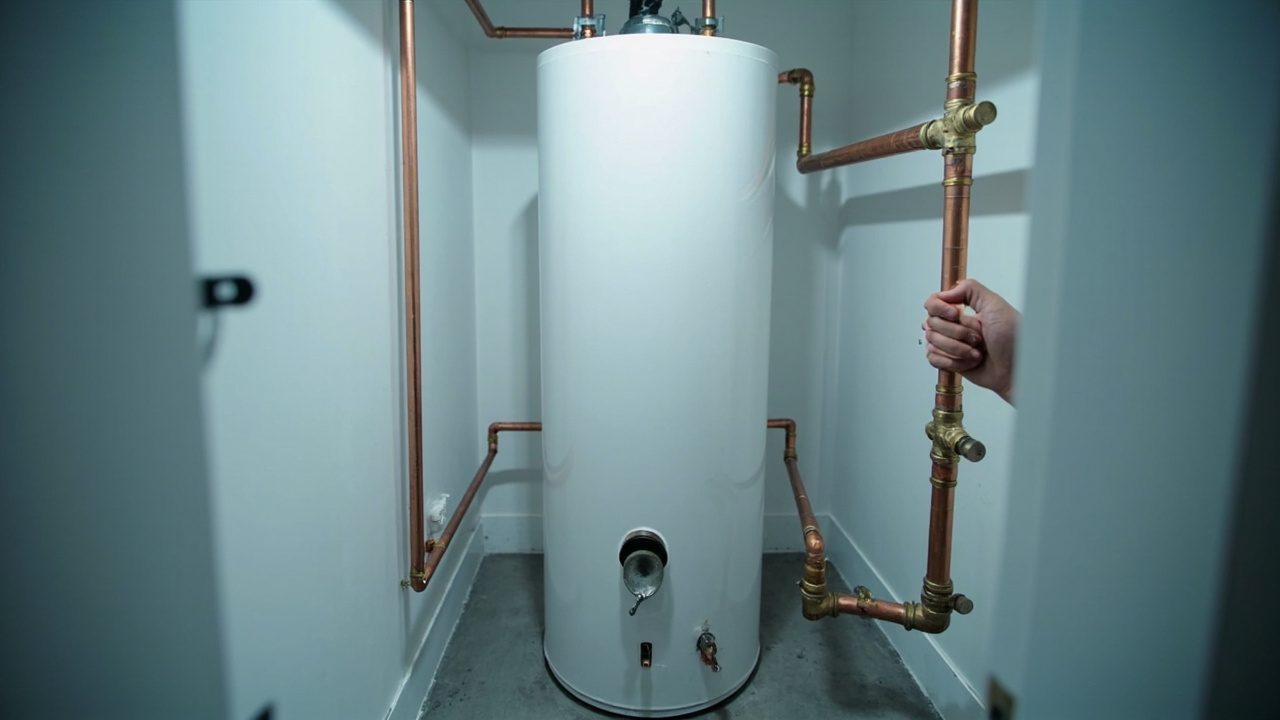
Do these in this order for the next five minutes. Shut the water off. Use the stop at the fixture if there is one, and if there is not, close the main where the line comes into the house or at the meter. If water has reached an outlet, a panel or a ceiling fixture, kill that circuit before anyone steps into the water. For the heater itself, close the cold inlet on top of the tank, turn the gas control off or the breaker off, then open a hot tap on a lower floor so the tank is not under vacuum. If you smell gas or rotten eggs, touch no switch and no phone charger, get everyone outside, leave the door open behind you, and call Texas Gas Service from outside.
Now read what you have. Water spreading from the base of the tank is a water heater leaking emergency, while rust that shows only at the hot tap, a valve on top that drips, or a tank that runs out halfway through the second shower are different faults. Relighting the pilot or resetting the breaker does nothing for a wet floor. Run the cold tap, then the hot. Clear cold with brown hot puts the rust inside your tank, and brown at both taps points to corroding galvanized supply pipe in the walls, the usual cause of discolored water in older homes here, which a new heater will not fix. Both are supply side faults. Pressurized water leaves the tank all night whether anyone is home, where a drain only leaks while something upstream runs.
El Paso water is moderately hard to hard, and scale forms steadily in tanks, heating elements and valves. Scale settles on the tank floor while the sacrificial anode rod keeps working beneath it until its metal is gone. Rusty hot water arriving first is the sign the rod has run out. A relief valve that drips on top of the tank points first at the pressure or the expansion tank behind it, which is why the valve alone is rarely the whole answer, and a slow drip at a fitting on top will keep weeping until the connection is remade.
An anode rod eaten away turns the steel tank into the sacrificial metal, rusty hot water arrives first, and a water heater burst arrives after, emptying the tank onto your floor. Rust at the hot tap alone, or any water at the base of the tank body, is the point where calling today beats waiting. A heater that is dead, with nothing wet and the fuel off, can wait for a scheduled visit.
Your local utility, El Paso Water, publishes service and water-quality information every El Paso homeowner should know.
How the anode rod pull decides repair or replace
The visit follows the water. With the cold inlet closed and the gas control or breaker off, the technician finds where water leaves the system, whether the relief valve discharge pipe, a fitting on top, the drain valve or the tank shell. Each points to a different fix, and only the shell ends the heater. Static pressure at a hose bib with everything in the house off comes next, because incoming pressure above the normal band, or a failed expansion tank on a closed system, is often the reason a relief valve weeps or a supply hose keeps failing. When the reading says so, a pressure reducing valve and a thermal expansion tank belong in the scope alongside the heater. The part that failed is often reporting on the system, and replacing it alone leaves the cause running.
One reading decides more than any other here, the anode rod pull. Pulling it needs headroom above the tank, so clearance gets checked before anyone promises it can be done today, and a low shelf in a garage or closet can settle the question before a wrench turns. A rod with sacrificial metal still along the core wire means the tank is intact and the failed part is a repair, meaning a gas control, a thermocouple, an element or a dip tube. A bare core wire means the sacrificial metal is gone and the steel tank is now the part being eaten. Fitting a new element or valve to that tank puts a part on a shell that keeps corroding, so the scope becomes replacement. You see the rod, and the written scope names the reading that produced the call.
Tank against tankless is the comparison to settle once the rod says replace. A tank is judged on capacity in gallons and its first hour rating, and a 40 gallon atmospheric vent tank or a 50 gallon tank slots into an existing install with the least new work. A condensing tankless unit is judged on gallons per minute at a given temperature rise, and a swap usually means a larger gas line, new venting and a different condensate path, which is more work than a night visit holds. That is why a tank fits same day water heater repair and a tankless conversion becomes a scheduled job. Local water leans the same direction. A tankless heat exchanger scales in hard water and needs flushing or descaling, so hardness gets a plan whichever heater goes in.
More detail on emergency water shut-off service is on its own page.
Independent standards matter too, the EPA's WaterSense program sets the efficiency benchmarks we use when recommending replacement fixtures.
Ask which of these readings was taken before any part is replaced.
| Instrument | Good reading | Bad reading | What it changes |
|---|---|---|---|
| Anode rod pull on a tank water heater | The rod still has sacrificial metal along the core wire | A bare core wire with the metal gone | The tank itself is now the part being eaten |
| Thermometer at the farthest hot tap | Hot water arriving around 120 degrees | Hot enough at the tap to scald a child in seconds | The first slug of water is whatever was sitting in the pipe |
| Screw on pressure gauge at a hose bib | Static pressure sitting in the 45 to 70 psi range with nothing running | Above 80 psi | Fixtures, supply hoses and water heaters start failing early |
| Overnight pressure hold with the gauge left | The morning reading is close to the reading taken the night before | A reading far above the night figure | The heater is expanding water into a closed system with nowhere to put it |
How an emergency heater call runs
Phone questions and isolation
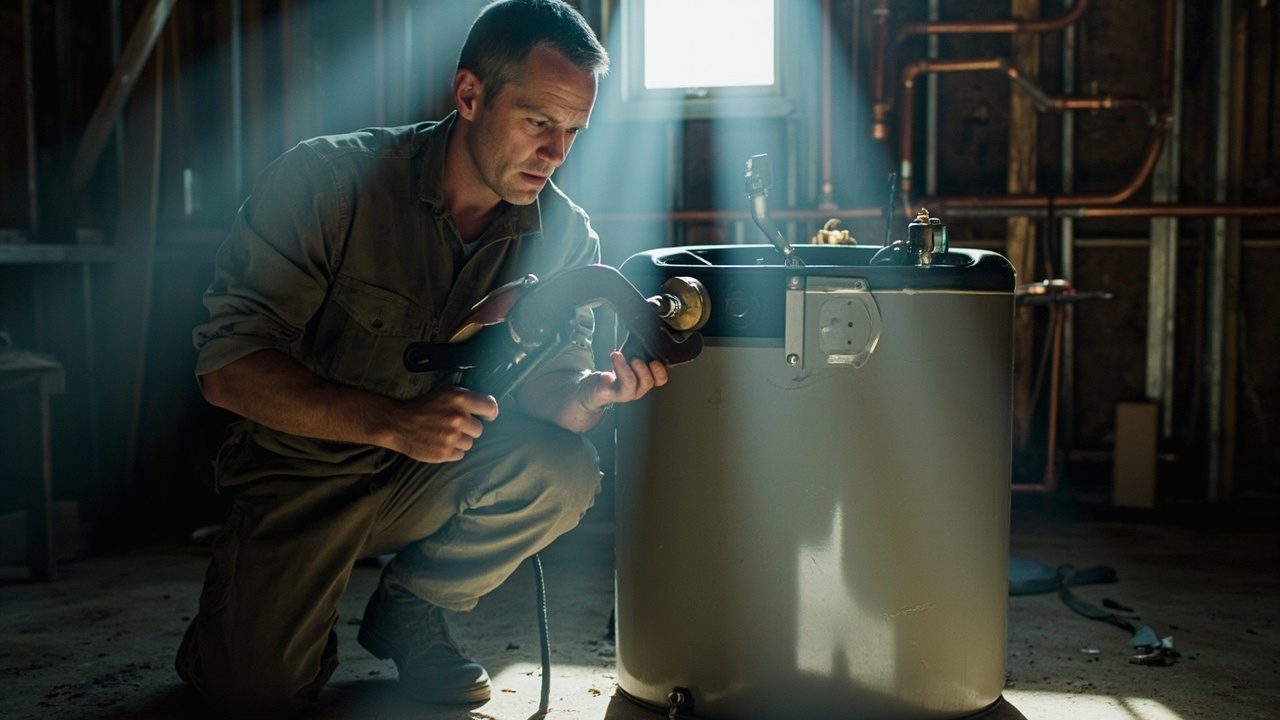
On the phone you are asked where the water is, roughly how old the heater is, and where the cold inlet valve and the gas control or breaker sit. On site the technician confirms the water and fuel are off, then finds where water leaves the system, starting at the relief valve discharge pipe and working down to the tank shell. A gauge connects to a hose bib for static pressure measurement when all fixtures are closed, and the meter shows whether a hidden supply loss is running. The anode rod is pulled last, with you watching, once headroom above the tank has been checked.
Your approval, then the work
Once you approve the written scope, isolation comes first, so the cold inlet and the fuel stay closed and a hot tap stays open on a lower floor. A repair means the failed part, the gas control, thermocouple, element or dip tube, comes out and the new one goes in. A replacement means the tank is drained, the old unit is disconnected, the new tank is set with a dielectric union wherever copper meets steel, and the temperature and pressure relief valve is piped down. A thermal expansion tank goes in if the pressure reading called for one. If scale or a corroded fitting turns up behind a connection, we stop and show you before going further.
Tested before we leave
Before we leave, on a gas heater the combustible gas detector and bubble solution go over every fitting, and no alarm and no growing bubble is the passing result. Static pressure is read again with everything off and should sit in the 45 to 70 psi range. The thermometer goes on the farthest hot tap after the tap has run a full minute, and around 120 degrees is the usual balance between scald risk and a tank that stays clean. You keep the written scope with the anode rod reading recorded on it, and the walkthrough shows you the cold inlet and the fuel control.
What an unfamiliar crew gets wrong on a heater call here
Gas work and a full heater replacement usually need a permit, and a like for like swap of an element, a thermocouple or a supply hose usually does not. The permit office covering your address makes the final call. Inside city limits and outside them can mean different offices, because work beyond the city line falls under the county or the neighboring town, and a crew that assumes one answer for the whole county loses time in an emergency finding that out.
Housing stock sets what the job demands. Slab homes from the 1970s through the 1990s run copper supply under or through the slab with the heater in a garage or closet, so a dielectric union goes on wherever copper meets the steel tank fittings. Newer subdivisions on the east and west sides run PEX from manifolds, and PEX has to be kept out of sunlight and protected where it passes through framing. Older central homes still carry galvanized supply, which is why brown water at both taps gets diagnosed before a heater gets sold. Older homes also hide an isolation problem, because an old stop that will not turn makes the main the only shutoff, and the whole house loses water while the swap happens.
Local water is the mistake a stranger to it makes most often. A crew unfamiliar with moderately hard to hard water sets a new tank without a hardness test, and the new tank scales the way the old one did. Freezes bring a second mistake. Brief hard freezes split exposed lines and hose bibs, and nothing shows until the thaw puts the pipe under pressure, so a ceiling stain hours after temperatures recover gets traced along the cold line as well as the heater.
On a gas heater, the fittings get a combustible gas detector and bubble solution before anyone leaves, because the detector shows where to look and the bubble solution proves it. The questions asked on the phone, the age of the heater, where it sits and whether the pipes are copper or PEX, exist because the stock across the county changes from one address to the next, and the answers decide which fittings and which venting the job needs before work begins.
Our page on commercial water heater systems covers that side of the work in more depth.
Permit and inspection questions? Planning & Inspections is the office we coordinate with on every permitted El Paso job.
What an after hours heater call looks like from your side
From call to doorstep
You call and the person who answers asks where the water is, whether the tank body or only a fitting is wet, whether the hot tap runs rusty, and whether anyone smells gas. Those answers sort a leaking tank that needs urgent hot water repair tonight from a dead heater that can wait for a scheduled visit. The arrival window depends on how many emergency jobs are ahead of yours, and if one runs long, the window moves and you are given the new one.
Floor and garage protection
A drop cloth goes down along the path from the heater to the door before anything comes apart, and tools stay staged on a mat beside the tank. The drain valve gets a hose run to the outside or to a floor drain, so flush water and scale never cross your floor. The old tank leaves with us, and the last thing done is wiping the base area dry and running a dry paper towel around each connection to catch any weeping.
What moves the scope
Access moves the job first, since a heater in a closet takes longer to reach and restore than one on an open garage wall. Repair against replacement moves it furthest, and the anode rod reading decides which. Matching old copper, PEX or steel to new, a tankless conversion with its gas line and venting, and a gas permit all push it up. After hours, weekend and holiday dispatch adds to the visit itself, so a leak you have isolated that stays dry can wait for a regular day. You approve the written scope before anything is drained or cut.
How technicians are checked
A new technician rides with a lead before working alone, and the lead signs off on tasks the technician has to demonstrate, including a clean anode rod pull, a gas fitting proved with detector and bubble solution, and a temperature and pressure relief valve piped correctly. On an unusual job, such as a tankless conversion in an older home, a second technician looks at the site before a scope is written. The crew studies the current code cycle, and any permit question is settled before work begins.
You Have Questions,
We Have Answers
A service call price depends on the hour, the access and the fault, so no fixed number exists beforehand. After hours and weekend dispatch raise the visit itself, while a heater on an open wall costs less labor than one boxed into a closet. The written scope lists the diagnosis and the repair separately, and you approve it before any part is ordered or drained.
No hot water alone is urgent but seldom an emergency when nothing is wet and the fuel is off. A tripped breaker, a dead upper element or a pilot blown out by a draft commonly causes it. Check for a scorched wire cover on an electric unit and a pilot flame that burns yellow instead of blue on gas. Wet floors or gas odor change the answer immediately.
Close the cold inlet valve and shut off the power or gas to stop a leaking heater. Then open a hot tap so the tank drains slowly, and hang a bucket under any fitting still weeping. Wrapping tape or epoxy around a seam fails because a steel tank under pressure keeps pushing water through corroded metal. Leaks from a top fitting sometimes hold for a day, while shell leaks never do.
Replacement cost in El Paso depends on tank capacity, fuel type, venting and what else the code requires. A 50 gallon tank costs more than a 40, a power vent adds parts and labor, and a moved unit means new gas or water lines. Adding an expansion tank, a pressure reducing valve or a permit raises the total. Tankless conversion sits highest because of gas line sizing and venting.
Cold water stays safe to use when only the heater has failed, so drinking, flushing and washing continue normally. Keep the heater's cold inlet closed if it is leaking, and leave the rest of the house supply open. Bathing works with kettle-warmed water. If the tank is electric and wet, leave the breaker off, because an element submerged in leaked water can trip or short.
A water heater emergency is any failure that floods a floor, threatens electrical gear or leaks gas. Also included is a tank whose relief valve discharges steadily, because that signals overpressure or overheating. Steam from the discharge pipe, a tank shell that is hot to the touch beyond the normal setting, and a rumbling sound from boiling sediment are warning signs. Each of these calls for shutting off fuel and water first.
Call a plumber who works on both gas and electric heaters and can send a technician the same day. Before dialing, check the breaker or pilot, then press the reset button on an electric heater's upper thermostat, which trips when the water overheats. A reset that trips again points to a failed thermostat or element. Tell the dispatcher what you tried, since it narrows the parts needed.
A tank heater needs a service visit about once a year, with a partial drain to clear sediment. Anode rods in hard water often need inspection every two to three years, since a spent rod exposes the steel. The relief valve should be lifted briefly to confirm it flows and reseats. Tankless units need descaling at similar intervals, and hard water shortens the gap between flushes.
A broken water heater is an emergency when the tank body leaks, gas is smelled or water reaches electrical equipment. A heater that produces no hot water, with a dry floor and fuel off, can wait for scheduled service. Water pooling in a pan under the tank means the drain line is carrying overflow, so a pan that keeps refilling upgrades the situation to urgent.
Why hard water changes emergency water heater repair in El Paso
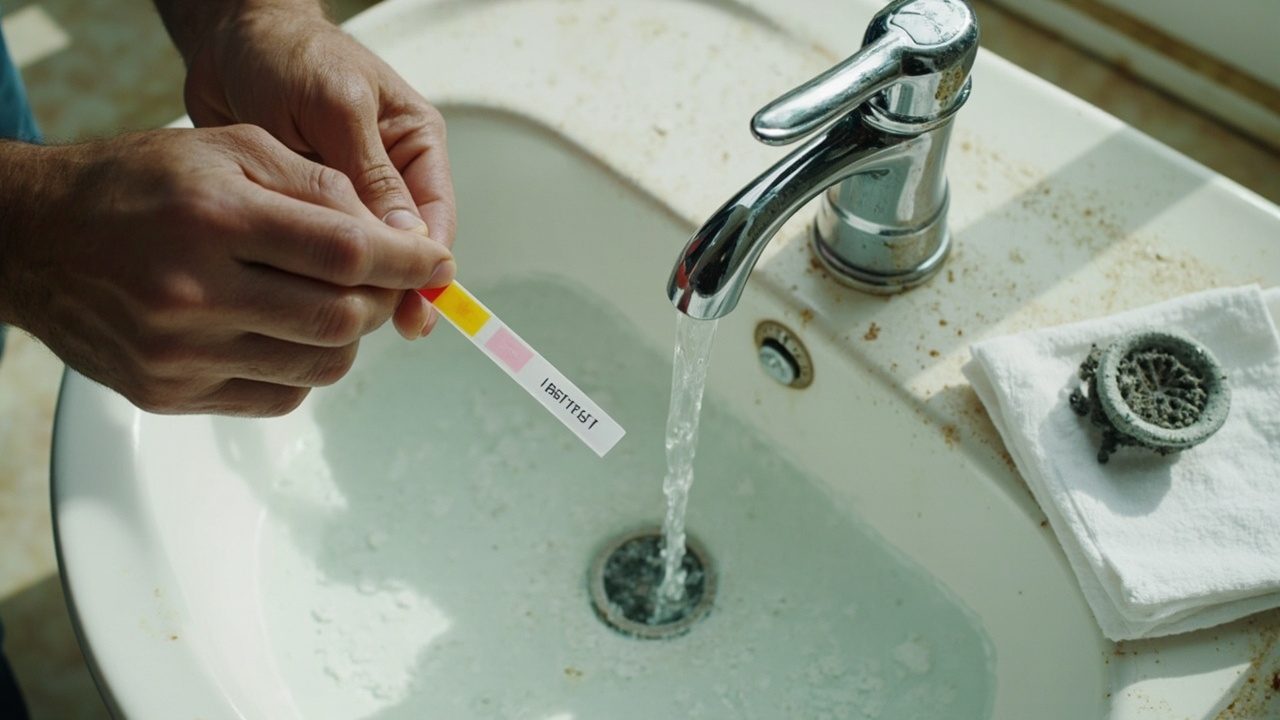
Water reaching El Paso taps is a blend of surface water and groundwater, and El Paso Water describes it as moderately hard to hard. A hardness test kit at the tap commonly reads around ten grains per gallon or more, and above about seven grains per gallon scale forms steadily on tank floors, heating elements and valves. That changes the job. A replacement tank goes in with a plan for flushing or descaling, and the choice between an ion exchange softener and a template assisted crystallization conditioner turns on the hardness reading and on whether a drain is available. Heat adds stress on top of the scale. Where the heater sits in a garage or closet, summer afternoons at or above one hundred degrees load the tank and its relief valve, and the scaled tank is the one that stops keeping up first.
When the permit office covering your address inspects a heater replacement, the gas connection, the relief valve discharge pipe and the expansion tank are what a crew should leave visible and testable, so an inspection does not turn into reopening a finished install. Knowing that up front changes the sequence, since fittings are made up in the order they will be tested. Freezing nights come every winter, and most hover just below freezing before daytime temperatures climb above it, so the ground does not freeze deeply and the damage lands on exposed pipe. During an arctic front that drops temperatures well into the teens, hose bibs and outdoor lines split. In those months incoming water arrives colder and the heater works through a larger temperature rise, so a scaled tank that got through summer runs short on the second shower.
Plumbing Services in The El Paso Area
Explore our service area and locate Bedrock Plumbing El Paso with ease. We're proudly local and serve the surrounding neighborhoods with fast response and honest pricing. Use the map to check our coverage area, or call us and we'll confirm in seconds.
Address:
Bedrock Plumbing El Paso, 221 North Kansas St, Suite 700, El Paso, TX, 79901
Additional Services We Offer
- 24/7 Emergency Plumbing Services
- Basement Flooding Pump-Out
- Burst Pipe Repair
- Emergency Sewer Backup Cleanup
- Emergency Sump Pump Failure
- Emergency Water Shut-Off Service
- Frozen Pipe Thawing & Repair
- Gas Leak Detection & Repair
- Main Water Line Break Repair
- Overflowing Toilet Repair
- Rapid Response Leak Repair
- Septic Tank Emergency Pumping
Finding and closing the main shutoff and swapping a braided supply hose are homeowner jobs, and you do not need us for either. DIY stops at anything soldered, anything on the gas line, and anything behind a finished wall or under a slab. A tank that seeps through its shell has no repair, and if the first visit finds that, or a leak beyond the heater, you are told so then, before any work and before an invoice.
Before you call, know whether water sits at the base of the tank, drips from a fitting on top or shows only as rust at the hot tap, and when it started. Note what changed just before it, such as a cold night. Locate the cold inlet valve and gas control, and read the age off the tank label if you can. Say whether anyone is home.
Last reviewed September 2026 by Dave Parker, Owner.