





What a split pipe looks like after a brief hard freeze
One tap runs dry while every other fixture in the house works, or a brown stain spreads across a ceiling hours after the morning warmed past freezing. Both begin the same way. Water in the line froze at the coldest, least protected point, and nothing showed until the ice cleared and the pipe was under pressure again. That places the fault on the supply side. Pressurized water escapes whether anyone is home or not, while a drain only leaks when something upstream runs, so a split from a freeze keeps running all night once it thaws.
The freeze window here runs from mid November to early March, and most cold nights inside it are short, just below freezing, with a mild afternoon behind them. Pipe inside a heated wall has the house's warmth around it on those nights. The damage comes when an arctic front drops the temperature well into the teens after weeks of easy weather, and exposed hose bibs, outdoor lines and irrigation backflow assemblies split first. Ground here does not freeze deeply, so the exposure is whatever stands in open air. A slab home built in the 1970s through the 1990s often has its water heater in a garage, and that garage wall holds less warmth than a living room does. On top of the tank, the cold inlet sits in the same air.
An evaporative cooler supply line is the one people forget. The cooler sits idle through the cold months with water standing in the line and a float valve at the end of it, and a hard freeze can split that line without anyone seeing it until spring startup puts pressure back on. You may already have wrapped a towel around a bib or left a tap running overnight. Draining the bib and covering it takes the standing water and the wind away from the fitting, which a towel cannot do.
To winterize plumbing here, drain and cover the bibs, drain the cooler line, and put insulation on any supply run that crosses an exterior wall or an unheated space. Insulation only protects what it covers, so a gap at one fitting leaves that fitting as the cold spot. Locate your main shutoff before the first cold night, since closing it within seconds limits how much water a split can release. If a pipe froze and a damp patch or a spreading stain now shows after the thaw, call today. A hairline supply leak behind tile keeps the framing damp because nothing dries inside a wall, and the pipe repair then turns into a wall rebuild.
If this sounds close but not quite your situation, noisy pipes may be the better starting point.
Independent standards matter too, the EPA's WaterSense program sets the efficiency benchmarks we use when recommending replacement fixtures.


How we read the line before we recommend anything
The visit runs in the order the water travels. To protect pipes in cold weather, a technician first turns everything in the house off, so no washer, ice maker or toilet is drawing, and then walks the supply outward from the main shutoff. Each stop and branch gets marked for what it serves: the hose bibs, the cooler line, and any line segment that passes through an outside wall or unheated area. Isolation comes before diagnosis, because the first useful act is shrinking the house into segments that each close on their own. On a prevention visit that means every exposed point has a stop you can find. After a freeze it means the split gets narrowed to one branch by closing stops and listening, rather than by opening a wall and hoping.
The gauge goes on at a hose bib. A screw on pressure gauge threads onto the bib the way a hose does, and the reading is taken with everything in the house off, because a running fixture hides the real static number. Static pressure between 45 and 70 psi is the good band, and above 80 psi is where fixtures, supply hoses and water heaters start failing early. The reading forks the job. Inside the band, the work stays with the exposed points, meaning covers, drained lines and insulation. Above 80, the scope adds a pressure reducing valve, because the bib you are protecting and the hoses behind it wear faster under that load and have less margin on the first hard freeze. Handling the bib also shows its condition, so a stiff handle, a weeping thread or a loose vacuum breaker gets noted while the weather is still mild.
Type L copper against PEX comes up when a line has to be replaced or rerouted after a split. Water chemistry, access and how long you keep the house decide it, and local conditions add two more. Intense sun degrades exposed plastic, so a PEX line has to stay covered wherever it leaves the wall, and a bare outdoor stub suits copper. Freeze exposure decides the routing of either material, which keeps the line inside the heated envelope. A slab home with copper through the slab is a different repair than a newer home with a PEX manifold and home run layout, where fewer joints sit inside the walls. What settles the choice on your house is what the isolation found. A second split in one segment points to replacing the segment, and a single split in otherwise sound pipe points to a repair at that joint.
More detail on how to shut off main water valve is on its own page.
Permit and inspection questions? Planning & Inspections is the office we coordinate with on every permitted El Paso job.
How a winterizing visit runs
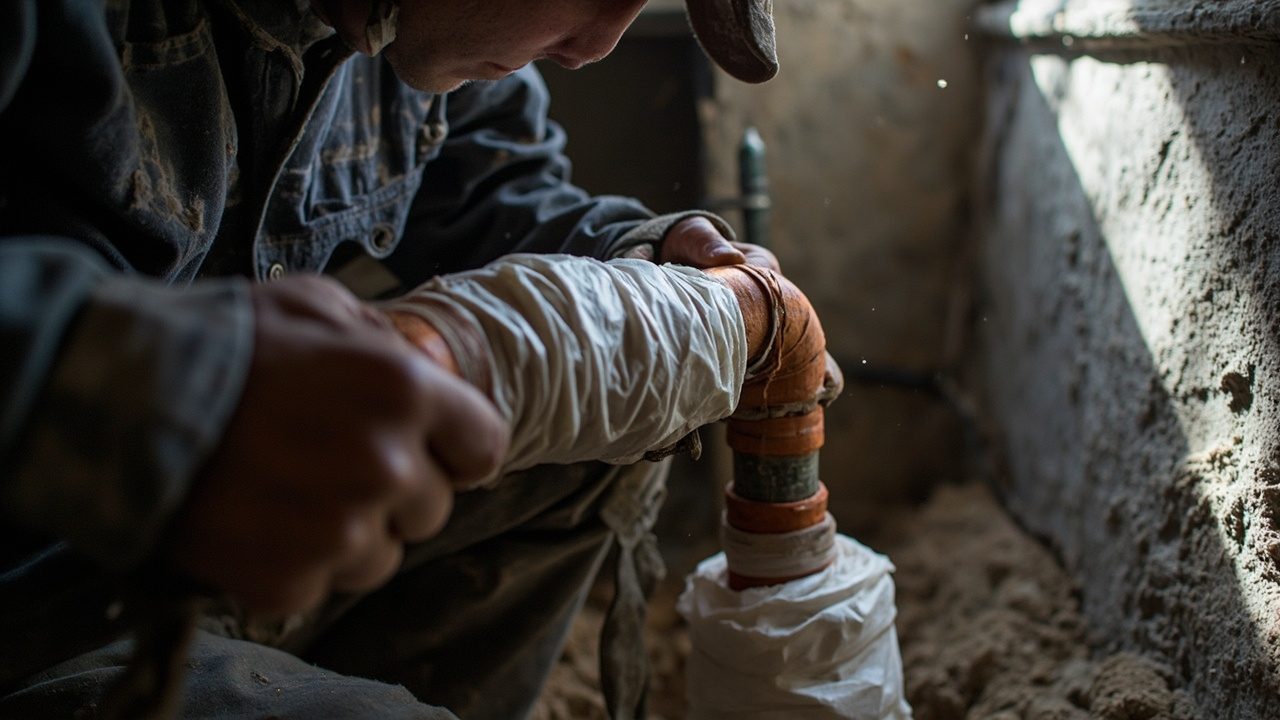
The call and the first read
On the phone we ask what is exposed, where the main shutoff is, and whether any line has already frozen. At the house, everything goes off first, so all fixtures sit idle. The gauge screws onto a hose bib and reads static pressure, with 45 to 70 psi as the good band and above 80 psi as the reading that changes the scope. Then the technician closes stops branch by branch, marking which serve the bibs, the cooler line and any run on an exterior wall. You watch the reading with us, so the number is yours too.
Approval and the work
Once you approve the written scope, the branch is isolated and drained first. Then the work follows the scope: bib covers go on, the hose bib vacuum breaker is replaced or seated, a cooler line is drained at its low point, and insulation goes around exposed supply runs with every fitting covered. If a stop turns out crusted or a fitting shows corrosion on the inside, we stop and show you before going further, and the added work is agreed before it starts. If pressure read above 80 psi, a pressure reducing valve gets its own line in the scope.
Verification and handover
Before we leave, the gauge goes back on the same hose bib with the house off, and the needle has to sit inside the band it was read against at the start. Every stop we touched gets closed and reopened, every tap on the branch runs to confirm flow, and each fitting gets a look for a drip. Insulated runs are checked joint by joint for gaps. You get a walkthrough of where each stop sits, which bibs are covered and which line is drained, plus a written list of those locations and the final reading.
Why brief hard freezes need different prevention than long winters
Permit questions on freeze prevention are short. Bib covers, pipe insulation, a drained cooler line and a replaced hose bib vacuum breaker usually need no permit. Gas work and main line work usually do, and the final call belongs to the permitting authority for your address, which can differ inside city limits and outside them. A crew that has worked across the county knows which question to ask before anything gets opened.
A crew unfamiliar with the desert brings a pipe insulation guide written for a long winter. That guide treats every pipe as equally at risk and sends the crew to wrap the whole house, when the exposure here is narrow: the bib, the outdoor line, the backflow assembly and the cooler supply. The wall looks finished, the cooler line stays full, and the split surfaces at spring startup as a wet wall behind the cooler. The cooler line drains at its low point, and finding that point takes a look at how the line is run. Getting the short list right is how you prevent pipes freezing without paying for coverage where it does nothing.
The second mistake is assuming the pipe material from the year the house was built. Local stock runs from late 1800s brick, adobe and frame homes with galvanized supply and cast iron drains, through mid century slab homes with galvanized or early copper, to 1970s through 1990s slab homes with copper through the slab and newer subdivisions with PEX manifolds. Where new pipe meets old cast iron, the joint needs a proper transition band. A stop on old galvanized that has not turned in years, crusted by moderately hard to hard water, can stick or break the first time someone closes it, and the room takes the full supply. A crew that tests every stop on a mild visit finds that out with the main within reach.
Demand climbs during arctic cold snaps, and calls arrive from the river valley and from the mesas and foothills in the same hours. The valley soil is finer and holds more water, while the mesas carry caliche hardpan that slows any dig for a split yard line or lateral. A crew that knows both sets its expectations for a job before anyone picks up a shovel.
Our page on frozen pipe thawing & repair covers that side of the work in more depth.
Price-checking is smart: marketplaces like Thumbtack publish typical cost ranges you can hold any quote against, including ours.
How a winterizing visit looks from your side
When the technician arrives
You call and we ask three things: what is frozen or exposed, whether water is running where it should not, and where your main shutoff is. Those answers sort a scheduled winterizing visit from a same day call for a split line. You get the arrival window in a confirming call before anyone comes to the door. During a cold snap, active leaks go ahead of prevention visits, so a scheduled visit can move, and you hear the new window before the old one passes.
Protecting your home
Before anything comes apart, floor covering goes down along the path from the door to the work, and shoe covers stay on inside. Water control comes next. The stop or main is closed and the branch is drained into a bucket, so the drained line does not run across a finished floor. Old bib parts, cut pipe and packaging leave with us. The last step is opening the stop, running the tap and wiping the area dry.
What moves the cost
Access moves the job furthest. A bib on an open exterior wall takes less labor than a pipe in a finished wall, under a slab or above a ceiling, where restoring the surface is often the larger half. Next comes one joint against the whole run, decided by the condition of the rest of that run. Matching old pipe to new adds work. The grade of hose bib, stop or heater you choose is the driver you control. You approve the written scope before work starts, and anything found behind a wall is agreed in writing first.
How technicians earn sign off
A new technician rides with a lead and demonstrates the same tasks on live jobs before working alone. Those include reading static pressure at a hose bib with the house off, closing and reopening every stop on a branch, and draining a cooler line. The lead signs off each task and reviews the first scopes a new technician writes. On an unusual job, such as mixed galvanized and copper in one house, a second technician looks at it before a scope is written.
You Have Questions,
We Have Answers
Open the cabinet doors under sinks on exterior walls and let warm room air reach the supply stops. Pipes behind a kitchen or bathroom sink sit against the cold side of the wall, and a closed cabinet door traps that chill around them. Disconnect and store garden hoses, since a hose left attached holds water inside the bib's stem. Set the thermostat no lower than the mid 50s degrees Fahrenheit if you travel, so the wall cavities stay above freezing.
Start a drip when the forecast low reaches about 20 degrees Fahrenheit, using a faucet on an exterior wall. Choose the one farthest from the main. The stream should be pencil-lead thin, roughly one drop per second running into a steady thread. Moving water rarely freezes solid, and the open tap relieves pressure that builds between an ice plug and the closed fixture. Open both the hot and cold sides on a single-handle mixer by setting the handle in the middle.
Texas homes freeze at the few exposed points, so target those first. Disconnect hoses, cover the bibs, and insulate any supply pipe in an unheated garage or attic. Foam sleeves rated for pipe wall thickness slip on quickly, and tape at the seams keeps wind from lifting them. Hard freezes in the state often come after a warm week, when owners have already taken covers down, so keep the covers in one labeled spot near the door.
Closing the main shutoff does not stop pipes from freezing, but it limits the damage if one splits. Water still sits in the lines and can expand into ice. Opening a low fixture after closing the main drains the plumbing above it, and less standing water means less to freeze. Drain only if you plan to be away, and switch off the water heater breaker or gas control first so the tank never runs with empty lines.
Shutting off the water leaves the pipes full, so they can still freeze. Ice forms from the water already trapped in the line, and the main valve only stops new supply from entering. The benefit is that a split spills only what the line holds, not continuous pressure. To protect the plumbing, close the main, open the lowest tap and the highest tap, and let the lines empty. Air in the pipe leaves room for ice to expand safely.
Pipes need roughly six hours or more at 32 degrees to begin freezing, and often longer. Freezing starts at the surface of the water, and the pipe wall, insulation and surrounding mass slow heat loss. A thin copper stub in open air loses heat far faster than a line inside an insulated wall, which can hold above freezing through a night at 32. Wind across an exposed fitting shortens the time noticeably, so a breezy night is riskier than a still one.
Uninsulated exposed pipe can start forming ice within a few hours at 30 degrees. A line inside a heated wall may stay liquid all night. Slush appears first, then a plug forms and the pressure between the plug and a closed tap rises. That trapped pressure splits the pipe, often a few inches away from the ice itself. Small diameter lines and outdoor stubs go first because they hold little water to release heat.
Frozen pipes thaw on their own once the air warms above freezing, but the pipe may already be split. A split often shows nothing while ice fills the crack, then sprays when flow returns. Leave the tap open a little during thaw so you see water return, and watch the pipe and nearby drywall for beading or a spreading stain. Never use an open flame on a frozen line, since heat conducts along copper and can scorch framing.
Water freezes at 32 degrees Fahrenheit, yet pipes usually need air below about 20 degrees before splitting. The gap exists because pipe walls, insulation and moving water hold heat for a while. Exposed pipes with wind on them, such as an outdoor bib, can freeze sooner. Ice alone does not burst the pipe. The break comes when ice blocks the line and pressure rises between the plug and a closed fixture.
Outdoor air near 20 degrees Fahrenheit for several hours makes interior pipes in unheated spaces vulnerable. Lines inside conditioned walls tolerate colder nights because the house's warmth reaches them. Pipes in a garage, an attic, or a crawl space or along an exterior wall lose that protection, and a gap in the wall insulation or a drafty penetration can chill a short section. Check those spots for cold air movement with the back of your hand.
Why brief desert freezes split exposed lines first
Winter here swings between mild afternoons and short freezes, so protection is built around a few hours of cold. Freezing nights happen every winter, most of them just below freezing, and arctic fronts push into the teens. That is the night an exposed hose bib, an irrigation backflow assembly or a cooler line splits. Summer stresses the same parts differently. Intense sun and heat degrade exposed plastic lines, so anything plastic left outside ages fast and needs cover through the year. The utility describes the water as moderately hard to hard, and above about seven grains per gallon scale forms steadily in valves, so a stop can refuse to close fully by the time you need it to isolate a branch. Caliche hardpan under a yard makes excavation for a ruptured yard line or lateral significantly more difficult. A cover, a drained line and a working stop keep pipes from freezing in the spots where digging would be slowest.
Work that stays on your side of the meter and involves no gas, such as bib covers, insulation and a drained cooler line, generally sits outside the inspection that follows permitted work. Replacing a split section behind a finished wall, or reconnecting a heater after freeze damage, is where permits and staged inspections usually enter, and the authority for your address makes that call. Inspection at stages means the open wall gets looked at before the drywall closes. Knowing that up front changes the sequence: isolate, cut, join, pressure test, inspect, close. A crew that plans around the inspector's visit leaves the wall open at the right moment and does not open the same wall twice. Where the utility's side of the line ends and yours begins is decided by the utility and the permitting authority, and a homeowner's first move is to close the main shutoff and tell whoever answers what the meter is doing.
Plumbing Services in The El Paso Area
Explore our service area and locate Bedrock Plumbing El Paso with ease. We're proudly local and serve the surrounding neighborhoods with fast response and honest pricing. Use the map to check our coverage area, or call us and we'll confirm in seconds.
Address:
Bedrock Plumbing El Paso, 221 North Kansas St, Suite 700, El Paso, TX, 79901
Additional Services We Offer
- Benefits of Water Softeners
- DIY vs. Professional Drain Cleaning
- How to Shut Off Main Water Valve
- Hydro Jetting vs. Snaking
- PEX vs. Copper Piping Guide
- Plumbing Financing Options
- Plumbing Inspection Checklist
- Plumbing Repair Cost Guide 2026
- Safe Drain Cleaning Products
- Signs You Need Sewer Repair
- Tank vs. Tankless Water Heaters
- Understanding Backflow Testing
Draining a hose bib before a freeze, covering it, finding and closing the main shutoff, and swapping a flapper or braided supply hose are homeowner jobs, and you do not need us for them. DIY stops at anything soldered, anything on the gas line, and anything behind a finished wall or under a slab. If the first visit finds that water has reached a panel or a circuit, that is an electrician's work, and we tell you so then.
Before you call, know which taps or hose bibs run dry, when it started, and what the overnight low was. Check whether any bib is dripping, and find your main shutoff. If you own an evaporative cooler, note whether its line has been drained. Any age you have for the house or its supply pipe helps, along with whether anyone is home.
Last reviewed September 2026 by Dave Parker, Owner.