





What a weeping angle stop and a stuck main mean with hard water
Water is beading at the nut of an angle stop under the sink, or a stain is spreading across a ceiling, and you cannot say which valve shuts down the house. Sort supply from drain first. A supply line keeps escaping all night under pressure whether anyone is home or not, while a drain only leaks when something upstream runs. If the wet spot grows with every fixture idle, you are looking at supply water, and the valve that matters is either the stop at that fixture or the main shutoff for the whole house.
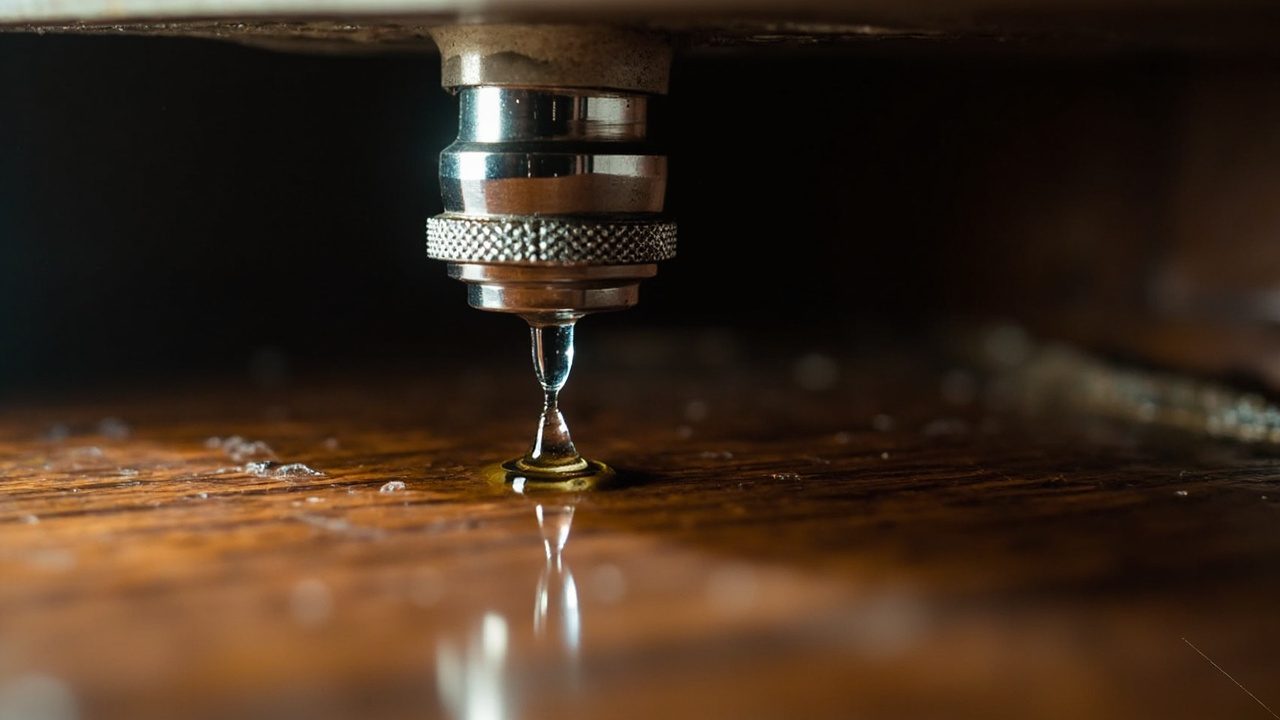
Local conditions work against both valves. The utility describes the supply as moderately hard to hard, commonly around ten grains per gallon or more, and above about seven grains scale forms steadily in valves. Scale crusts the compression nut and the stem of any valve nobody turns. An angle stop shows it first, as a bead at the nut with mineral crust around it, and a main that has sat open for years can stick partway through its travel. In older homes with galvanized supply, the pipe corrodes from the inside, which is also what discolors the water. Winter adds a second cause. Freezing nights happen every winter, and occasional arctic cold fronts drop temperatures well into the teens, which splits exposed hose bibs and outdoor lines at their coldest point. Nothing shows until the ice clears and pressure returns, so the first sign is often a ceiling stain hours after the temperature recovered. The first freeze arrives in mid November on average.
Finding the main comes first, and the search follows the pipe. The main sits where the line comes into the house or at the meter, so trace the supply from the street side of the lot toward the house until you reach a handle. Two main valve types turn up. One has a round wheel handle that takes several turns, and the other has a lever that swings a quarter turn, lying along the pipe when open and across it when closed. A wheel closes clockwise. Stop when it firms up, because forcing a scaled stem can break it.
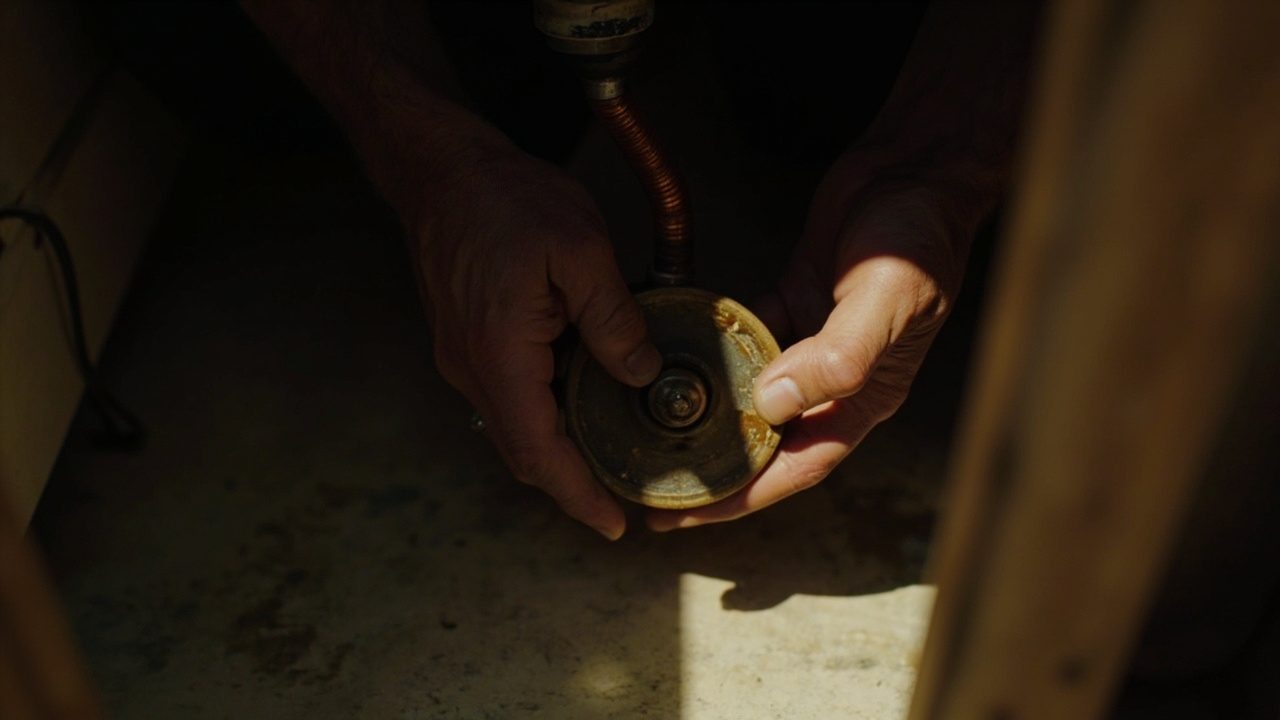
When a stop weeps at the nut, the nut is corroding, and once it corrodes it can no longer be snugged. The next faucet change can then snap the stop off in your hand, and the room takes the full supply. Call today if a stop is weeping and you have not found a main that turns.
More detail on main water line break repair is on its own page.
We install and service equipment from major manufacturers like Rheem to manufacturer specifications.
How the meter finds the leak before anyone opens a wall
Isolation comes before diagnosis, and the water meter leak indicator anchors it. With every fixture closed and the dishwasher and washer idle, the technician reads the dial or the small leak wheel and watches it for fifteen minutes. Any movement at all with the whole house off means water is leaving the system somewhere you cannot see. Then the main shutoff is closed and the meter is watched again. A dial that stops puts the loss on the house side. A dial that keeps moving with the main closed puts it on the street side. On the house side, branches close one at a time until the dial stops, and only then does anyone open a surface.
Each reading decides a fork. A dial that stops when the main closes keeps the job inside the house, and the branch that stops it sets the scope, whether that is a fixture stop, a supply hose or a run inside a wall. A dial that keeps moving moves the job out to the service line, which is a different repair from anything under your sink. One caution applies. A main valve that does not seal can imitate a street side loss, so the technician opens a tap on the lowest floor and watches it. A tap that runs dry proves the valve holds. A tap that keeps running makes the valve itself the first repair. You see the reading and the written scope before any valve or pipe is replaced.
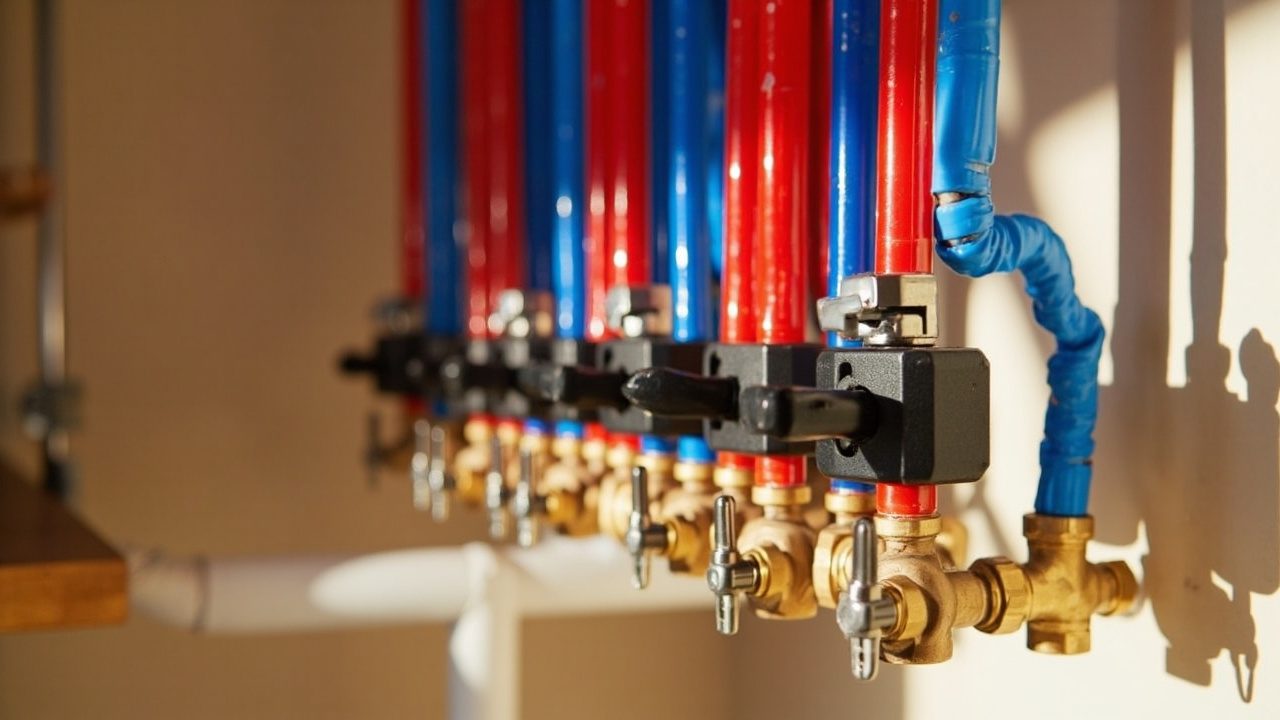
Which supply material sits behind your walls decides how much of the house one valve controls. Type L copper is soldered and rigid, so a leak inside a wall is usually isolated with the main and the fixture stops, and any tee in the run is a joint someone may have to reach. PEX on a manifold gives each fixture group its own valve, so the branch test can end at the manifold rather than in drywall. Local conditions push the choice further. Sun and heat degrade exposed plastic, so PEX has to be kept out of sunlight wherever it is exposed, while copper tolerates heat directly. Moderately hard to hard water scales any valve nobody exercises, whichever material the pipe is. Repair or repipe is decided by what the isolation found and how the rest of that run looks, since a second failure in one segment points to the segment rather than the spot.
Our page on benefits of water softeners covers that side of the work in more depth.
Price-checking is smart: marketplaces like Thumbtack publish typical cost ranges you can hold any quote against, including ours.
How a main shutoff call runs
Questions, then isolation
The call starts with what you see and where the main sits, then whether flow occurs with all fixtures closed. On site, you are asked to keep every fixture, the dishwasher and the washer closed while the technician reads the meter leak indicator for fifteen minutes. You can watch the dial too. Then the main is closed with you standing there, so you learn its handle and its direction, and the meter is read again. Branch valves at a manifold or fixture stops close next, each one tested until the needle holds steady. No wall opens during any of it.
Approval, then the work
Once you approve the written scope, the isolation valve for that segment closes first, whether it is one fixture stop, one manifold branch or the main. The main operation follows in trade terms. That means an angle stop swapped for a new stop with a braided supply, a push fit fitting or soldered joint on a repaired run, or a new main shutoff where the old stem will not seal. The whole building loses water only when the main itself is being replaced. If corrosion or a second pipe material turns up behind a component, work stops and we show you before going further.
Reading before we leave
Before we leave, the meter leak indicator goes back under watch with every fixture closed, and it has to hold still for the same fifteen minutes as the first read. The main is closed and opened once more with you watching, and the lowest tap is checked to run dry when the main is shut. We walk you through each valve we touched and point out any branch valves you did not know you had. You keep the written scope, marked with the location and type of every valve worked on.
Why local knowledge decides which valve gets closed first
Which permit authority applies depends on the address. Inside city limits the city issues plumbing permits and inspects at stages during construction, while work outside city limits falls under the county or the neighboring town. Replacing a main shutoff or repiping a run usually draws a permit, and a like-for-like swap of an angle stop or a supply hose usually does not. The final call belongs to the authority, so a crew that works the county asks first rather than after the wall is open.
Crews unfamiliar with the county tend to misread a house from the street. A slab on grade home from the 2000s onward has PEX supply on a manifold, and a crew expecting a single main starts cutting drywall to stop a leak that branch valve isolation would have prevented. A home from the 1940s through the 1960s has galvanized or early copper supply, and forcing its main on a scaled stem can snap it. A crew that joins new copper straight onto old galvanized without a proper transition, such as a dielectric union, builds a corroding joint into the wall. Identifying the supply layout before opening walls saves drywall repair and prevents the damage that comes from unnecessary cuts into finished surfaces.
The water heater adds its own mistake. In slab homes from the 1970s through the 1990s the tank often sits in a garage or a closet, and shutting the main leaves that tank full. When the failure is at the heater, the sequence is the cold inlet on top of the tank, then the gas control or breaker, then a hot tap on a lower floor so the tank is not under vacuum. After an arctic front, hose bibs and backflow assemblies get checked before anyone assumes the loss is inside the walls.
Response runs across the county, and the newer subdivisions on the east and west sides sit far from the older central stock, so the first phone questions decide which layout to expect before anyone drives.
See emergency water shut-off service for how the related work is scoped and priced.
Your local utility, El Paso Water, publishes service and water-quality information every El Paso homeowner should know.
What working with Bedrock Plumbing El Paso looks like day to day
How the call becomes a visit
The person who answers asks what you see, when it started, whether water is running with the fixtures idle, and where the main and any branch valves sit. Those answers sort a same day visit from a scheduled one, and water escaping under pressure goes first. You leave the call with an arrival window. If the job ahead runs long, you hear the new window while you can still plan around it.
Floors and walls protected
Before anything comes apart, drop cloths go down under the cabinet or across the floor near the manifold, and a bucket sits under the stop while the nut comes off. Access openings in drywall are cut to the size of the fitting and no larger. Water is closed at the stop or branch first, so nothing runs while a surface is open. Debris is bagged and leaves with us, and the last step is opening the valve and wiping the area dry.
What moves the scope
Access moves the scope first, meaning a finished wall, tile, a ceiling below, a slab or a crawlspace, and putting that surface back. Depth and length of any excavation come next, then whether the fix is one joint or the whole run. Matching existing pipe material and size raises the scope wherever old and new meet, since a dielectric union or transition band has to be added. Fixture grade and after hours dispatch follow. You approve the written scope before work starts, including what happens if the opening finds more.
How technicians earn sign-off
A new technician rides with a lead and demonstrates the isolation sequence on the meter before working alone, reading the dial, closing the main and closing branches until the dial stops. The lead signs off on that demonstration. The current code cycle gets studied as it changes. On anything unusual, such as several pipe materials in one house, a second technician looks at it before a scope is written.
You Have Questions,
We Have Answers
Yes, closing the main is safe and is the correct first move for any uncontrolled supply leak. Water stays in the pipes above the lowest open tap, so open a faucet on the top floor to let air in and the lines drain faster. Leave the water heater's cold inlet alone unless the heater is the problem. Once the main is closed, plan to restore water within a few hours so stagnant lines and a warm tank do not sit idle.
Turn a wheel handle clockwise until it firms up, or swing a lever a quarter turn across the pipe. Wheel valves, usually gate type, tighten with each rotation and may need six or more turns. Ball valves with levers stop at a clear mechanical limit. Never force a wheel past resistance, because the brass stem thread can strip and leave the valve spinning freely without closing anything. Open a lowest-floor tap afterward to confirm flow drops.
Water keeps running when the downstream pipes are still full or the valve is not sealing. A few gallons normally drain from the lowest fixture within a minute or two. A steady stream that never tapers means the gate has worn or scale is holding it off the seat. A gate valve with a corroded disc can pass water even at full closure and needs replacement.
Yes, any homeowner can close the main, and locating the handle before an emergency saves the most time. Check inside the garage, a utility closet, or along the front foundation wall where the line enters. Some homes also have a second shutoff at the meter box near the curb, which usually needs a meter key and belongs to the utility. Try turning the house valve once a year so the stem does not seize.
Find the valve where the supply pipe enters the house and close it fully. Look for a pipe about three quarters to one inch across coming through the wall or slab edge, often near the water heater. Close every faucet first if you can, then shut the valve and open the lowest tap to bleed pressure. A dry tap after a minute confirms it holds.
Yes, closing and reopening your own main is normal homeowner work. Open it slowly, about a quarter turn at a time, so pressure returns gradually and does not slam fixtures or shift a weak joint. Afterward, open a tap until air sputters out and the flow runs steady. Cutting, soldering, or replacing the valve is a different job, because it means draining the whole system and working on a pipe that may be corroded.
Water usually runs one to three minutes at a tap, then slows to a drip as the pipes drain. Height matters, since a tap on a lower floor drains everything above it and runs longer. A long dribble past five minutes suggests the valve is leaking by, or that a water heater or a pressurized supply from another source is feeding the line. Opening a high tap first speeds the drain.
Find the valve on the supply line entering the house and turn it to its closed position. Common spots are the garage wall, beside the water heater, a hall closet, or an exterior wall with a small access cover. A round wheel closes clockwise, and a lever closes when it points across the pipe. Once closed, run a hose bib or lowest tap until the flow stops to confirm the valve is holding.
Close the stop at the leaking fixture first, using the small oval or round handle on the supply line. You will find it beneath the sink or behind the toilet. Turn it clockwise until it stops, without hard force, since old stops can crack. Guests can use the same method at any bathroom. If the fixture has no stop, close the main, which is the only remaining option until a repair.
Shut the water at the utility meter valve with a meter key if you can reach it. Close the water heater's cold inlet to protect the tank from draining and overheating. Turn off fixtures that are running and open a low tap to relieve pressure. A failed main shutoff is replaced as its own repair. Avoid striking or heating the stuck valve, since either can crack the body.
How manifold plumbing changes a main water shutoff in El Paso County
Homes built from the 2000s onward in this county use slab on grade foundations with PEX supply, PVC drains and laterals, and manifold style distribution. That layout changes the shutoff plan. Water leaves the main and reaches a manifold, and from there a separate PEX line runs to each fixture group, each with its own valve. Closing one branch stops one bathroom or the kitchen while the rest of the house keeps water, which limits damage when a supply hose or fixture fails. Homes from the 1970s through the 1990s differ, with copper supply run under or through the slab, so a hot line under a floor is a live possibility and the main plus the fixture stops are the working tools. Caliche hardpan slows any excavation on the service line to either type. Intense sun and heat degrade exposed plastic lines, so PEX stays covered and out of sunlight.
Work on the supply side is inspected in stages, and which authority does the inspecting depends on whether your address sits inside city limits, under the county or in a neighboring town. What an inspector wants to see at each stage is theirs to say. A repipe or a main shutoff replacement is the kind of job that draws that attention, while a like-for-like fixture stop usually does not, and gas work and main line work are where permits and inspections apply more than to a faucet. Whether a loss sits on your side or the utility side is settled by watching the dial with the main closed, and then the authority and the utility decide where responsibility sits. Knowing this up front changes the sequence. The technician isolates and reads first, tells you which authority applies, and holds the opening of any wall until the scope is written and approved, so nothing is cut twice. A gas smell at a heater in a garage or closet goes to the gas utility from outside the house before anything else.
Plumbing Services in The El Paso Area
Explore our service area and locate Bedrock Plumbing El Paso with ease. We're proudly local and serve the surrounding neighborhoods with fast response and honest pricing. Use the map to check our coverage area, or call us and we'll confirm in seconds.
Address:
Bedrock Plumbing El Paso, 221 North Kansas St, Suite 700, El Paso, TX, 79901
Additional Services We Offer
- Benefits of Water Softeners
- DIY vs. Professional Drain Cleaning
- How to Prevent Frozen Pipes
- Hydro Jetting vs. Snaking
- PEX vs. Copper Piping Guide
- Plumbing Financing Options
- Plumbing Inspection Checklist
- Plumbing Repair Cost Guide 2026
- Safe Drain Cleaning Products
- Signs You Need Sewer Repair
- Tank vs. Tankless Water Heaters
- Understanding Backflow Testing
Finding and closing your main is a homeowner job and you do not need us for it. Plunging a toilet, swapping a flapper or braided supply hose and draining a hose bib before a freeze are yours too. DIY stops at anything soldered, anything on the gas line, anything behind a finished wall or under a slab. We do not repair electrical after water reaches a panel, and we say so on the first visit and tell you who does.
Before you call, know what you are seeing and when it started, and what changed just before it. Read the meter dial with every fixture closed if you can, and note whether your main has a wheel or a lever and whether a manifold with a valve per branch is in the house. Any age you have for the house or the valve helps. Say whether anyone is home.
Last reviewed September 2026 by Dave Parker, Owner.